
The main difference between SEO and GEO: Google evaluates a page as a whole and shows a list of websites, while an AI system picks individual paragraphs from different pages and builds a ready-made answer from them.
In simple terms:
Good GEO builds on the basic principles of SEO (the site must be technically accessible, fast and indexed). But GEO adds a new layer of requirements focused not on the page as a whole but on each paragraph as a self-contained unit of meaning.
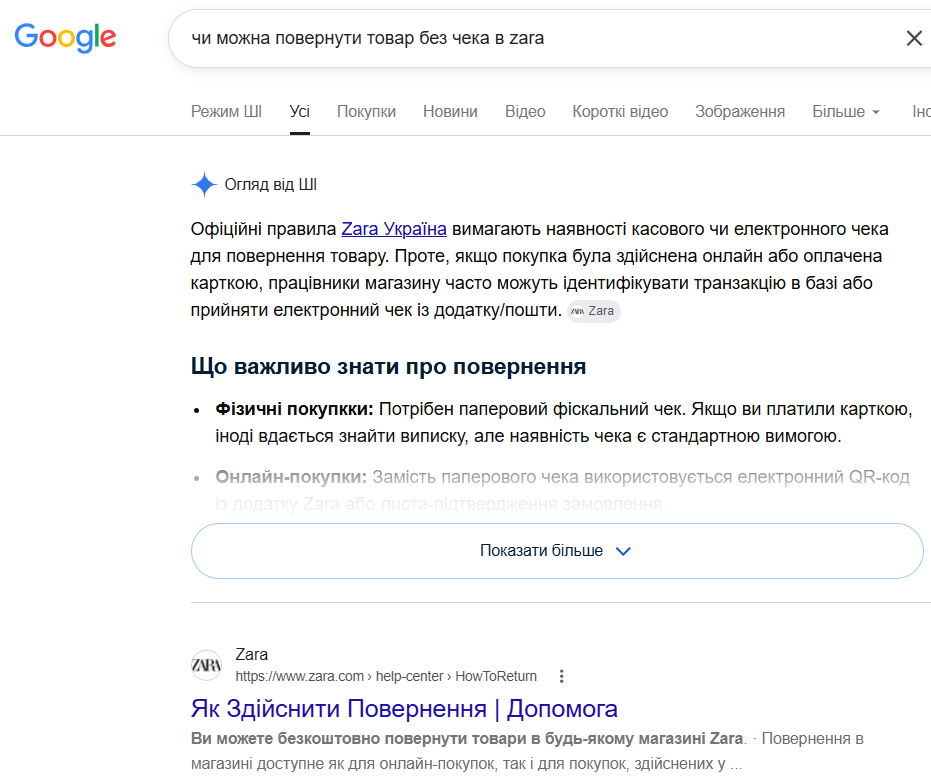
Search Google for “can I return an item without a receipt” and you’ll land on an online store page where you have to scroll through the entire “Returns and exchanges” section to find the answer. AI will pull out the exact sentence from the returns policy about items without a receipt and cite the source.
Let’s look at how an answer is found in SEO and in GEO.
The result is a list of links sorted by these signals.
AI search follows a different logic. The model draws on 2 sources of knowledge at once:
The way information is selected also differs from Google: the model looks not for the best-ranking page but for text fragments closest in meaning to the query (vector similarity). We’ll walk through the whole RAG mechanism in section 3.
| What are we comparing? | Regular Google (SEO) | Artificial intelligence (GEO) |
| What does it evaluate? | A whole page or website | A single paragraph containing the answer |
| How does it search? | By how relevant a page is to the query, plus hundreds of ranking signals | By how close in meaning a single fragment is to the question |
| What matters to it? | Relevance, site authority and links pointing to it | Clarity, accurate facts and a short answer |
| What does the reader get? | A list of sites to keep searching through | A short, ready-made answer with sources |
The result: the model takes several paragraphs closest in meaning from different sites and synthesises them into one coherent answer with citations.
Being present in AI is not just about the ChatGPT chat. Today there are 3 main places where AI shows your content to users:
1. In AI chats themselves (ChatGPT, Perplexity, Claude, Gemini).
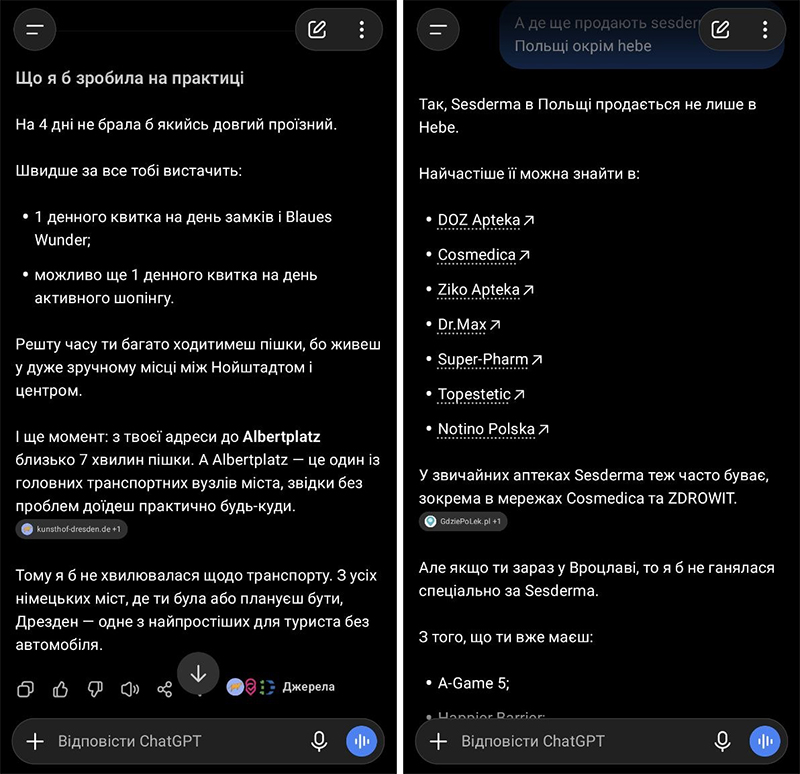
The user opens the app or the chat website and asks a question. The AI searches the internet, writes an answer and adds links to your articles as sources.
2. In AI Overviews in regular Google.
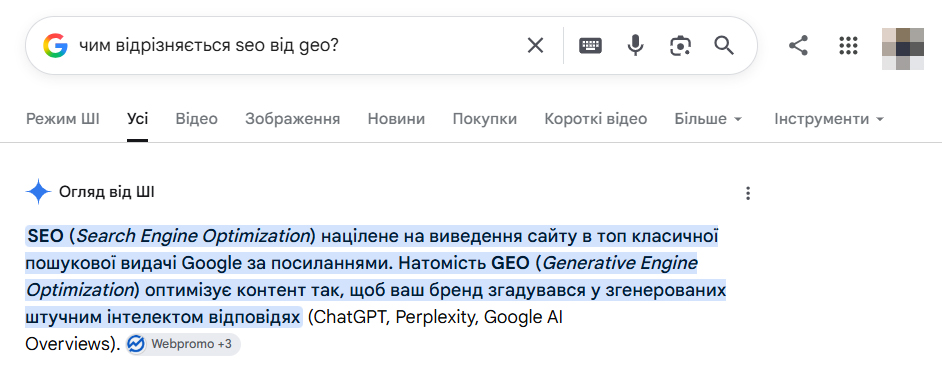
This is a short AI-generated answer that appears at the very top of Google’s search results (above the regular links). It has the widest reach, because it is seen by millions of people who are simply searching for something on Google.
3. In AI Mode and AI search engines.
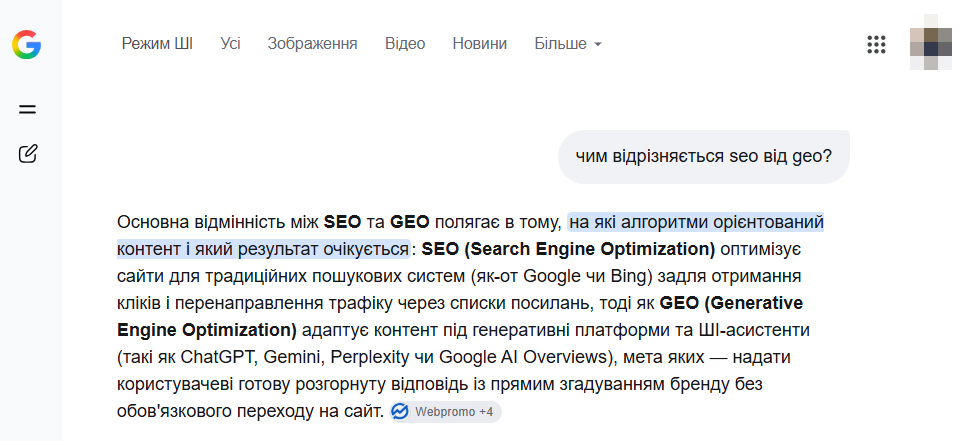
AI Mode is a separate Google Search mode where, instead of a list of sites, you go straight into a conversation with AI. It gives a detailed answer with link cards to websites and lets you ask follow-up questions. ChatGPT Search and Copilot search work in a similar way.
In other words, SEO competes to get a site into the classic search results or the list of links under an AI answer, while GEO works to make sure AI reads the site, recognises it as authoritative and uses its facts directly in the generated answer on each of these platforms.
For a site to appear both in Google’s results and in AI answers, it’s important to understand that they look at your site through different technical lenses.
Google relies on infrastructure signals (how fast the site loads, whether other sites link to it, whether the code is marked up correctly). For an LLM, what matters is knowledge structure, direct accessibility for its crawlers and the factual density of the content.
| Area | Classic SEO (Google) | GEO / AI citation (LLM) |
| Crawler access | robots.txt allows Googlebot | robots.txt should allow AI search bots: OAI-SearchBot and ChatGPT-User (OpenAI), Claude-SearchBot and Claude-User (Anthropic), PerplexityBot. Model-training bots (GPTBot, ClaudeBot) can be blocked separately – this does not affect citations in answers |
| Sitemap | sitemap.xml – the main source for discovering new URLs | llms.txt (an experimental standard, not yet officially adopted) – a file in the site root with a short summary of the site’s structure specifically for AI |
| Technical health | Core Web Vitals: loading speed (LCP), responsiveness (INP), layout stability (CLS) | Clean HTML: the text should be in the HTML straight away rather than loaded by complex scripts (JavaScript/React). Speed matters too: AI bots have limited time to load a page, so a very slow page may go unread |
| Structured data | Schema.org: markup for rich snippets (Product, Article, Organization) | Heading structure (H1–H4) and Q&A: logically splitting text into question-and-answer blocks where each heading clearly describes the paragraph below it |
| Content presentation | Keyword optimisation, depth of topic coverage, long-form content | Fact density: specific figures, names, research and definitions without filler or vague introductions |
| Authority and off-site promotion | Domain authority and link building: growing backlinks to pass link equity (PageRank), E-E-A-T and NAP for local SEO | Brand authority and PR: AI assesses not just the domain but how well-known the brand is online. Citations on authoritative sites in your niche matter. Classic link building is combined with digital PR to build entity mentions that shape the brand’s authority in training data and on the web |
So high Google rankings don’t guarantee being cited by AI: these are 2 separate sets of requirements, and it’s worth optimising your site for both at the same time.
1. Managing crawlers (robots.txt and llms.txt)
Most standard robots.txt rules open a site to Google but can accidentally block generative search bots. If you block OAI-SearchBot, Claude-SearchBot or PerplexityBot, AI won’t be able to find and read your articles.
llms.txt is a new developer-community initiative: a text file where you describe what your site is about in short points for the models. For now it is optional, and none of the major companies (OpenAI, Anthropic, Google) has officially confirmed it as a required standard.
2. Content format and structure
An LLM splits an article into separate chunks of meaning and evaluates each one on its own. So clear headings, a Q&A format and high fact density (figures, lists, direct definitions instead of filler) directly affect your chances of being quoted. How this selection works in detail is covered in the next section.
But the right signals alone are not enough. To understand why some paragraphs make it into an AI answer and others don’t, we need to look at the technical process the model uses to decide.
Every time you ask AI a question, it runs a technical process called Retrieval-Augmented Generation (RAG).
In the answer, AI’s interaction with your brand can take different forms:
1. Brand mention – AI names your brand in the text as an expert or original source but does not add a clickable link to your site.
Example: "According to a study by Ahrefs, 90% of pages get no traffic…"
2. Citation / link – AI uses facts or information from your site and links to it in the list of sources but does not name the brand in the answer itself.
Example: "For GEO, it’s important to give crawlers access in robots.txt [1]." (where [1] links to your site).
3. Full citation (mention + citation) – the ideal scenario: AI names your brand in the answer and also gives a clickable link to your site in the sources.
Example: "According to the Serpstat guide [1], code quality matters more than speed…"
User query → Web search → Top-N documents → Synthesis and citation
To make it into the final AI answer, your content has to pass 3 mandatory filters in sequence.
First, the model looks for where potentially useful information exists online. To do this it queries a search index – its own or a third party’s (for example, Bing or Brave; Gemini relies on Google Search). Companies disclose only part of what sources each system uses.
How it works: your query is turned into several search phrases, and the system gets a list of dozens of candidate sites – just as if you opened Google and looked at the first results. If your site isn’t in the index the system uses, or if bots are blocked from accessing it, the model simply won’t know you exist. You’re invisible before the evaluation even starts.
The model doesn’t read candidate pages in full – it cuts each one into small pieces of text (usually from a few sentences to a few paragraphs) and checks each piece separately. Then both the query and each piece of text are converted into numerical coordinates (vectors). The closer the coordinates, the closer the meaning, even if the words are completely different. For example, "get my money back" and "refund policy" end up close together even though they share no words.
The pieces that pass are the ones that answer the essence of the query directly and clearly.
At the final stage, the model takes the selected pieces from different sites and assembles them into one coherent answer, combining them with background knowledge from training where appropriate. It discards filler, vague metaphors, promotional calls to action and contradictory statements.
Texts with the best chance of being quoted have:
RAG is a three-stage filter: "find → check relevance → check how easy it is to quote". Only content with a clear structure and direct answers gets through all 3 – vague filler is weeded out at the second stage.
The paradox: a page ranks #1 on Google and gets thousands of clicks, yet AI doesn’t see it and cites a competitor from page 2 instead. The reason is simple: Google assesses the page’s overall authority, while Claude looks for a specific fact in the moment. If a page doesn’t meet AI’s technical requirements, it becomes invisible to it.
Why this happens:
Anthropic has 3 different bots: ClaudeBot (model training), Claude-User (fetches a page live when a user asks a question) and Claude-SearchBot (indexing for search in advance). If only ClaudeBot is blocked, you simply won’t be in the training data – that’s not critical. But blocking Claude-User or Claude-SearchBot means Claude cannot read the page and cite it.
How to fix it:
User-agent: Claude-User
Allow: /
User-agent: Claude-SearchBot
Allow: /
How to fix it: use server-side rendering (SSR) or static site generation (SSG) so the text is in the page code from the start.
How to fix it: clear H2/H3 subheadings plus the inverted-pyramid principle – the main point goes at the start of a section, not at the end.
How to fix it: a Q&A format – the question in an H3 heading, a direct 1–2 sentence answer right below it, then the details and explanations.
Short answer: SEO and GEO do share a foundation, but they solve different problems. SEO makes sure your site is found and visited. GEO makes sure you’re quoted in an answer after which the user may not go anywhere at all. By our estimate, about two thirds of the work overlaps. The rest is something a classic SEO contractor doesn’t do in principle, because it isn’t part of their remit and isn’t measured by their metrics.
| Area of work | Works for both SEO and GEO |
|---|---|
| Technical accessibility | Speed, response codes, no crawl errors |
| Indexing | The site must be indexed by Google and Bing – AI systems take their candidates from search indexes |
| Content quality | Accuracy, freshness, author expertise |
| Heading structure | A logical H2/H3 hierarchy and clear navigation |
| Brand authority | Mentions, links, domain reputation |
This is the part that makes it feel like "it’s all the same thing". And that’s partly fair: GEO doesn’t work without solid SEO. Models mostly pull sources from content that is already well indexed. So GEO isn’t an alternative to your contractor – it’s a layer on top of what they’ve already done.
| What we do | Classic SEO | GEO |
|---|---|---|
| Who we allow in robots.txt | Googlebot, Bingbot | Also AI search bots: OAI-SearchBot, ChatGPT-User, Claude-SearchBot, Claude-User, PerplexityBot and others |
| Unit of optimisation | The whole page | A single paragraph (chunk) as a self-contained answer |
| What we write for | Full topic coverage and keeping the user engaged | Fact extraction: a direct answer in the first sentence |
| Rendering | Google renders JavaScript | AI bots read raw HTML and don’t wait for content to load |
| Off-site work | Links that pass domain authority | Brand mentions in text – even without a link (comparisons, roundups, industry reviews, forums) |
| How we measure results | Rankings, clicks, Search Console data | Share of mentions and citations across an agreed set of queries in several AI systems |
| Stability of results | Rankings hold for weeks | Answers can vary from session to session |
In other words, the tools are similar but the criteria for success are not. A text that’s perfect for SEO (detailed, with a gradual lead-in) can be technically hard to quote – and vice versa.
Google Search Console doesn’t show whether ChatGPT mentions you. Analytics doesn’t tell you how many people read an answer about your category and went nowhere. In a standard SEO report, the situation looks like this:
And the cause gets blamed on seasonality or another Google update. In reality, some of the queries were taken over by AI answers that quoted someone else. This is exactly the situation from section 4: a page ranks #1 yet is invisible to the model. Without a separate measurement you won’t find out – not because your contractor is doing a bad job, but because that metric simply isn’t in their toolkit.
The key takeaway for a business owner: you’re not losing rankings – you’re losing clicks at the same rankings. SEO keeps working; there are just fewer situations in which the results of that work reach people.
Classic search results have a second and third page: you’re lower down, but you’re there. An AI answer has no second page – the model cites a handful of sources. You’re either among them or not there at all.
On top of that, the model gradually forms a stable picture of each category: who the main players are and who to point people to. That picture is built not only from your website but from all the mentions of you online. The longer you’re absent, the more expensive it becomes to get in later – you’re not catching up on a ranking but on your reputation in the data.
We don’t think everyone needs GEO right now. There’s no point starting if:
GEO doesn’t replace or duplicate SEO. It’s a separate layer of work on top of existing optimisation: opening access to AI bots, rewriting key pages so that each block is a self-contained answer, making sure content renders without JavaScript, strengthening brand mentions on external sites and – most importantly – starting to measure what nobody measured before: how often you’re named in answers and what exactly is said about you.
SEO makes sure you’re found. GEO makes sure you’re named. About two thirds of the work overlaps, but it’s the remaining third that decides whether you appear in the answer your customer reads instead of opening websites. We’re not suggesting you replace SEO – we’re suggesting you add the layer it doesn’t have.
Go through this list before publishing new content or auditing existing pages. It will help you make sure a page is technically accessible to AI systems, contains high-quality structured content and has a better chance of being used in generative search answers.
There is no single official standard for GEO. The best results today come from sites that combine strong classic SEO, technically accessible content, high-quality information and clear trust signals (authorship, sources, structured data, regular updates).
SEO remains the foundation of your online visibility, ensuring indexing, technical health and domain authority. But without GEO (Generative Engine Optimization) you risk becoming “invisible” to millions of users who no longer scroll through search results but get ready-made answers from AI.
We’ve collected the practical steps – how to check whether ChatGPT, Perplexity and Gemini mention your brand and how to measure AI visibility – in our article ChatGPT SEO: How to Get Cited by ChatGPT, Perplexity and Other AI Systems. If you want to build this work systematically, see our Generative Engine Optimization service for the format and pricing.