This page lists current pricing for website promotion and related services: SEO, paid search and social advertising, ASO, web analytics and website development. You can order a single service or a full-service package.
The prices in the table are starting points. The final cost depends on your niche, the level of competition, the geography of the campaign and the current state of your website. Below we explain what makes up the budget, how many hours of team work sit behind each rate, and when to expect the first results.
At ITForce we offer not only promotion services but a full website development cycle — from the initial idea to the launch of a finished resource. We build business-card websites, landing pages, corporate sites and online stores that are ready for SEO and advertising from day one.
Website development cost depends on the complexity of the project, the design, integrations and the number of pages:
The price includes custom design, the work of a full team (developer, designer, project manager, analyst) and a basic SEO structure. You receive a resource that is ready to promote and built around your business goals.
For promotion, we offer several formats — SEO, Google Ads, paid social advertising (Facebook, Instagram, TikTok) and full-service solutions that combine everything in one.
The cost depends on your business goals, the scope of work and the competition in your niche:
We build a strategy that matches your business objectives and the budget you have available.
Competition in your niche
If your sector is highly competitive (eCommerce, legal or medical services, for example), reaching results takes more time, more budget and more analytical work. We assess the search landscape and build a realistic promotion strategy around it.
Goals and geography
Promotion within a single city costs less than a national or international campaign. Geography determines the number of keywords, the number of competitors and the complexity of the strategy.
Current state of the website
Before work begins we run a technical and SEO audit: loading speed, mobile experience, structure, content and internal errors. If the site needs work, we either take it on or propose building a new one.
Promotion format
SEO delivers organic traffic growth, paid search delivers fast results, and full-service solutions combine SEO, advertising and analytics. The cost depends on the set of work you choose.
Project team
Your website is handled by an ITForce team: SEO specialists, PPC specialists, copywriters, link builders, analysts and project managers. We do not bring in random contractors — quality is controlled at every stage.
Timeline
The faster you need results, the more resources are required. For a fast start we usually recommend pairing advertising with SEO: advertising brings the first customers immediately, SEO works for the long term.
Content
Have your own copywriter? Good. If not, we produce everything needed: SEO articles, product descriptions and blog material.
Website promotion is the combined work of a team. SEO specialists, PPC experts, analysts, copywriters and a project manager all contribute to the project.
Within a monthly retainer, the average hourly rate of a specialist is $30–40, so the budget is shaped by the number of hours the project needs.
A typical month of work can look like this:
In total, the team spends roughly 30–50 hours a month developing the website.
The consultation rate deserves a separate explanation. The $30–40 hourly figure is a blended rate within a monthly retainer, where work is distributed between specialists of different levels. A standalone expert consultation or audit is priced differently: there, every hour is spent by a senior specialist in that discipline, and the rate is $100 per hour.
Building a website is only the first step. For it to bring in enquiries, sales and new customers consistently, systematic online promotion is required.
In most cases the minimum agency fee starts from $550–900 per month, depending on the service. The exact figure depends on competition in your niche, the geography of the campaign, the number of products or services and your business goals.
An online marketing budget usually consists of two parts: the agency fee and the advertising budget.
This is an investment in the team responsible for strategy and continuous improvement of results. It covers:
These are the funds spent directly on advertising — in Google Ads or on social platforms (Facebook, Instagram, TikTok).
This money does not pay for agency work — it is charged by the advertising platforms for clicks or impressions.
For most of our clients, the total marketing budget (agency work plus advertising) starts from $2,000–3,000 per month. That level makes it possible to gather enough data to optimise and to measure the result rather than guess at it.
We do not work from a template. Every client receives an individual proposal built around their niche, their goals and the current state of the project.
Our aim is a clear process, control over results and long-term effectiveness.
Submit a request and we will get in touch to discuss the task and find the right format for working together.

This factor broadens our team’s perspective by working on a wide range of projects across various industries.
To illustrate the bigger picture, here’s one example:
We once worked on a website promotion case in the escort services niche.
It’s a highly specific field we initially knew nothing about. We had to develop a new approach from scratch, implement and test multiple hypotheses to identify the factor that would benefit the client. And we made it work!
In addition to refining the website structure, we implemented a service filtering system. This solution is rarely used on adult-themed websites, but our team’s strategic thinking and analysis of various scenarios led to a tool that increased traffic by 14 times.
Earlier, we mentioned that working with professionals can improve performance by 2 to 5 times, and even reduce your budget. You may ask how that is possible?
Here’s another real-life example:
The owner of a flower delivery shop had previously used paid advertising services. The result? A mess of ad campaigns, duplicate keywords, and zero revenue.
When the client came to us, we collected and clustered the semantics, highlighted key advantages, corrected issues in the existing campaigns, and set up new ones.
The team’s critical thinking enabled us to build and evolve a strategy that not only achieved the desired result but even exceeded it.
We managed to cut the campaign budget in half, increase profit by 4.5 times, and reduce the cost per transaction by 3.6 times.
It’s worth noting that this was for the Canadian market, and the campaigns were tailored specifically for English-speaking audiences.
This is often done to save money, as hiring professionals can be expensive. Let’s be honest, most of these DIY attempts fail due to the lack of a structured, systematic approach.
Another Case from Practice:
Email marketing often seems easy—after all, we’ve all sent emails at some point.
That’s exactly what our client did: he managed the email channel himself for a women’s clothing store. He approached us intending to boost both website traffic and sales.
We discovered that the email campaigns were sent infrequently and lacked consistency. Our specialist created automated sequences, developed a content plan, and identified newsworthy topics.
To maximize the impact, the audience was segmented, and a separate trigger sequence was created for each group. This led to a rapid increase in both traffic and transactions.
In just two months of working together, we increased traffic 14 times and boosted email revenue by more than 20 times. But the results could have been even more impressive if the client had reached out to ITForce earlier.
This is highly valued in professional environments. It eliminates the constant stress over advertising or email campaigns.
You gain the ability to delegate your marketing efforts and trust that the results will meet your expectations—realistic ones, of course.

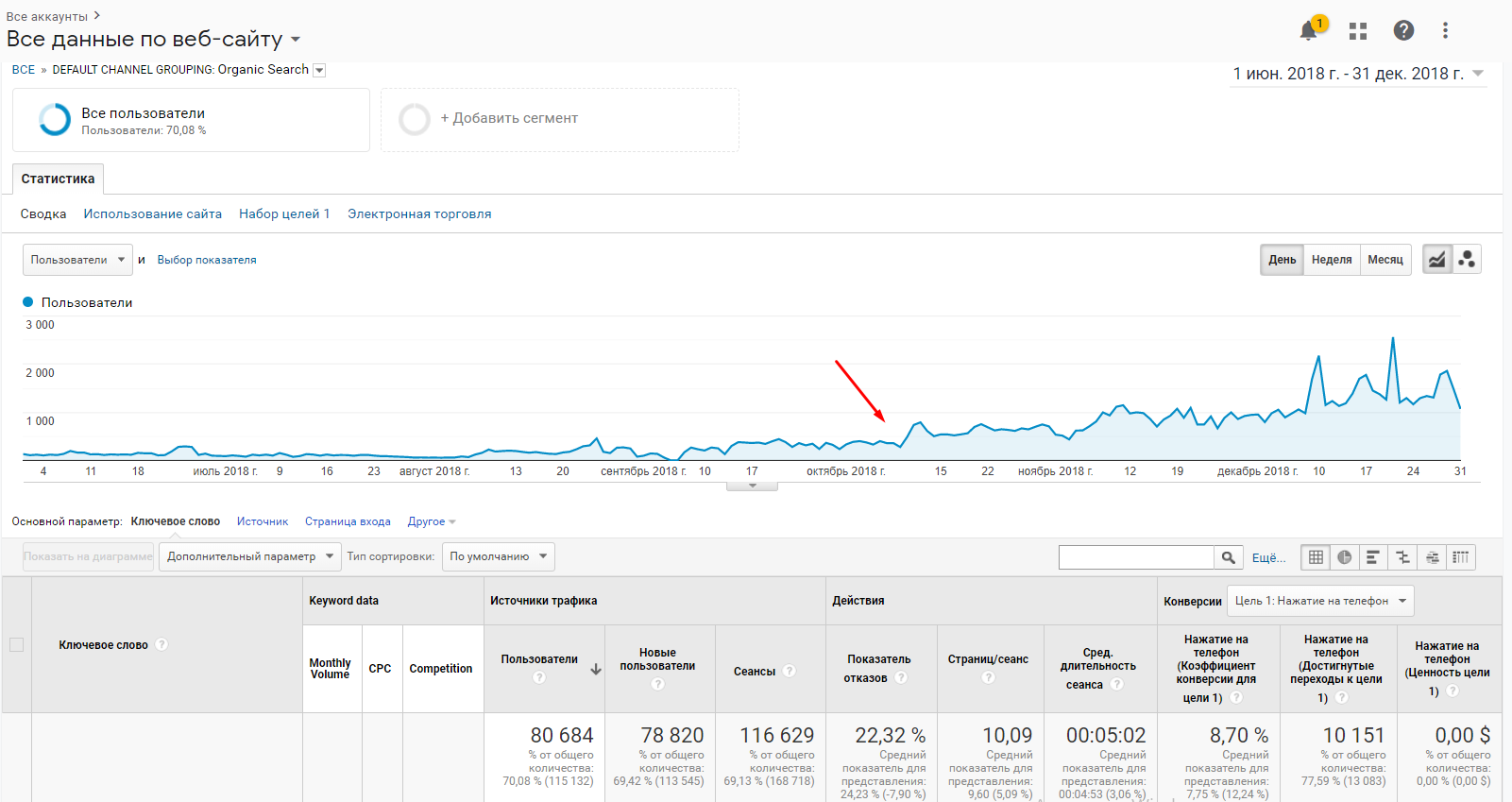



Clients care not only about the cost of website promotion, but also about when the first results appear.
It is important to understand that different marketing tools work at different speeds. On average, the timelines look like this.
Advertising campaign launch — from 1–2 weeks
During this time the team analyses the niche, selects keywords, builds the campaign structure, prepares the ads and configures analytics. Once live, advertising starts bringing in the first visitors and leads.
First SEO results — from 3–4 months
Search promotion takes time: Google has to index the changes on the site, assess content quality and gradually raise the site’s positions in search results.
Steady traffic growth — 6–12 months of work
This is where SEO delivers its clearest effect: the site holds strong positions for key queries, organic traffic grows and the number of enquiries increases.
These timelines are indicative. Actual progress depends on competition in the niche, the state of the site at the start and how quickly decisions are approved on the client side.
This is why in most projects we build the marketing strategy to combine the speed of advertising with the long-term effect of SEO. That approach brings customers in from the beginning while building a stable traffic source for the future.


The work of a professional team shows in three ways.
The plan and the actions are justified. Every step rests on audit data, competitor analysis and the project’s own metrics — not on general assumptions about how things ought to be done.
The process is transparent. You see what work was done, how much time it took and how it affected the numbers. Changes are agreed before they reach the site.
Communication is predictable. You have a project manager, regular reporting and a clear channel of contact — you never have to chase the status of the work yourself.
Professionals bring experience across different niches and project types.
It is precisely the knowledge gained from previous cases that shapes the strategy for a specific business, taking the particulars of its niche into account.
How we work
We do not make promises about rankings or lead volumes before seeing your website and your data. Realistic targets are agreed with you after the audit.
Why clients choose us
Submit a request — we will discuss your task and find the right format for working together.