




About the Client
Pepperdecor.com specializes in packaging production and container decoration (B2B). The company operates its own manufacturing facility with nearly 10 years of industry experience.
Services
Core offering - glass container decoration and packaging:
1. Decoration
- Screen printing
- Coating (matte, gloss, soft-touch, gradients)
- Hot stamping (metallic effects)
2. Additional services
- Frosting (matte glass finish)
- Full-color printing
- Branding (logos, design)
3. Packaging solutions
- Full cycle: from design to finished container
- Works with various jar and bottle types
- Brand-specific packaging concepts
Pepper-Decor is a manufacturing contractor for brands, producing custom packaging (primarily glass) with premium decoration.
What Pepper Decor decorates:
- bottles (alcohol, beverages)
- jars (food, cosmetics)
- flacons (perfumes)
- candles and decorative items
- diffusers
The company operates on a one-stop solution principle, managing the full cycle from concept to finished product. In-house manufacturing provides quality control at every stage and enables effective collaboration with international clients. The combination of quality standards, design-focused approach, and fast turnaround makes Pepper-Decor a reliable partner for brands, while flexibility in custom project execution allows solutions to be tailored to specific business needs.
Workflow
Before commencing work, we conducted a site and campaign audit. The following issues were identified during the audit of the pepper-decor.cz website and Google Ads campaigns.
Website and conversions
1. Incorrectly configured conversion tracking - the conversion was firing on button click even when the form had not been filled out.
2. The contact form is difficult to find on the website:
- it was only available in the footer of the homepage;
- on other pages, the form is accessible via a small, easy-to-miss button (also in the footer).
3. Campaigns were running across multiple countries without a multilingual site structure - we recommended creating separate language versions for the respective target countries.
Search campaigns
- DSA groups in search campaigns were only triggering for branded queries. These should either be removed from the general campaign or the brand should be added to the negative keyword list.
- Conversions from branded traffic were significantly cheaper than others, which could distort campaign performance evaluation.
Google Ads
1. Low ad quality:
- insufficient number of headlines;
- first and second headlines were pinned;
- description was pinned.
2. Ad extensions were not being used:
- images;
- logo;
- company name;
- phone number (despite calls being counted as a conversion).
Performance Max
- PMax campaigns were missing page descriptions and callout extensions.
- Uneven impression distribution across countries. Some geographic targets were receiving no impressions at all.
- Incorrect audience signal segmentation logic in PMax. Splitting asset groups by a single audience did not make sense, as signals do not function as traditional targeting.
- No placement analysis or exclusions had been conducted at the account level.
General strategy shortcomings. The site required further development:
- adding language versions;
- moving CTA buttons to visible areas of the pages.
For PMax, conversions should have been limited to key actions only (form submissions), as clicks and page visits could artificially inflate results, particularly at a low tCPA. Where a Google Business profile existed, we recommended connecting it to the ad account.
A report documenting the identified issues and optimization recommendations was submitted to the client's team for review and implementation.
Since Pepper Decor operates in the EU market, we provided a mandatory recommendation to configure Consent Mode in GA4 in line with Google's official guidelines. Without it, running ads legally and effectively in Europe was not possible: GDPR and DMA regulations require sites to obtain explicit user consent for tracking. Ignoring Consent Mode would cause Google to block remarketing data collection and audience building, while the effectiveness of PMax and search campaign algorithms could drop due to blind spots in analytics.
For technical implementation, we proposed two approaches: integration via Google-certified Consent Management Platforms (CMP) or a custom solution deployed by developers using Google's developer documentation.
Campaigns configured at the start of the engagement:
- ITF_Search_Campaign_EN,
- ITF_Search_Campaign_CZ,
- ITF_Performance Max_en-cz.
Conversion goals for tracking and algorithm optimization:
Email interactions
- Homepage: email copy + click
- "About Us" page: email copy + click on two email addresses
Phone interactions
- Phone number copy + click (sitewide)
Form submissions
- Homepage: form submission
- Consultation form: form submission after button click
To promote the priority services of branded glass container decoration (Printing on glass bottles and Printing on glass jars) in the Czech Republic and Slovakia, we configured and launched round-the-clock search campaigns and Performance Max campaigns. Targeting was set for mobile and desktop users searching in Czech and English. Web analytics and conversion tracking were fully configured within the project to measure performance and ensure correct algorithm optimization.
First month of work
We configured and implemented the Microsoft Clarity tag to gain deeper insight into user behavior on the site. In parallel, we audited the account and removed outdated goals, retaining only the priority conversions that were genuinely relevant to the client's business.
Search advertising
- Czech Republic: campaign paused due to low search query volume.
- Germany (new campaign): launched, existing keywords updated, and ads fully refreshed.
- EN campaign scaling: new geos added - Slovakia, Latvia, Austria (English language).
- Austria: campaign running in two languages - German and English.
Video advertising
- 2 video ads launched targeting Latvia with a minimal budget for brand awareness.
- Targeting: English language, B2B segment focus (manufacturers using glass bottles).
The client's priority was attracting exclusively targeted B2B traffic rather than maximizing lead volume. The acceptable target is 1–2 high-quality inquiries per month, provided they fully match the ideal customer profile.
The client then proposed adding Latvia to the geo targeting. At the time, the ITF_Performance Max_en-cz campaign had 2 asset groups configured (ads in English and Czech). Adding Latvia would have risked Czech-language ads appearing in that region, which would be irrelevant. We therefore proposed either pausing the Czech asset group and keeping only English ads with Slovakia and Latvia added to the campaign, or separating Latvia into a standalone PMax campaign. Italy, Croatia, and Serbia were also added to the English search campaign.
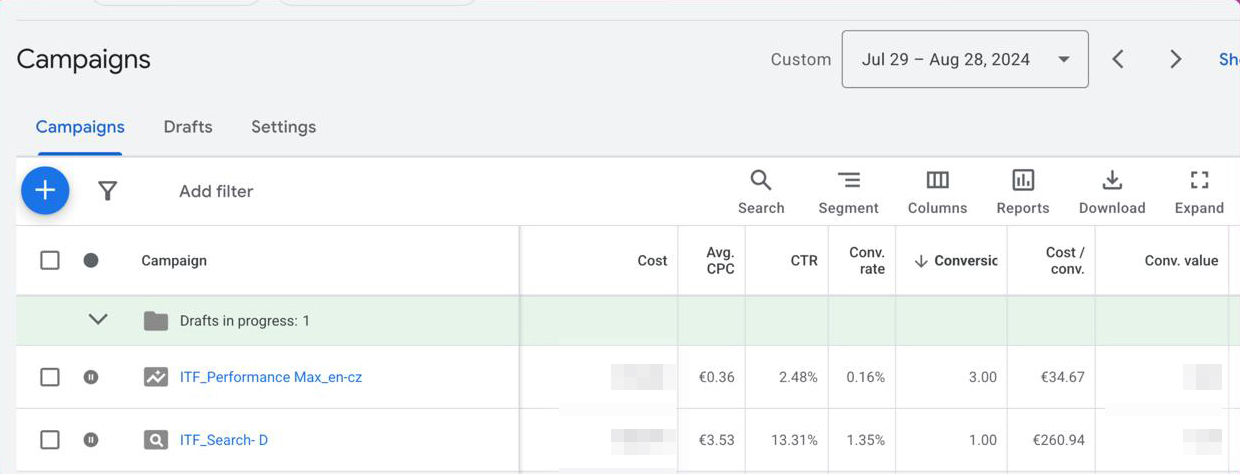
In the first month, the campaigns we configured generated 4 conversions. During the algorithm learning and data collection phase, any conversions at all were a positive signal — the system had at least identified who was ready to buy. The search campaign showed a relatively high cost per conversion, which is natural in the early weeks as campaigns were launched with a broader keyword set to gather maximum data.
The packaging and decoration niche is highly visual cause clients buy with their eyes. PMax success is heavily dependent on creative quality, which we flagged to the client upfront and followed up with a request for as many ad banner variants as possible.
Conversion tracking issue
We recorded 1 send_form_click conversion in Google Ads, but it was not appearing in GA4. Investigation showed that GTM tags were firing correctly (conversions were being tracked), but no data was showing in GA4's DebugView or Real-time reports (the debugger could not detect the user's device). Consent Mode was displaying as active. We suspected the issue was either a developer access permissions problem on the site affecting DebugView visibility, or a system bug.
We then noticed that a Consent Mode warning had reappeared in analytics. Since Consent Mode had been working on 08.08, the question arose as to whether any changes had been made to the site. From our experience, implementing a custom Consent Mode setup frequently breaks analytics. While the issue fell outside our web development expertise, our PPC specialist promptly ran through the basic settings checklist. Finding no visible errors, it became clear that the problem ran deeper in the site's code. Our recommendation was to switch to a certified CMP solution (e.g. Cookiebot). We passed a task to the developer to restore site access and verify all configurations.
However, following the developer's fixes, the problem remained unresolved. Consent Mode was still showing as inactive (though data updates can take up to 24 hours), the debugger was not pushing events at all, and GA4 itself was periodically throwing a critical error. We concluded that the applied fixes had not produced results, and that the root causes of the debugger and analytics failures needed to be investigated purely on the development side. The client's developer took ownership of the issue.
In the course of campaign optimization, at the client's initiative, all keywords were switched to phrase/exact match for maximum traffic precision, and geo targeting was expanded to cover all of Europe (excluding the UK and Eastern Europe). English-language ads were launched for all countries, with German-language ads added for Austria, Germany, Switzerland, and Belgium.
Meanwhile, the event debugger was not detecting events, but Google Ads showed 2 conversion actions recorded over the previous 14 days:
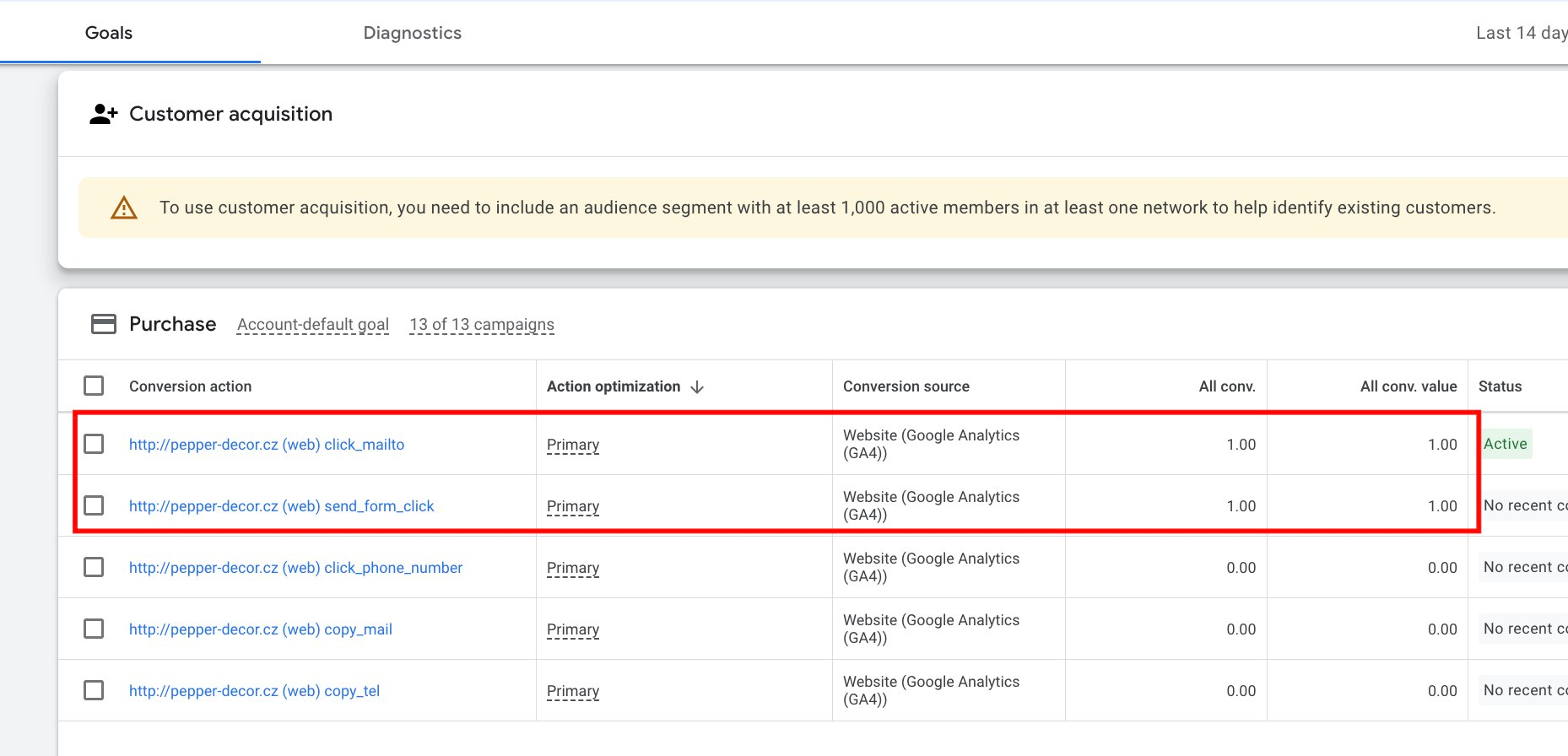
The issue was resolved by a developer on our team, and from September 4, 2024, conversions were firing correctly.
We configured an ad schedule running Monday through Friday, with Saturday and Sunday fully disabled. The headlines "Glass bottles" and "Printing on glass bottles" were pinned across all ads, along with the description "We offer the highest quality printing services on glass bottles and jars. MOQ - 3000 pcs". Minimum order references were also updated sitewide, changing MOQ to 3000 pcs. The additional sitelink to the Additional Services page was removed, and desktop ad serving was disabled.
Traffic and conversion drop in GA4
In August 2024, we noticed a sharp drop in traffic (Direct, Organic, LinkedIn) and a conversion tracking failure in GA4. The drop was artificial, tied to incorrect tracking logic rather than any decline in ad or channel quality.
Likely cause: during the work, we installed and configured a new GTM container (as access to the old one had been lost). Ad launch partially absorbed organic traffic. Consent Mode was then implemented - by default, data was blocked from being sent to GA4 until the user clicked "Accept". Since most users ignored the banner, analytics numbers dropped. Over one period, Google Ads recorded 500 clicks while GA4 showed only 40 (with just 150 total site users). The gclid tag was functioning - had it been broken, traffic would have been attributed to other channels, but it was not appearing in GA4 at all. The system simply was not seeing users who had not clicked the banner.
What we did
To resolve the situation, we proposed switching to a softer consent logic:
- New logic: data is sent by default unless the user explicitly clicks to decline.
- Banner text updated to: "By continuing to use this website, you consent to use your data" - with a correct link to the Privacy Policy added.
The client approved the proposed solution, and our developer implemented the changes on the site. GA4 data was subsequently normalized.
We then consolidated the language (EN + DE) and geographic settings of the campaigns into unified campaigns to collect data faster and optimize traffic more effectively. To evaluate the potential of the bottles segment, it was separated into a standalone campaign for a two-week test, keeping its analytics and optimization independent from existing campaigns. The client allocated an additional budget for this launch, so the spending limits of active campaigns remained unchanged.
From December 2024/January 2025, we moved to an hourly billing model covering optimization of existing campaigns and setup of new ones based on client requests. However, the strategic direction later shifted, and the client decided to redirect all budgets and efforts to search engine optimization (SEO).
List of advertising optimization and scaling work
1. Campaign management and budget/geo adjustments
- ITF_Search_Campaign_EN: geo targeting expanded (new countries added, excluding Switzerland, Belgium, and Germany).
- ITF_Search-D campaign (Austria geo): new geos added (Switzerland, Belgium, Germany). The campaign includes ads and keywords in both German and English.
- ITF_Search-Glass Bottles campaign: daily budget increased.
- Optimization: underperforming geographic locations disabled in agreement with the client.
2. Keyword and negative keyword management
- Search query analysis and negation:
- Regular search query cleanup. Non-targeted queries added to negative keyword lists.
- Targeted search queries added to relevant ad groups, with some added in exact match.
- Keyword optimization:
- New keyword pool agreed upon with the client.
- Some keywords moved from broad match to phrase match.
- Underperforming keywords paused.
- Existing ad groups expanded with additional relevant keywords.
3. Ad and asset (extension) optimization
- Responsive Search Ads (RSA): ad quality improved, new headlines added (including those recommended by the system).
- Ad copy updates (MOQ): the pinned headline was updated across all ads from "MOQ is 5000 pieces" to the more concise and clear "Minimum Order Quantity 5000pcs".
- Performance Max: ads within the PMax campaign were improved.
- Assets (extensions):
- Company logo and Business Name added at the account level.
- New images added to extensions.
- Extensions (images with text overlays) rejected by the moderation system were disabled.
4. Targeting and audience signal setup
- Targeting audiences configured for individual keyword groups.
- ITF_Performance Max_en-cz campaign: audience signals optimized (direct competitor sites and resources with a clear USP added).
5. Video campaign management (YouTube)
- New ITF_Video campaign configured and launched with a test budget.
- Video ad exclusions applied: negative keyword list added, irrelevant topics and placements excluded.
- Result: video advertising was subsequently disabled in agreement with the client due to poor performance.
6. Bidding strategies and testing
- ITF_Search-D campaign: bidding strategy changed to Maximize Conversions for testing purposes.
7. Web analytics, tracking, and GA4
- Conversion goal fixes: tracking reconfigured and corrected for goals that were previously not recording: click_social_media, email_text_copy, phone_text_copy. All are now firing correctly.
- Integration: updated goals successfully imported into the Google Ads account.
- Traffic verification: gclid tag transmission verified - integration is working without errors.
- Ad conversions are coming through, however Direct traffic was noted to pull attribution from other channels occasionally. A DebugView access request (GA4 DebugView / Tag Assistant) was submitted for a detailed audit and verification of goal-to-source mapping in GA4.
8. Working with Google recommendations
- A full audit of system recommendations was conducted: useful ad improvement suggestions were applied, while all non-targeted and irrelevant recommendations were manually dismissed to maintain the Optimization Score.
SEO
Primary SEO objective: ranking the site in top positions in search results.
Main goal: increasing the number of service orders generated through the site (conversion-focused, not traffic-focused).
No comprehensive SEO work had been carried out previously. Only paid advertising (PPC) had been running.
Target geos for promotion: Germany, Austria, Czech Republic, Slovakia, Greece, Serbia, Italy.
Search promotion work began with niche and competitive landscape analysis. The niche analysis was primarily aimed at determining whether demand existed for the product or service at all and identifying the countries where that demand was strongest.
Niche and competitor analysis
1. Demand and semantic analysis
- Low search volume: global search query frequency in this niche is very low across most priority regions.
- Traffic dilution: for English and Spanish-language queries, demand was further spread across multiple countries (USA, India, UK, Latin America).
- Competition: the niche has a large number of indirect competitors focused on small-batch branded merchandise or general print-on-everything services.
- Priority regions: Germany, the UK, and Spain proved to be the most promising regions for semantic collection.
2. Competitor landscape in search results
- Lack of SEO optimization: most competitor sites had no systematic optimization. Titles, meta tags, and page copy frequently contained no target keywords.
- Branded traffic: sites with notable traffic (e.g., dekorglass.pl or pslgmbh.de) were receiving it primarily through branded queries (company name searches) rather than topical keywords.
- Backlinks: competitors were largely not actively building backlinks. Existing profiles had formed organically through domain age or through SEO services and directory listings.
3. Key metrics comparison
| Website | Traffic | DR (authority) | Donors | Domain Age |
| pepper-decor.cz | 27 | 7 | 72 | 11 |
| dekorglass.pl | 1100 | 35 | 190 | 23 |
| pslgmbh.de | 8400 | 14 | 50 | 10 |
| deco-glas.de | 47 | 27 | 137 | 10 |
| pcmgrupo.com | 42 | 3,1 | 30 | 27 |
Key niche analysis findings and recommendations
- Domain zone change: we recommended switching from the regional .cz domain to a broader international zone (e.g., .com) for better ranking across multiple countries.
- SEO as a growth driver: given competitors' weak optimization, a solid technical setup and properly targeted meta tags (Title, Description) were set to become a significant competitive advantage.
- Link building strategy: rather than mirroring competitors, a custom link building strategy needed to be developed - guided by industry best practices and authoritative niche resources.
- Brand development: work on brand awareness was essential - through social media, review management (SERM), and other marketing channels, as branded search was the primary traffic driver for niche leaders.
Demand in the niche existed, but remained low. The greatest demand potential was observed in Germany, the UK, and Spain — and we recommended focusing promotion efforts on these regions.
We also conducted a site structure analysis. This was necessary to understand how competitors organize their content and navigation, what they feature on the homepage, how they structure their menus, and which pages are treated as key. This was especially relevant given that the client was planning a migration to a new domain, making it both logical and technically sound to build a clear, user-friendly site from the ground up.
Site structure proposals submitted
Internal authority redistribution:
- We recommended removing the glassbottles page link from the main menu. As a secondary page for promotion purposes, its authority should be redirected to more important service pages.
- The glassbottles link should be retained only on the main service pages (screen-printing, coating, hot-stamping), as a dedicated block or a link at the bottom of the page.
"Services" section restructuring:
- We recommended creating separate pages for each additional service with basic SEO optimization (Title, H1, Description):
- bottle-procurement
- logistics
- product-development
- labelling
- plastic-decoration
Links to these new pages should be placed only within the "About" section, to avoid overloading the main menu with authority.
- We recommended removing the general services page and setting up a 301 redirect to the "About" page for all language versions.
Priority page reinforcement:
- We proposed adding direct links to the key print service pages (screen-printing, coating, hot-stamping) in the site footer. This would pass additional internal authority to these pages from every page on the site.
The primary goal was to make the decoration service pages as visible as possible to search engines, while pushing secondary content into the background. The site's flexible structure allowed secondary services to be tucked deeper into the site architecture, while preserving the ability to quickly bring them back to the main menu if needed.
Following the migration to pepperdecor.com, a page authority correction phase was planned to preserve rankings across all language versions. The post-migration development strategy was unified across all localizations (EN, CZ, DE, ES, IT) to ensure stable promotion across the European market.
The next step was a technical audit. A pre-migration technical audit was necessary to document the current state of the site, which pages were being indexed, what errors already existed, and what technical foundation would be carried over to the new domain. A timely check prevents old issues from being transferred along with the content to a fresh resource.
Technical audit
1. Critical technical errors
- Junk and spam pages: a large number of empty pages with numeric slugs (e.g.,/110/) were found cluttering the search index. These needed to be removed with a 410 response code.
- Broken redirects in the menu: service links in the English and Spanish versions were pointing to incorrect URLs or creating unnecessary redirect chains due to missing trailing slashes.
- Incorrect 302 redirects: temporary redirects were being used instead of permanent ones (301), preventing correct page authority transfer.
2. SEO and content structure
- Product page optimization: unique Title, H1, and Description tags were missing from product pages. The product name was incorrectly marked up with an H4 tag instead of H1.
- Authority redistribution: the glassbottles page was consuming too much internal link authority. We recommended removing it from the main menu and keeping it only as a supporting link on service pages.
- Heading hierarchy: on many pages, H2 and H4 tags were being used for design elements, confusing search crawlers. These needed to be replaced with standard styled text.
3. Speed and rendering
- Heavy images: service logos and background images were not optimized, slowing the site down - switching to WebP format was recommended.
- Missing alt texts: product images had no descriptions, losing the opportunity to capture traffic from image search.
- Structured data: Organization markup was absent, making the site less prominent in search results.
Based on these findings, we prepared migration recommendations.
Pre-migration preparation
The new domain passed verification: it had previously been registered, likely for resale, but no critical history or negative signals were found.
1. Test environment setup
- Blocking from indexation: during development, we recommended fully blocking the new domain from search engines.
- Password protection: site access needed to be restricted via password through .htaccess or server-level settings.
- SSL certificate: installation and configuration of an SSL certificate was mandatory for secure connections.
2. Content and structure migration
- Data transfer: full migration of the site engine, copy, images, and video from the old domain pepper-decor.cz to the new one.
- Language versions: updating the language folder structure in line with the new distribution table.
- Link updates: all internal links in menus and site elements needed to be updated to reflect the new domain.
- Hreflang attributes: language version relationships needed to be configured for new pages, mirroring the old site's structure.
3. Redirect configuration
- Rule priority: specific redirect rules needed to be applied before the general domain-change rule.
- Redirect table: prepared URL mapping lists to redirect old URLs to the new structure.
- Automatic replacement: a regular expression needed to be configured to automatically replace pepper-decor.cz with pepperdecor.com across all remaining pages.
4. Final steps and support
- robots.txt update: the sitemap.xml address needed to be replaced with the new, current one.
- Google Search Console: ownership of the new domain needed to be verified after migration was complete.
- Domain retention: the old domain pepper-decor.cz needed to remain in the client's ownership indefinitely to keep redirects functioning.
This process was designed to ensure migration without any loss of search rankings. Redirects were the priority. We then encountered errors in WordPress execution.
URL and Polylang plugin issue
The issue stemmed from a slug conflict: in WordPress, two pages cannot share the same URL even if they are different language versions. As a result, when attempting to create /cz/screen-printing/, the system automatically appended -2, since /screen-printing/ was already in use. The Polylang plugin also requires unique slugs for each page by default. The only workaround was custom code. For example, adding a filter to functions.php that forces translated pages to use the same slug. After that, the slug needed to be set manually. No out-of-the-box interface solution exists, so this could not be resolved without a developer, and the issue was passed to the client's specialist.
Recommended changes to the Coating service page across all languages
To improve visibility to AI systems and increase conversion in the B2B segment, we provided optimization recommendations for service pages (using Coating/Lacquering as an example):
1. AI optimization strategy. To help AI systems (ChatGPT, Gemini, etc.) more easily find and cite the content, the following needed to be added:
- Short answers (Answer Engine Optimization): 40-60 word blocks placed immediately below H2/H3 headings.
- Definitional Summary: a clear service definition (what it is, what it's for, what it's compatible with) immediately after the main H1 heading.
- Specific blocks: comparison sections (e.g., lacquering vs. painting), technical specifications (finish types, batch volumes), and trust signals (quality control, samples).
2. Recommendations for the English version (/coating/)
- Intro after H1: add a block defining Glass bottle coating as an industrial process for creating a decorative or protective layer for premium brands.
- Comparison block: clearly differentiate Varnishing (thin, transparent layer) and Lacquering (dense, opaque coating).
- Finish list: specify available options: gloss, matte, satin, soft-touch, gradient.
- FAQ: add a section covering application areas (cosmetics, perfumery, premium spirits) and compatibility with screen printing.
3. Recommendations for the Czech version (/cz/lakovani/)
- Heading update: H1 recommended to be changed to the more descriptive: "Povrchová úprava skleněných lahví."
- Add new sections:
- "Co je povrchová úprava?" (technology definition).
- "Rozdíl mezi lakováním a jinými dekoracemi" (explanation of the difference between coating and graphic decoration).
- B2B signals: add information about the availability of samples before full production runs.
4. Recommendations for the German version (/de/beschichtung/)
- Professional terminology: use the terms Veredelung (finishing) and Serienfertigung (series production).
- Commercial signals: emphasize reproducible results (reproduzierbare Ergebnisse) and compliance with technical specifications.
- Industry block: list target industries separately: cosmetics, beverages, home fragrances.
5. Recommendations for the Italian and Spanish versions
- Italian (Rivestimento): use H1 "Rivestimento di bottiglie in vetro." Add an explanation of laccatura (lacquering) and batch quality control.
- Spanish (Revestimiento): strengthen sections on compatibility with hot foil stamping (estampación en caliente) and the perfumería and cosmética sectors.
6. Universal FAQ block (for all languages) was to include ready-made text for FAQ sections addressing key client questions:
- What is it? (process definition).
- Can methods be combined? (yes, with printing and hot stamping).
- What effects are available? (matte, gloss, gradient).
- Can only part of the bottle be coated? (yes, full or partial coverage).
The purpose of these blocks was to help the site appear in Google's "position zero" (featured snippets). All proposed recommendations were submitted to the client for approval and implementation.
Link building strategy
We recommended beginning link building work only after migrating to the new domain and completing a full technical optimization review. Given the niche's specifics, there was no need for continuous acquisition of expensive permanent links. However, regular growth was recommended to help accelerate ranking improvements. The primary goal of the link building strategy was to build brand awareness for "Pepper Decor" across priority geographic regions.
Recommended link types
- Submissions. Listings in directories and profiles (preferably niche-relevant) to diversify the backlink profile and give it a natural appearance.
- Crowd links. Links placed in existing or newly created forum threads, intended to help promote low-frequency queries.
- Permanent links. Articles placed on topically relevant (manufacturing, B2B, advertising) or news sites. These carry the most weight for keyword promotion.
Permanent link acquisition strategy
- Gradual scaling. We recommended starting with 2-3 links per month during the first two months to minimize the risk of penalties, gradually increasing to 5-10 per month.
- Press releases. Where niche donor sites were unavailable, links were recommended to be placed in press releases on high-quality news resources in the target region.
- Client collaboration. Once a month, the client planned to provide news updates, which would serve as the basis for articles (with subsequent rewriting and translation).
Going forward, we shifted the link building approach toward strengthening brand expertise — moving to authoritative English-language articles based on brand case studies, positioning the client's brand as an industry expert. These image-building publications were designed to work in conjunction with the mandatory implementation of the latest technical and structural recommendations on the client's site, maximizing the conversion of new reach into audience trust.
Results
To assess baseline ad performance, we took the period 29.07-30.11.2024 - the stage preceding the start of hourly optimization work on the account.
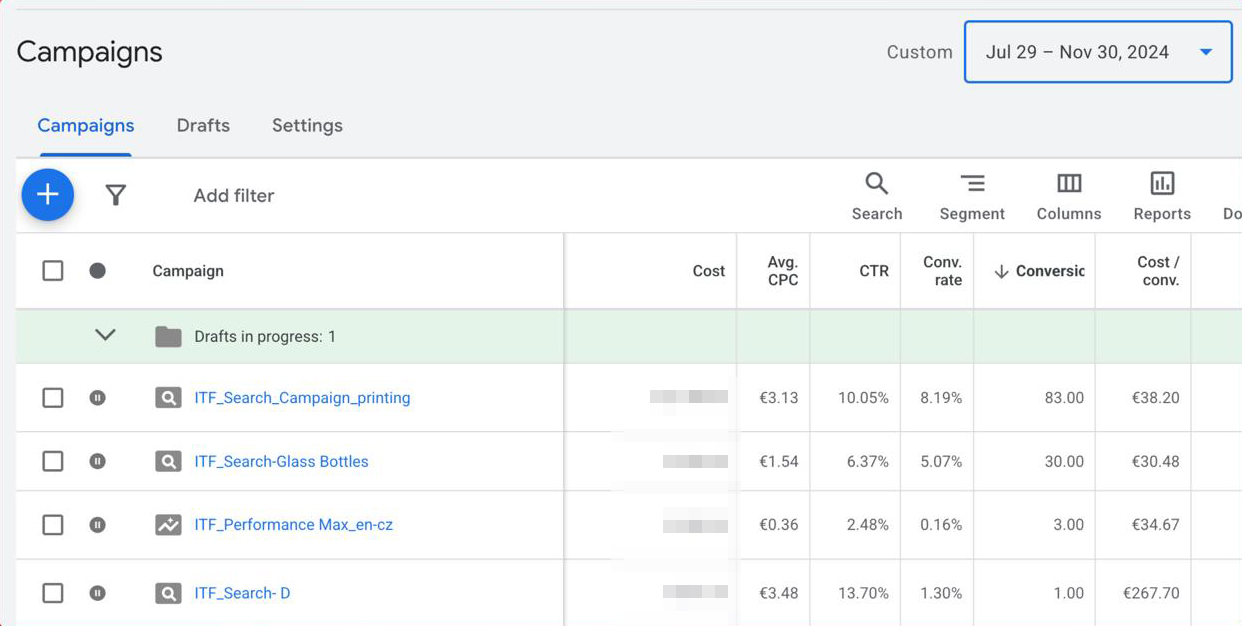
Search-Glass Bottles - a new high-performing direction targeting a specific product category.
- 30 conversions.
- 5.07% conversion rate.
- €30.48 cost per conversion - the lowest cost per conversion across all search campaigns. Cost per click here is half that of the print search campaign (€1.54).
Performance Max_en-cz was disabled early in the engagement and remained at 3 conversions.
Search-D - the most expensive campaign from the start. It also remained at just 1 conversion at €267.
The testing strategy proved its worth: the high cost per click in the first month, while we were fine-tuning the settings, allowed us to gather the data needed to optimize. As a result, we reached 117 conversions over 4 months. Search traffic became highly effective - search campaigns delivered a strong conversion rate, meaning our targeting successfully filtered out non-relevant audiences and drove high-intent users to the site who were ready to place orders.
GA4 traffic channels
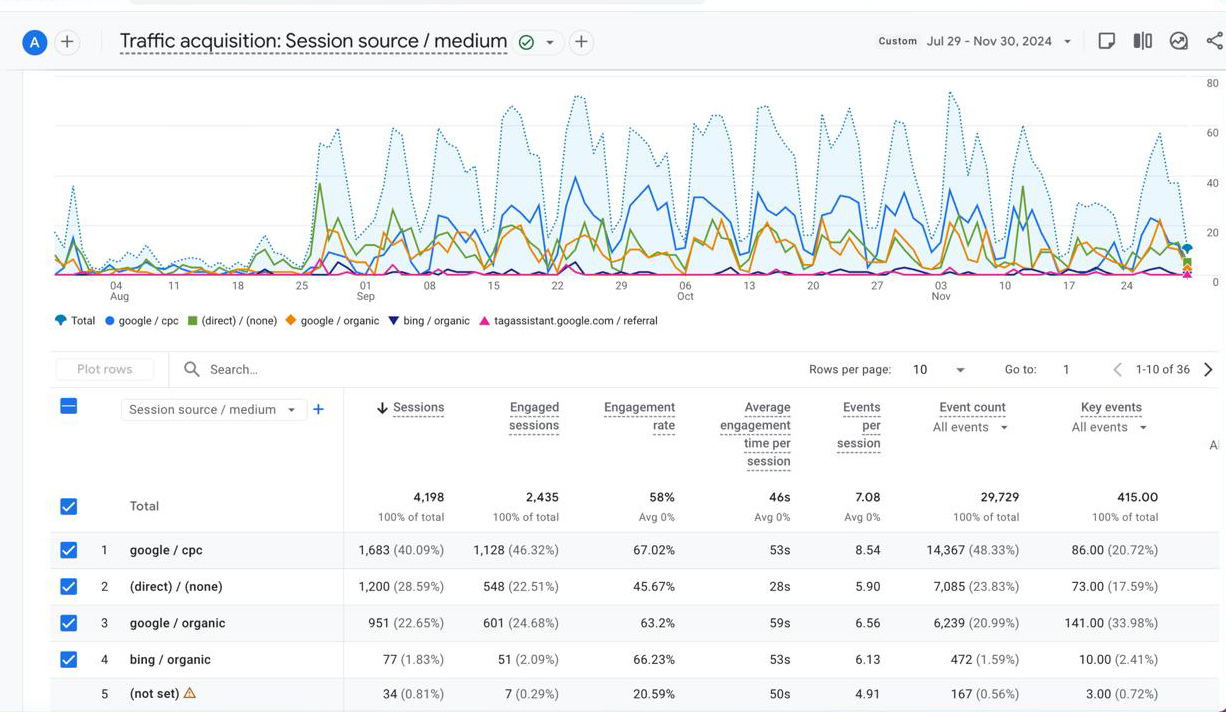
The screenshot shows that paid advertising (google/cpc) was the primary traffic source on the site during the selected period and delivered the strongest performance metrics:
- 1,683 sessions (40.09% of total site traffic) - ads drove the largest share of visitors.
- 67.02% engagement rate - nearly 7 out of 10 users arriving from ads did not simply close the site, but spent more than 10 seconds on it, viewed multiple pages, or completed a target action. This confirms that Google Ads traffic is highly targeted.
- 53 seconds average engagement time - users were actively exploring the services offered.
- 8.54 events per session - the highest figure among all major channels, indicating active clicking and interaction with the site.
- 86 key events, accounting for 20.72% of all conversions on the site.
Conversion discrepancy
Google Ads reported 117 conversions, while Google Analytics 4 showed 86 for the google/cpc channel over the same period. Google Ads applies its own attribution models. For example, accounting for clicks that led to a conversion several days later, or view-through conversions. GA4, on the other hand, records conversions exclusively on a session-based model. It is also worth noting that in August 2024, tracking discrepancies in traffic and conversion data were observed, which affected the accuracy of final figures across both analytics systems.
The google/cpc channel proved its effectiveness, driving high-quality traffic to the site. A 67% engagement rate confirmed that search campaigns were targeting the right keywords and that ads were meeting user expectations. Ad traffic was the most active of all channels. The events-per-session figure of 8.54 indicates that the ad audience was the most engaged with the site's interface.
SEO promotion results
We will evaluate the effectiveness of our work across 3 stages: first, we will look at launch metrics and early wins from the first month; next, we will analyze the site migration period to assess its resilience to that technical challenge; and finally, we will evaluate the long-term impact of the strategy by reviewing the site's state and rankings in May/June 2026.
First month promotion results
The English version demonstrated positive dynamics and semantic core expansion (an increase in the number of ranking queries), indicating that the site's technical foundation and overall domain authority were being received positively by search engines. The English version typically gets indexed and ranked faster due to higher competition, which causes Google's algorithms to crawl these segments of the web more frequently. Growth here is a "green flag" for the entire project.
German and Spanish versions: these markets have their own characteristics. German Google (google.de) is highly demanding in terms of E-E-A-T and localization, while Spanish search often requires more time for content to gain traction.
After adding new content to the site, it is advisable to manually submit it for re-indexing (via Search Console or the API).
- Relevance: Google will finally detect keywords in the correct zones (LSI, headings, meta tags), allowing it to clearly classify the DE and ES pages.
- Update signal: frequent content updates prompt bots to crawl the site more often.
- Answer completeness: new content reduces bounce rate and improves behavioral factors.
Post-migration site performance should be evaluated in the context of correct technical configuration rather than immediate results.
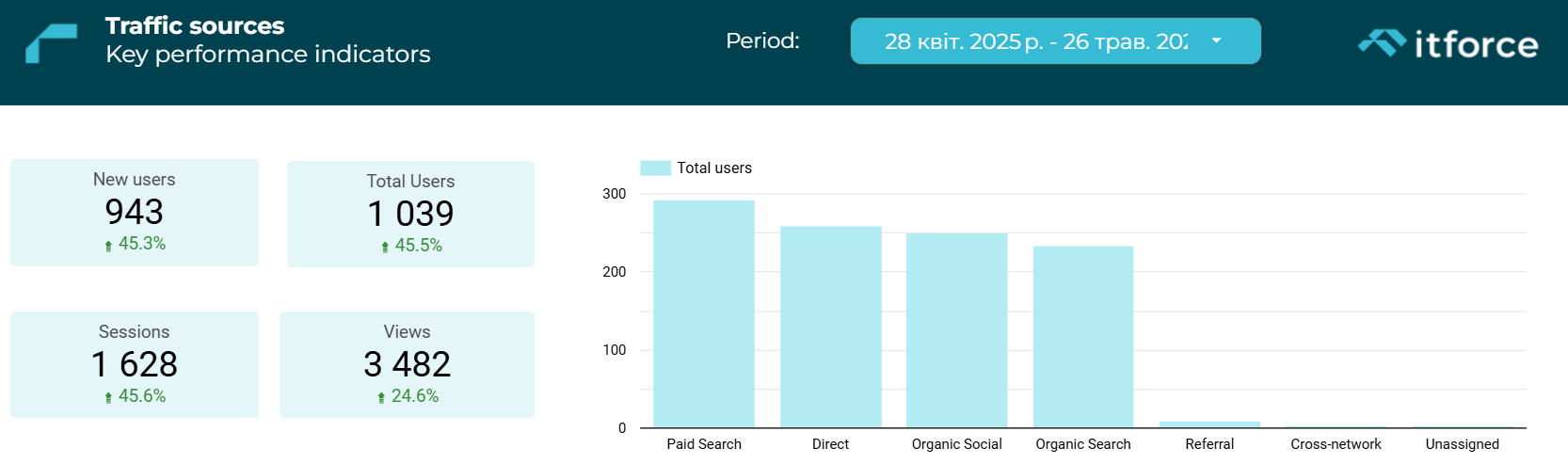
Overall metrics
- Audience growth: new users reached 943, up 45.3% compared to the previous period.
- Total activity: 1,039 users (+45.5%) and 1,628 sessions (+45.6%).
- Page views: total views reached 3,482 (+24.6%).
Traffic was distributed fairly evenly across the main channels, indicating a healthy acquisition structure:
- Paid search: the primary traffic source (~290 users), confirming ad effectiveness on the new domain.
- Direct: the figure (~260 users) indicated that clients had already memorized the new address or were using saved bookmarks, or that configured redirects from the old domain were working correctly.
- Organic social: activity across social channels brought in approximately 250 users.
- Organic search: despite the recent migration, the site was already receiving a significant share of search traffic (~230 users), confirming that redirects from the old pepper-decor.cz domain had been configured correctly.
Rankings are not taken into account here, as the site had just migrated to a new domain at that point, and query positions may have temporarily fluctuated while search engines processed the changes.
Overall, the migration to the new domain was proceeding successfully. A confident growth trend was observed across all key metrics (averaging +45%). Organic search already accounted for a significant share of total traffic, confirming the soundness of the chosen technical strategy and successful authority transfer from the old site.
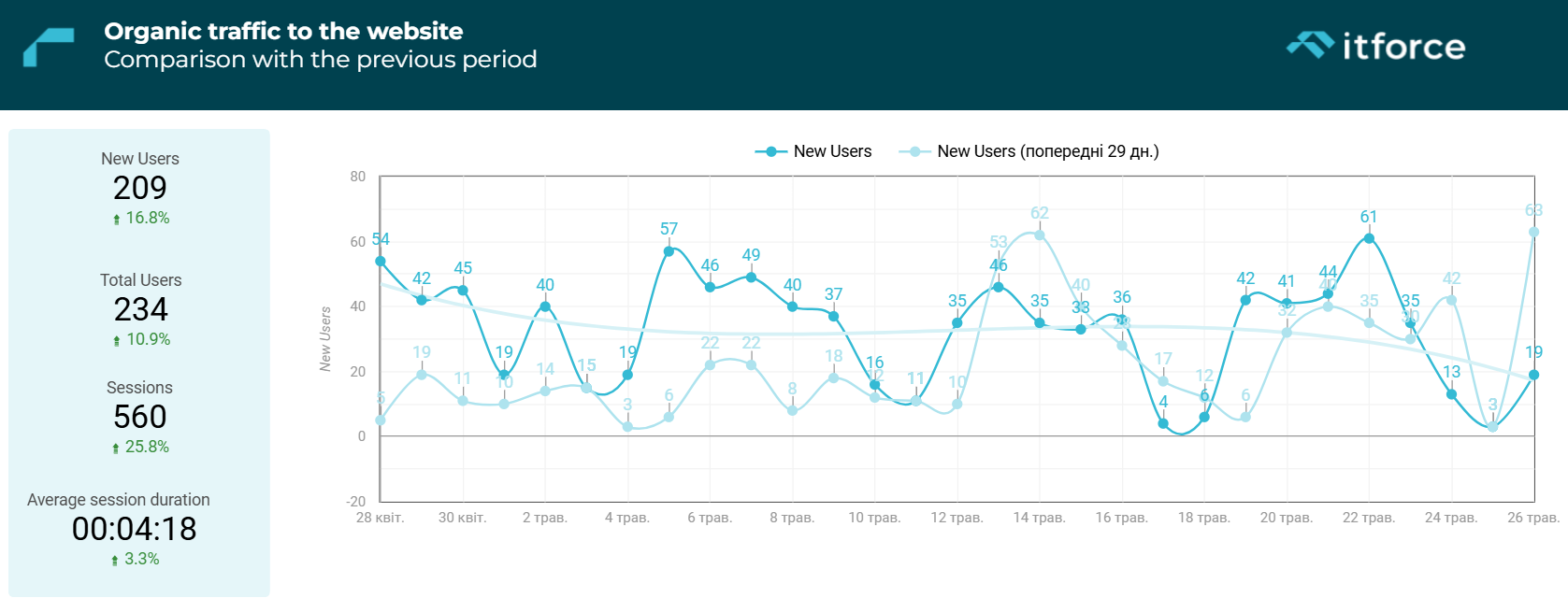
Key organic traffic metrics comparison
- New users: 209, up 16.8% compared to the previous period.
- Total users: 234 (+10.9%).
- Sessions: 560 visits, representing significant growth of 25.8%.
- Traffic quality: average session duration increased by 3.3% to 4:18 min, indicating that the new content and site structure were holding visitors' attention.
Traffic dynamics analysis
- Steady growth: the dark line (current period) runs above the light line (previous period) in the majority of cases.
- Peak days: notable activity spikes were observed (e.g., May 5, 14, and 21), with new organic users reaching 50-60 per day.
- Redirect effectiveness: organic growth during the migration to the new pepperdecor.com domain confirms that search engines are successfully re-indexing the site and transferring authority from the old pepper-decor.cz domain.
Organic traffic not only held steady after the migration. It demonstrated meaningful quality growth. Users began spending more time on the site, and total search visits grew by a quarter, which is an excellent result for a domain migration phase.
Traffic data for the final month of the engagement (28.05-25.06):


Traffic showed a moderate decline compared to the previous 29-day period. Total users decreased by 15.4%, sessions dropped by 19.3%, and average session duration fell by 37.0%, which may indicate reduced user engagement or lower-quality traffic during this period.
The positive ranking dynamics following AI-driven citation optimization remain an important signal. The Coating page, where improvements had already been implemented, reached TOP positions across all language versions. We therefore recommended gradually applying the same approach to the Hot Stamping and Screen Printing pages. Continuing to refine the homepage and overall site structure to improve relevance, navigation, and visibility also remains a priority.
Recommendations for upcoming periods:


Overall picture by region
- Spain and Germany (Google ES, DE) - the most dynamic markets. The EN Hot Stamping cluster broke through to the top 15 (Spain - position 6, Germany - position 13). Localized German queries are holding top positions: position 2 (DE Hot Stamping) and position 3 (DE Screen Printing).
- Slovakia and Greece (Google SK, GR) - showing the strongest results for the EN Coating cluster, reaching position 1 in both countries.
- Czech Republic (Google CZ) - demonstrating steady growth across all visible English-language queries (EN Main Page, Screen Printing, and Coating closed the period in the top 15 or top 10).
- United Kingdom (Google UK) - following a significant climb in early May, a minor correction occurred (-2 to -4 positions), but EN Coating remains in the top 10 (position 9) and EN Screen Printing sits at position 24.
Localized pages (particularly in Germany) consistently hold the top search positions compared to their English-language counterparts.
The English-language semantics of the homepage showed a decline across all geos, while local language versions and service pages remained stable. The Pepper-Decor homepage covers too many directions (decoration, coating, packaging) and functions as a general hub. Meanwhile, competitors in the Czech Republic, Spain, and Germany (DECO GLAS, Norman's Printery, and others) have created dedicated narrow landing pages targeting the "Bottle Printing Services" query, while the client's homepage addresses this query too broadly, and Google now demands a precise answer matched to a specific intent.
We proposed splitting page roles within the site structure:
- Homepage (brand-focused): reorient it exclusively toward general queries about glass container decoration, presenting the brand, its technologies, and the company as a whole. It should serve as a representative hub.
- New landing page (commercial): create a dedicated URL targeting the "bottle printing services" and "printing on glass bottles" query cluster. Populate it with a clear bottle printing service offering (methods, container types, workflow, FAQ) and set up logical internal linking to deeper technology pages (coating, screen printing, hot stamping).
The client subsequently decided to develop the project independently, bringing in their own team to handle site promotion.