



Read the case study to learn more about the client's SEO performance results Search engine optimization for a fragrance retail website.
About the Client
TWINS Parfum Online Store: perfumes and solid perfumes, deodorants, scented candles, and diffusers for home and auto.
Client advantages:
- High product quality backed by certifications.
- Fast shipping across Ukraine via Nova Post (free shipping on orders over 1,500 UAH).
- Hassle-free product exchanges and returns.
Workflow
The project came onboard with pre-existing advertising setups, so our immediate priority was conducting a technical audit of the ad campaigns and tracking systems. For each product category, the client specified a target CPA within UAH 150, which we strictly adhere to during ad optimization. Additionally, dynamic value tracking is not enabled in the client's account. Each conversion is assigned a static value, which must be taken into account when evaluating the performance of the paid search campaigns.
The primary objective for PPC is to scale sales volume while maintaining a stable cost per conversion.
Initial optimization:
- Analytics - verified e-commerce performance, added GA4 Purchase goal as a secondary action to track actual value within the account (the client's primary conversion goal was originally set to TwinsParfum (web) generate_lead).
- Optimization - processed system recommendations (implemented relevant ones, dismissed non-applicable suggestions).
- Performance Max - upgraded ad strength and asset quality (integrated headlines and descriptions highlighting the client's USP. Created an additional asset group without creatives for A/B testing).
- Merchant Center - reviewed account access and product feeds; flagged restricted inventory items and submitted them for manual review. Integrated an RU product feed and configured brand attribute rules.
Preparation for new Ad Campaign launches (approved by the client):
- Configured a standard campaign Shopping - Standard.
- Set up a new Sales-PMax_ru (targeting the RU feed).
Target Geography - Ukraine (excluding occupied territories).
Devices - Mobile and Desktop.
Schedule - 24/7.
In May 2025, we encountered a Google Merchant Center suspension. The issue originated within the product feed, and all ad campaigns were paused until the matter was resolved.
Google's manual product review revealed that the checkout page lacked an input field for users to manually enter their shipping address. The client’s developer promptly implemented this Google requirement, resulting in the account being unsuspended and fully reinstated. Ad delivery resumed the same day.
Budget experiment in the "Sales-Max" Ad Campaign
In July, we decided to test a hypothesis by temporarily scaling the budget for our primary Performance Max campaign, which drives the highest volume of conversions. While the testing window was too brief for a fully comprehensive evaluation, we recorded the following performance metrics within the account:
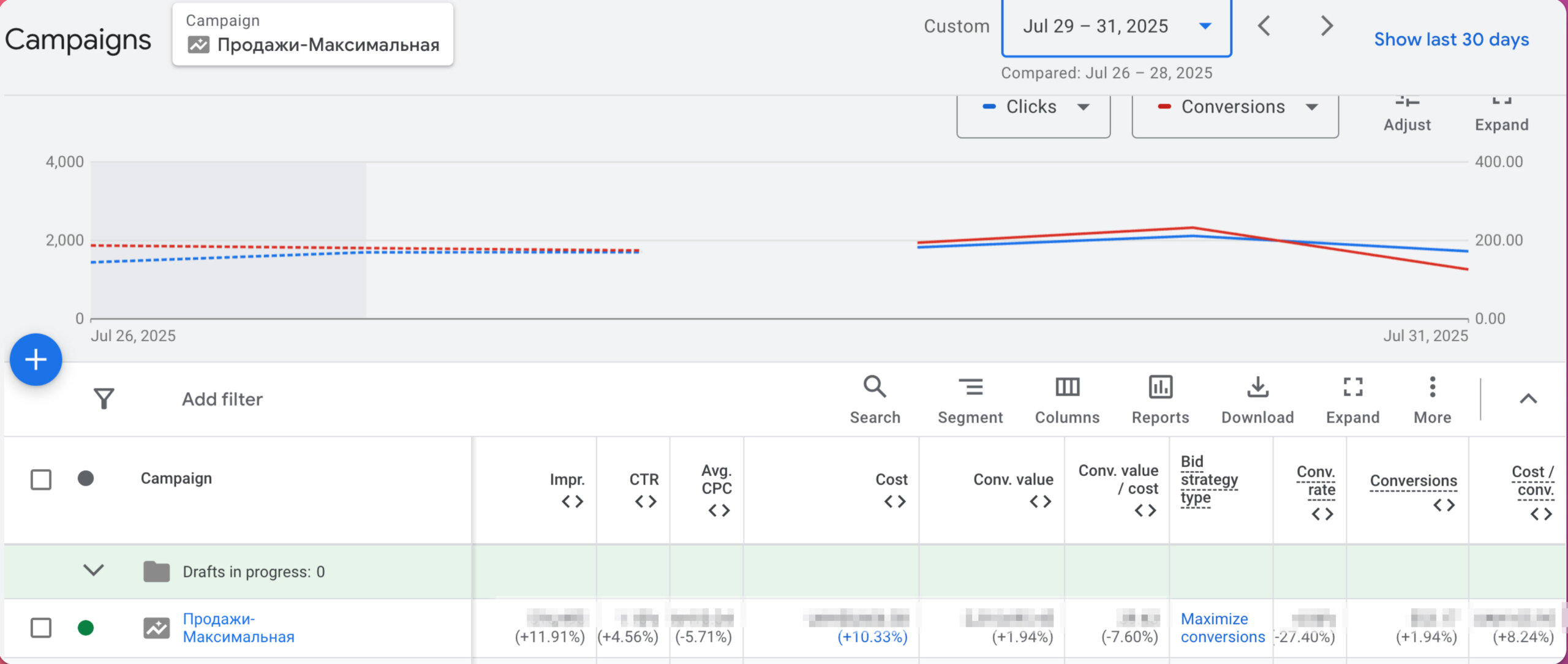
The budget increase generated more impressions and clicks, but traffic quality dropped, with the conversion rate decreasing by 27.4%. CTR rose by 4.56%, demonstrating that the ads remained relevant even at higher volumes. The average cost per click (CPC) decreased by 5.71%, which serves as a positive scaling signal. Conversions increased by 1.94% due to the higher budget spend, but the cost per conversion rose by 8.24%.
Given the stable performance of the current campaigns, we aligned with the client on an uncapped budget scaling strategy. Following Google’s recommendation, the client decided to increase ad spend by 20-25% from current levels on the 25th of each month. This approach will test the hypothesis that controlled budget growth at the end of the month provides the system with the necessary resources to capture additional conversion volume and deeper market insights.
Enhanced conversions
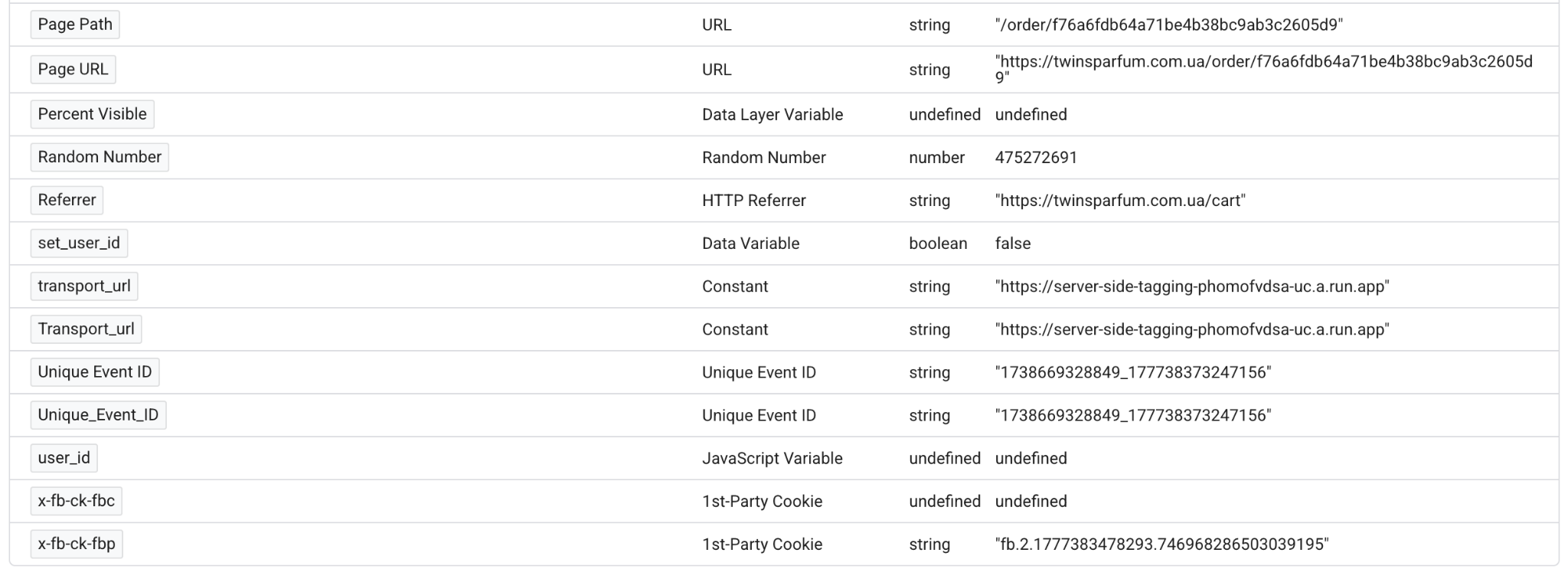
While setting up Enhanced Conversions, we encountered a technical bottleneck - the system failed to transmit the required data properly, specifically missing customer emails and phone numbers:
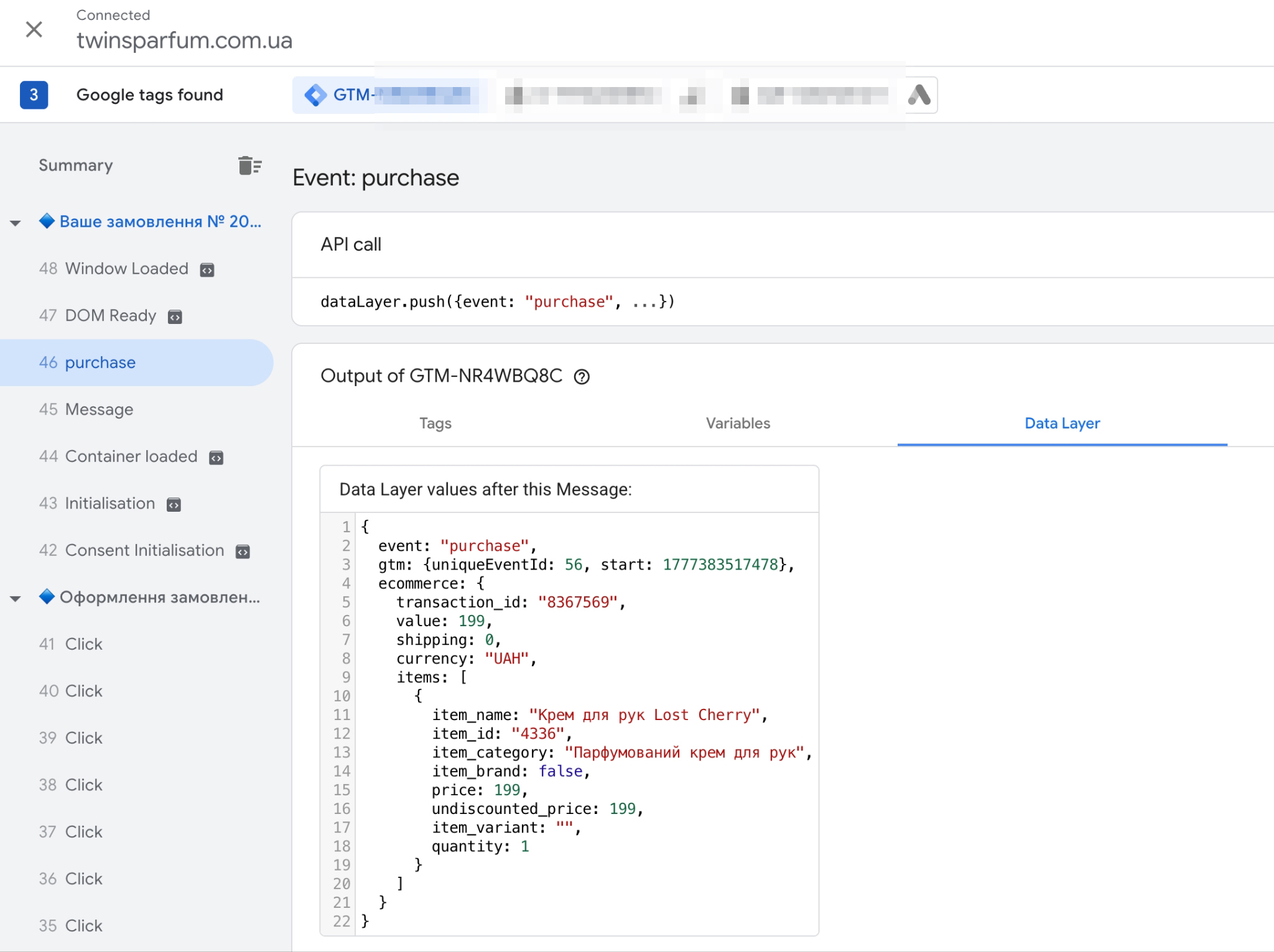
As we explored alternative solutions, we discovered that the client’s developer needed to implement backend website modifications because the site triggers a Purchase event that requires these phone and email fields. We attempted to inject these parameters via the DOM, but they returned empty values. Consequently, we escalated this data transmission task to the client’s developer for implementation.
AI Max for Search
In August, we approved a test for a new feature in search campaigns: AI Max for Search. However, we disabled the automatic final URL selection. Also in August, we first noticed a discrepancy between Purchase and Generate lead conversions, which track the same action.
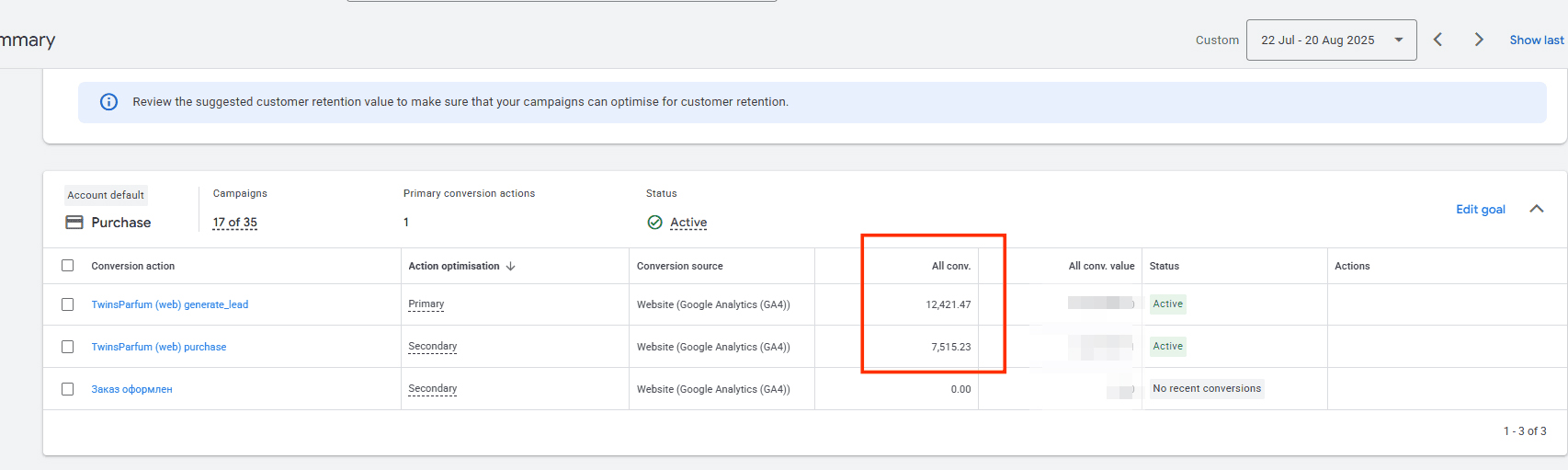
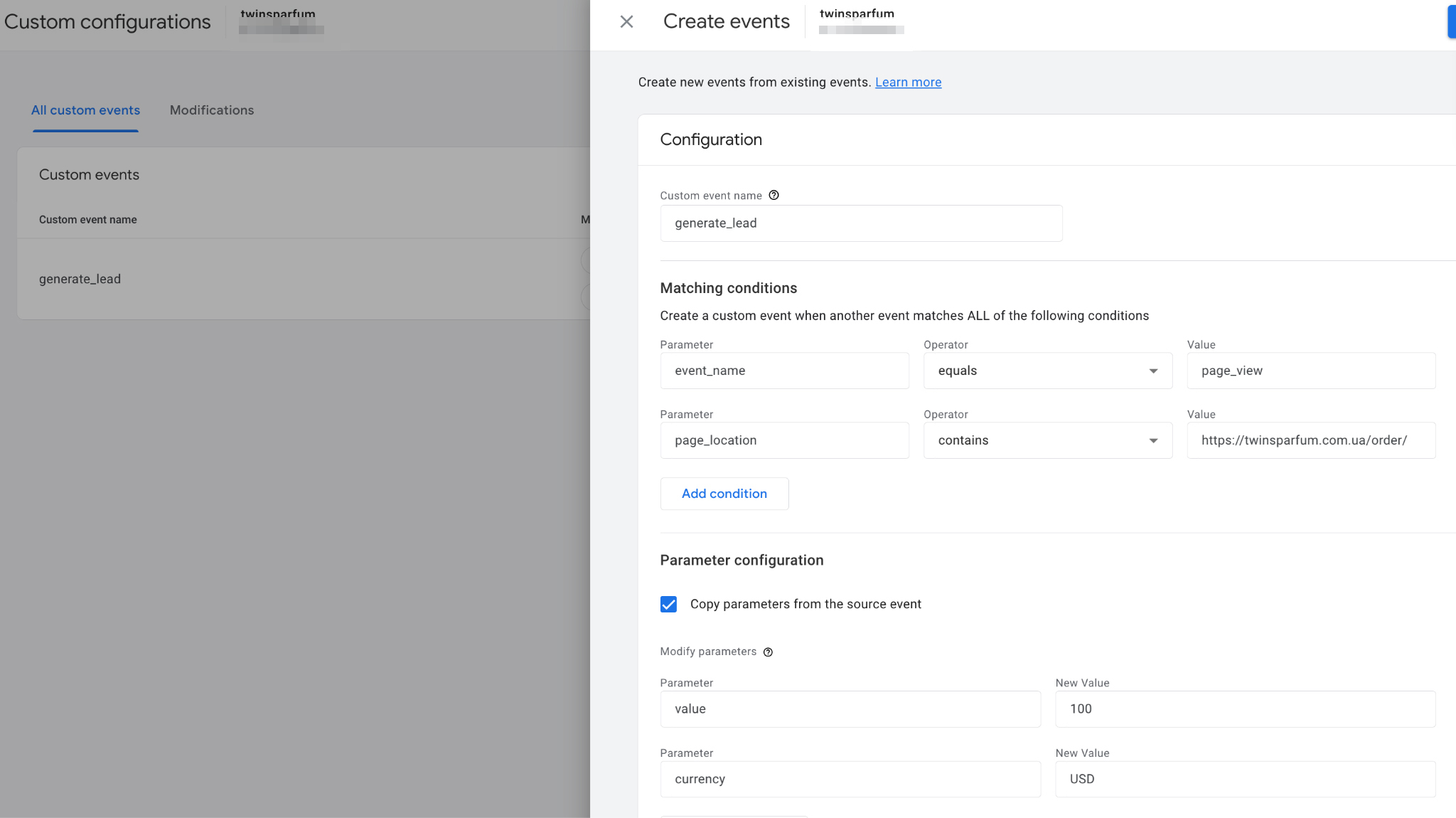
We hypothesized that Purchase triggers only once per transaction, whereas Generate lead can fire multiple times (for example, upon page refresh) due to this rule-based configuration.
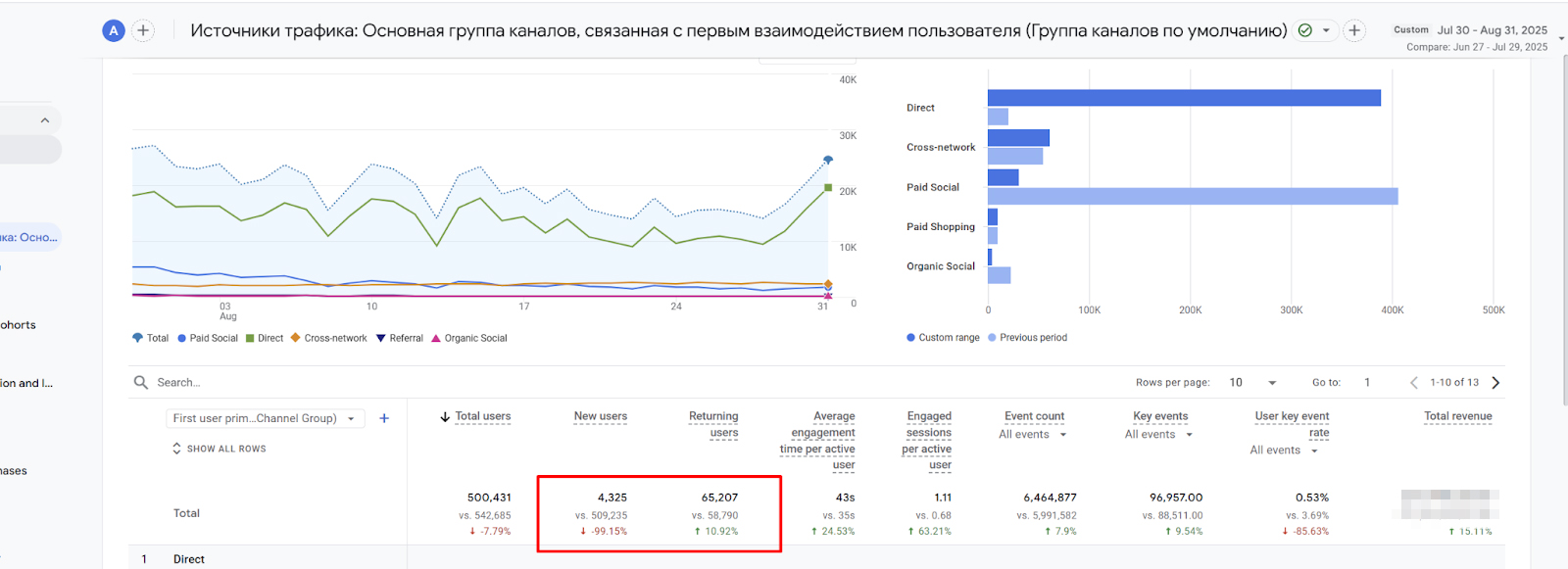
In October, the issue escalated. The new-user-specific chart revealed that the client's account was incorrectly tracking new user acquisition across channels, with a sharp shift in data logging occurring on July 29.
On that day, the team implemented analytics dashboard configurations that likely impacted the data tracking, primarily the activation of the User-ID feature in GA4. Enabling this feature, specifically the activation of Google signals, could have altered the Analytics reporting. Here is how the blended reporting identity comparison looked.
And this is how it appeared when switched to device-based
Essentially, the account used a blended reporting identity, but the absence of Google signals effectively made it function as device-based (which is why the device-based report displayed the data). The discrepancy stemmed from deduplication: device-based identity tracked users via client_id/device, often splitting a single individual into multiple new users. Once Google signals were enabled, the system captured Google identifiers if a user logged into Google (Gmail, YouTube, Chrome, etc.), allowing GA4 to stitch the user journey across different devices and browsers.
As of today, the issue is resolved, and data transmits correctly.
Unfair сompetition
The client discovered a competitor in the ad space attempting to completely copy our client's product: the label featured the client's logo, but used a new product name. The client requested that we file a complaint, as they hold a registered trademark.
Black Friday
To ensure maximum relevance, we launched a dedicated Performance Max campaign featuring targeted promotions (1 promotion = 1 asset group):
- Car Fragrances – Buy 2, Get 1 Free (1+1=3).
- Hand Creams – 30% Off, plus Buy 2, Get 1 Free (1+1=3).
- Deodorants – 30% Off, plus Buy 2, Get 1 Free (1+1=3).
- Entire Product Range – Buy 2, Get 1 Free (2=3).
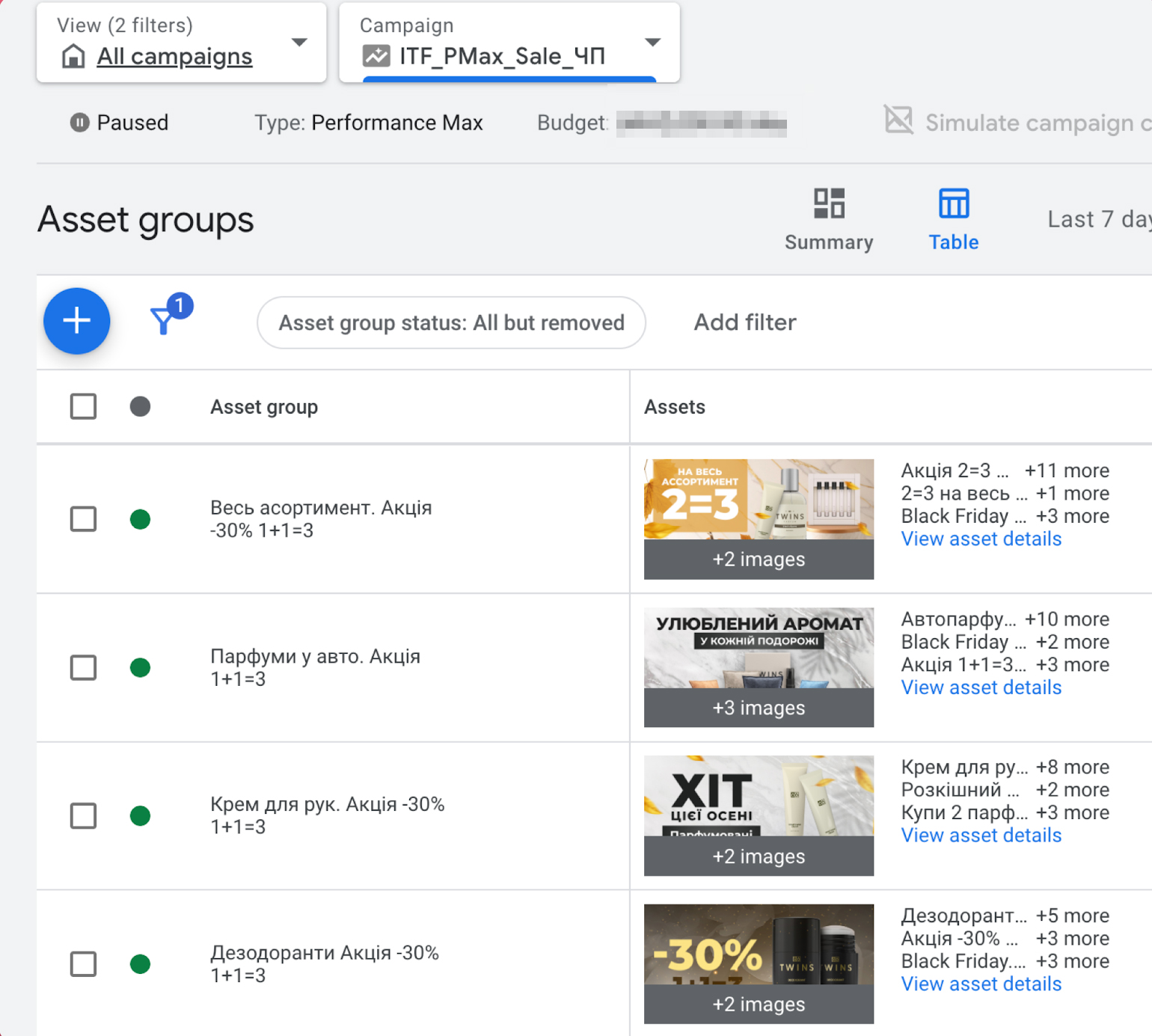
We established the initial budget based on our industry experience, with plans for subsequent scaling.
Geography: Ukraine, excluding occupied territories.
To prevent this wide range of promotions from cannibalizing or causing a performance drop in our standard campaigns, we configured a separate ITF_PMax_Sale_BF campaign with matching asset groups. The campaign's performance metrics leading up to Black Friday were:
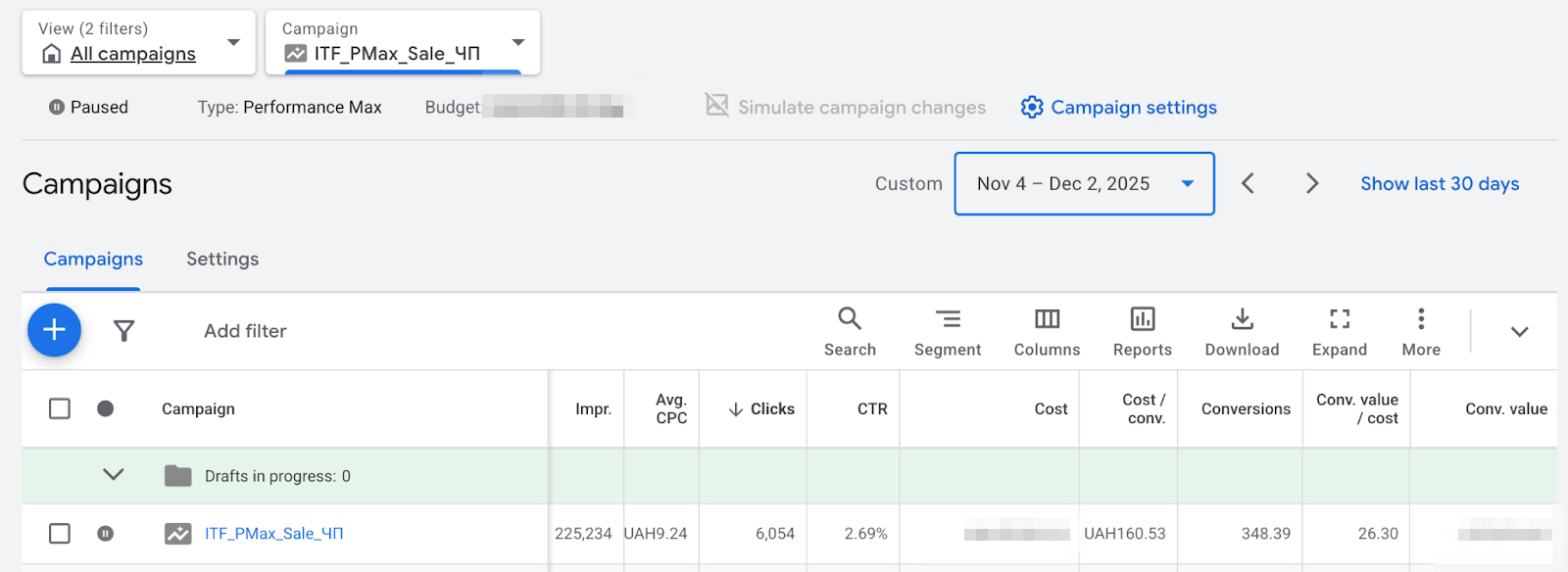
The total conversion value exceeded ad spend nearly threefold. Over the promotional period, the campaign generated 348.39 conversions at an average cost of UAH 160.53. The ads drove over 6,000 clicks, with every 17th click resulting in a conversion.
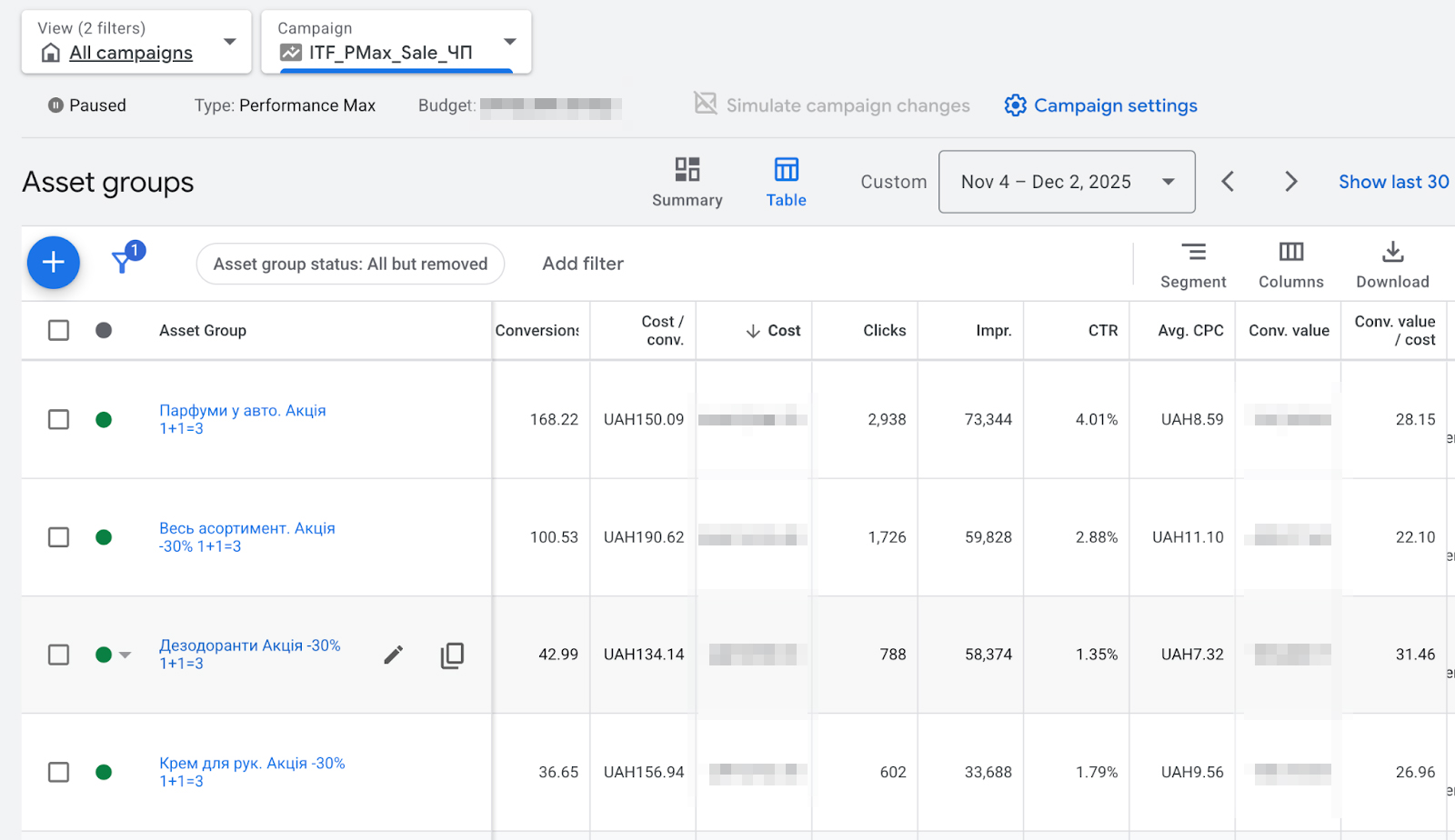
The "Car Perfume Promo: Buy 2 Get 1 Free" asset group made the largest contribution to the overall performance, generating the highest value and driving the most conversions (168.22). A 4.01% CTR confirms that this offer resonated best with the audience. The "Deodorant Promo: 30% Off, Buy 2 Get 1 Free" group delivered the optimal cost per conversion at 134.14 UAH. This efficiency stemmed from having the lowest CPC (7.32 UAH), making this category the most cost-effective for scaling. The "Storewide Promo: 30% Off, Buy 2 Get 1 Free" group secured a steady stream of orders (100.53 conversions) due to its substantial reach. The "Hand Cream" group demonstrated balanced results, yielding a 156.94 UAH cost per conversion with an acceptable return value.
The "Buy 2 Get 1 Free" promotion performed best within the car perfume category, making it the primary revenue driver. Overall, the dedicated Black Friday campaign delivered maximum efficiency thanks to precise configuration. We successfully maintained a low CPC (under 10 UAH) during a highly competitive, overheated ad auction period.
Demand Gen
In November 2025, we received approval to launch a Demand Gen campaign. The selected target geography was Ukraine, excluding occupied territories:
- The campaign is segmented by product groups to ensure maximum relevance (displaying specific products and headlines for each corresponding category, such as deodorants).
- Configured the product feed and integrated the creative assets.
- Developed tailored text ads for both image assets and video formats to maximize ad inventory reach. Implemented a 2.5%
- Lookalike audience built from the client's customer list to capture the most relevant traffic.
- Established the daily budget based on system recommendations to optimize the initial campaign learning phase.
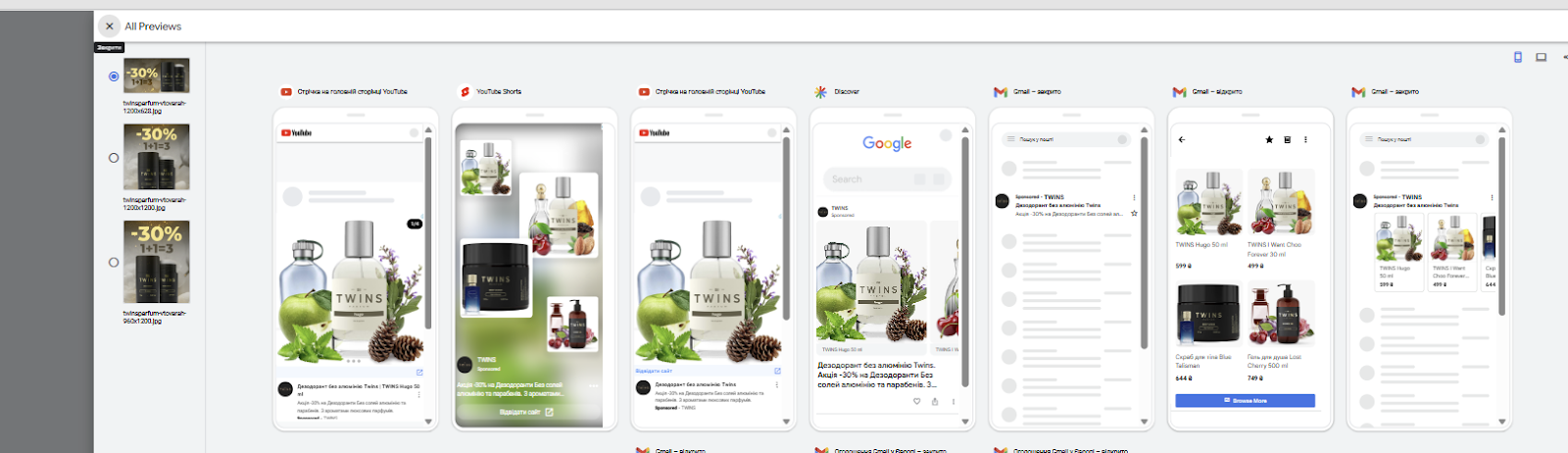
As an ITForce Google Premium Partner, we work in close alignment with the Google team. This partnership involves regular sync calls and joint account performance reviews. Leveraging these direct recommendations from Google representatives allows us to identify growth opportunities faster and implement solutions that boost the client's ad spend ROI.
During a recent session with Google experts, we received strategic recommendations for running and scaling the Demand Gen campaign. This analysis remains under NDA, as it leverages Google's internal insights, which are unavailable in the standard account interface. Our Google Premium Partner status grants us access to these exclusive insights, allowing us to utilize restricted data to optimize client projects.
Google's proprietary competitor analysis tool uses a list of competitors we provide to identify the platforms driving the most traffic to rivals, as well as their ad budgets and marketing tools. Comparing these average competitor benchmarks against our client's metrics yields an objective market position assessment and highlights the most promising growth vectors. Implementing the tailored recommendations from this sync call became the key driver in improving traffic quality and stabilizing ad performance.
The Demand Gen campaign launched successfully, generating 56 high-value conversions within its first seven days. The audience segments this campaign generated also successfully fed into and converted through Performance Max and Search campaigns. At the account level, this traffic delivered a 4,120% ROAS.

Additionally, following Google's recommendation, we adjusted the Search Brand budget. The account successfully captured demand, but budget caps prevented the campaign from handling the surge in search queries. Consequently, we aligned with the client to scale the Demand Gen budget.
In March 2026, following Google's recommendations to scale performance, we:
- Adjusted the budgets for the top-performing campaigns to capture additional conversions by leveraging current market demand.
- Added the business name and logo assets to the Search_Brand campaign; according to Google data, utilizing all asset types in the beauty vertical typically increases conversion rates and reduces CPA.
- Upgraded the video content within Performance Max to enable the algorithms to operate more efficiently across all Google platforms.
Furthermore, we received a recommendation to finalize the transition to a dynamic conversion value tracking model. This will provide Google's algorithms with more precise revenue data per transaction to further optimize ad spend return.
Transitioning to optimization for the Purchase Ad
In March 2026, we planned a transition to Purchase as the primary conversion goal in Google Ads. To avoid disrupting the algorithmic learning phase, we structured a gradual rollout since the account had long optimized for the generate_lead.
Approved transition plan:
- During weeks 1-2, we begin with mid-tier campaigns (Sales-Performance Max (shower gels), ITF-PMax-Home Fragrances, and Sales-PMax-Deodorants) and monitor purchasing dynamics and CPA.
- Next, we transition the majority of the PMax campaigns: PMax-Car Diffusers_Kyiv, PMax-Car Diffusers_Ukraine, Performance Max_Body Scrub, PMax-Hand Creams, and PMax-Bath Bombs.
- The subsequent phase involves the lowest-volume campaigns (lower-performing Performance Max (travel), ITF_PMax scented sachets, ITF_PMax Accessories, and ITF_Sales-PMax_LP_Perfumes).
- Once performance stabilizes, we transition the major campaigns (Sales-PMax and Standard Shopping).
In the final phase, we transition to the primary campaign "Sales-Max". Following this, we will set the Google Ads purchase event as the primary account-level conversion action, leaving generate_lead as a secondary action for analytical tracking. The team is currently implementing the first iteration of these changes.
Ad examples:


Comprehensive list of account optimization work
1. General account management and performance monitoring
- Strategic Configurations: Primary goal - TwinsParfum (web) purchase. Utilizing automated scripts to audit PMax search queries, analyze channel performance, and instantly flag disapproved products.
- Audit and Optimization: Routinely processing Google Ads recommendations (applying relevant updates and dismissing non-applicable ones). Cleaning up irrelevant search queries across all campaign types.
- Branding and Creative Assets: Deployed the new company logo and updated responsive search ads.
- Integrated new ad extensions (sitelinks), specifically "Home Spray," along with structured snippets.
- Updated on-site promotional campaigns (March 8, Black Friday, Women's Day) and integrated them directly into the ad copy.
- Audiences: Implemented Observation audience segments, refreshed interest-based signals (Black Friday, Women's Day), and uploaded targeted customer lists.
2. Google Merchant Center and work with the feed
- Policy and Disapprovals: Continuously monitoring product disapprovals (common triggers include "Alcoholic beverages", "Adult content", and "Mobile URL errors"). Manually reviewed flagged products and asset items and resubmitted them for review.
- Optimization: Routinely adding new inventory items from the feed into active rotation (perfumes, deodorants, scrubs). Pausing products yielding low visibility or high CPA.
- Support requests: Filed appeals for "Destination not working on mobile devices" errors after verifying that all destination URLs load correctly.
3. Performance Max (PMax) - Optimization and Scaling
Core and Categorical campaigns
- Sales-PMax (Core): Optimized "Interests", "Remarketing", and "No signals" asset groups. Paused underperforming locations and products (including Travel items and diffusers, which we segmented into dedicated campaigns).
- Shower Gels: Gradually scaled the budget (+10-20%). Added search themes and implemented a Target CPA strategy.
- Deodorants: Increased the budget by 15%. Refreshed creative assets, enhanced ad copy, and integrated relevant search themes into asset groups.
- Home Fragrances: Scaled the budget (+100 UAH and +10%). Updated creative assets, added search themes, and paused underperforming products.
- Body Scrub: Enabled final URL expansion. Integrated remarketing lists, applied a Target CPA of 150, and paused weak asset groups.
New and Test launches
- Accessories (Makeup Bags): New campaign. Transitioned to Target CPA. Created an "interests+rem" asset group. Scaled the budget by 35%.
- Scented Sachets: New campaign. Increased the total budget by 75%. Implemented tCPA and updated the asset group.
- Bath Bombs: Deployed tCPA. Increased the budget by 10%. Relaunched the "no ad + signal" group with updated audience signals.
- Hand Creams: Set tCPA. Scaled the budget by 30%. Updated the product assortment.
- Car Diffusers (Kyiv/Ukraine): Gradually increased the budget (+10%). Added search themes and new video assets. Transitioned to tCPA (~100–115 UAH).
- LP_Perfumes: Implemented tCPA and scaled the budget. PMax (Feedless): Relaunched with fresh creative assets to drive new customer acquisition.
- Home Spray: Configured the campaign; awaiting client budget approval to launch.
4. Search & Shopping
- Search_Brand: Enhanced responsive search ads. Added high-intent queries to the keyword list and paused underperforming keywords.
- Search_General: Tested keyword semantics and tROAS. Paused the campaign due to an elevated CPA.
- Shopping - Standard: Tested Maximize Clicks and tCPA bidding strategies.
- Optimization: Paused the "Solid Perfume", "Deodorants", and "Hand Cream" categories due to low performance within Shopping. Adjustments: Decreased device bid adjustments and paused underperforming geographic locations (specifically, the Poltava region).
5. Demand Gen
- Creatives: Refreshed banners and video assets. Upgraded ad strength and quality. Optimization: Paused geographic locations yielding a high cost per acquisition (CPA).
Next steps:
- Finalize the budget and launch the "Home Spray" campaign.
- Monitor the stability of Target CPA bidding strategies across the newly launched campaigns (Accessories, Scented Sachets).
- Compile a list of product IDs for underperforming perfumes to segment them into a dedicated feed or apply product exclusions.
Tools Implemented
GA4 served as the primary tool to analyze on-site user behavior and import key events into the advertising account.
GTM enabled tracking tag configuration and accurate conversion data transmission without modifying the website's source code.
Google Ads Keyword Planner helped build a high-quality semantic core, estimate potential traffic volume, and forecast the optimal cost per click (CPC).
Google Gemini served as an AI assistant to quickly brainstorm ideas, structure marketing strategies, and analyze performance data.
ChatGPT assisted in writing and adapting ad headlines and descriptions to align with relevant user search queries.
PPC performance results
To summarize, we evaluated KPI fulfillment over the active project reporting period (January 2025-February 2026). The overall conversion and cost metrics are as follows:
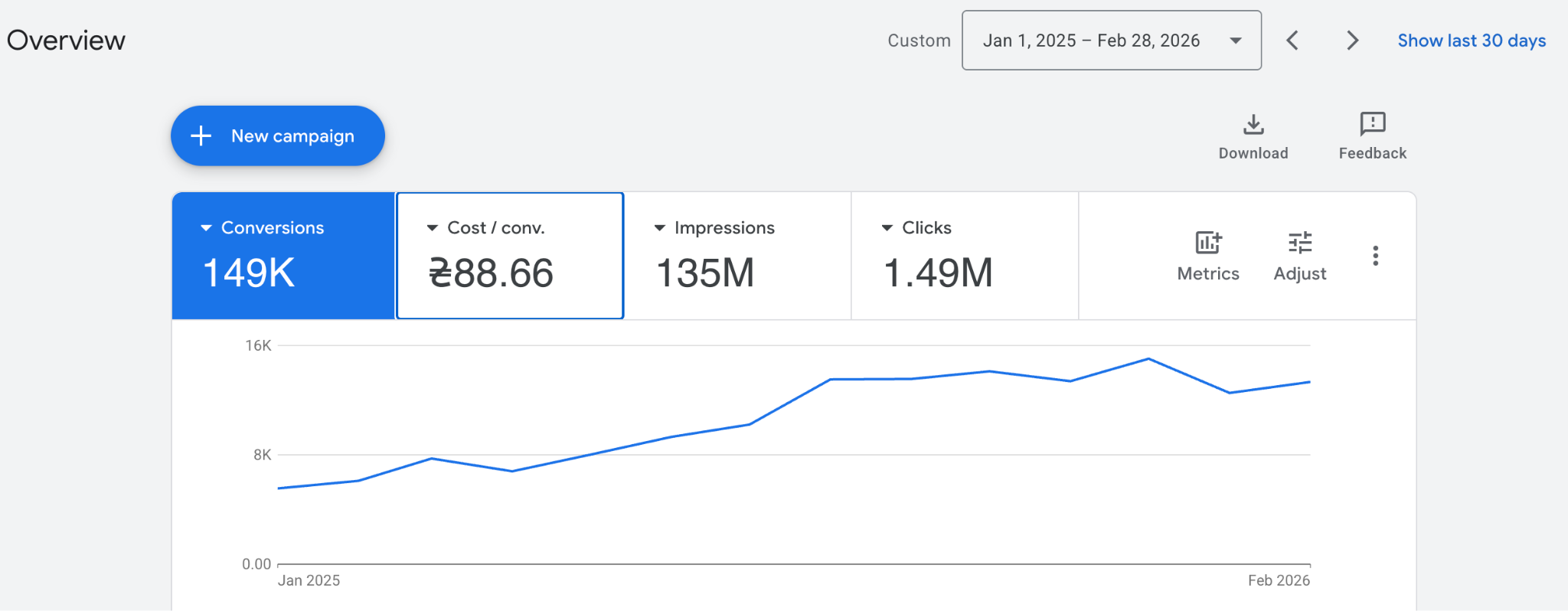
Throughout 2025 and early 2026, the project demonstrated steady scalability. Monthly conversions more than doubled, increasing from 5.5k to 12.6k. Despite this massive volume growth, the cost per acquisition (CPA) remained stable at approximately 89 UAH, proving that efficient campaign optimization sustained profitable growth as budgets scaled.
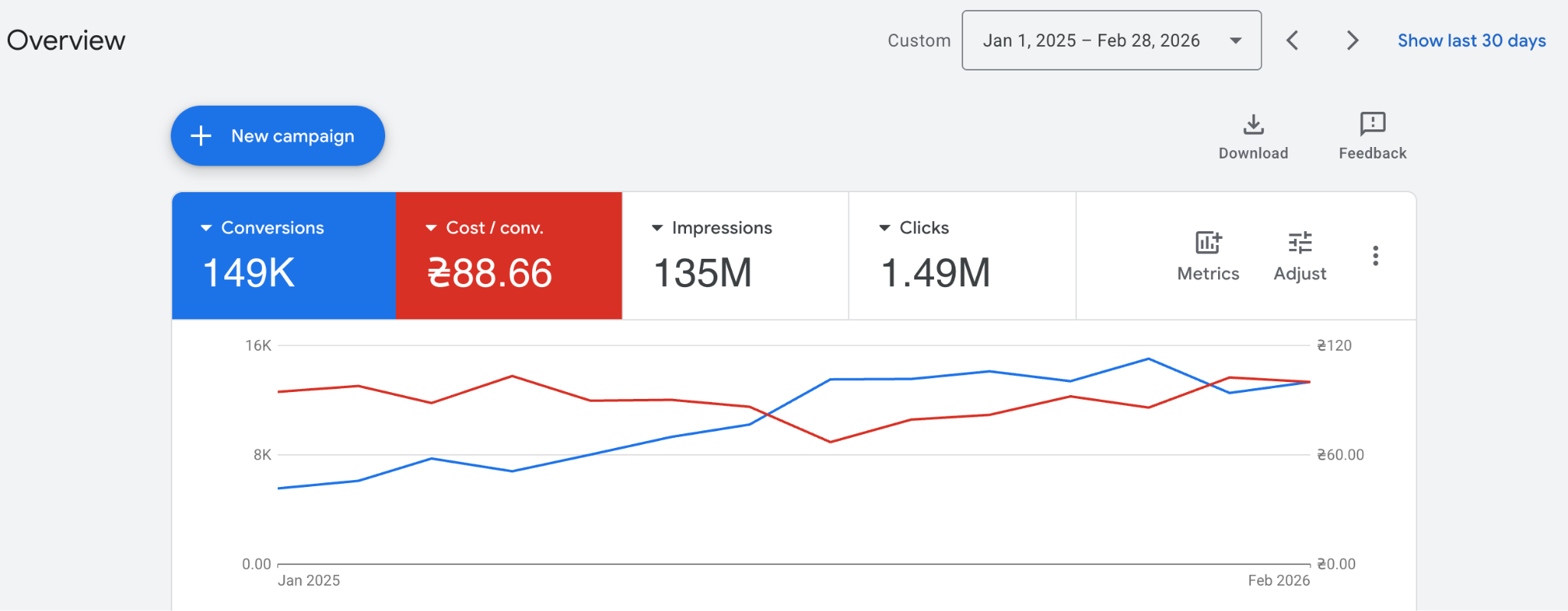
Starting in June, the blue line (conversions) trends upward while the red line (cost) declines. This trajectory demonstrates successful algorithmic learning and efficient keyword and audience optimization, yielding increased volume alongside a decreasing unit cost.
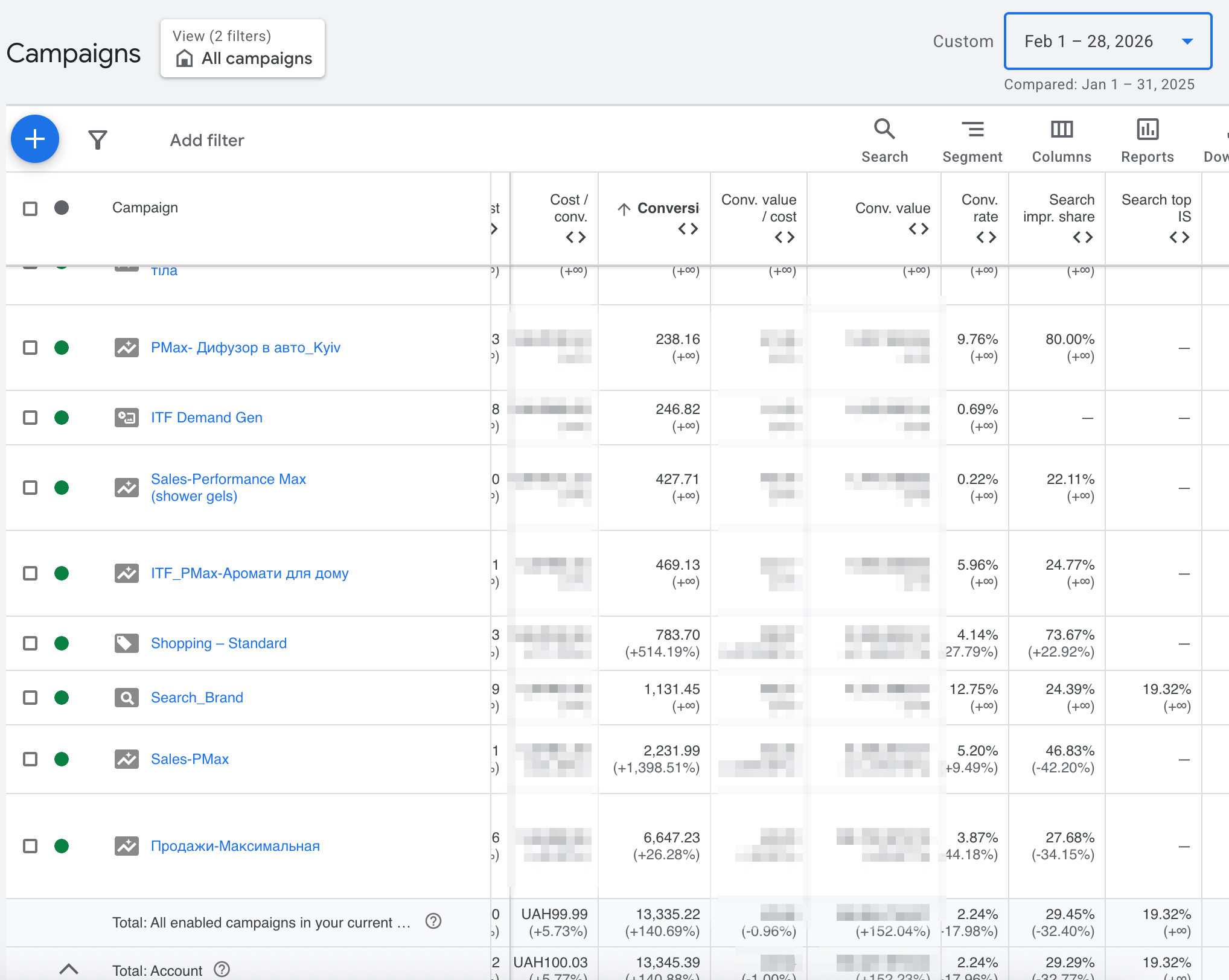
- Conversions: 13,335.22 (+140.69% compared to January 2025).
- Cost per Conversion: 100.03 (+5.77%) UAH.
- Total Spend: +152.23%.
The project scaled aggressively: while the budget increased by 152%, conversions surged by 140%. Despite the higher spend, we successfully maintained a stable cost per acquisition (CPA only increased by 6%) and preserved a high return on ad spend.
Comparing traffic metrics from the CPC channel:
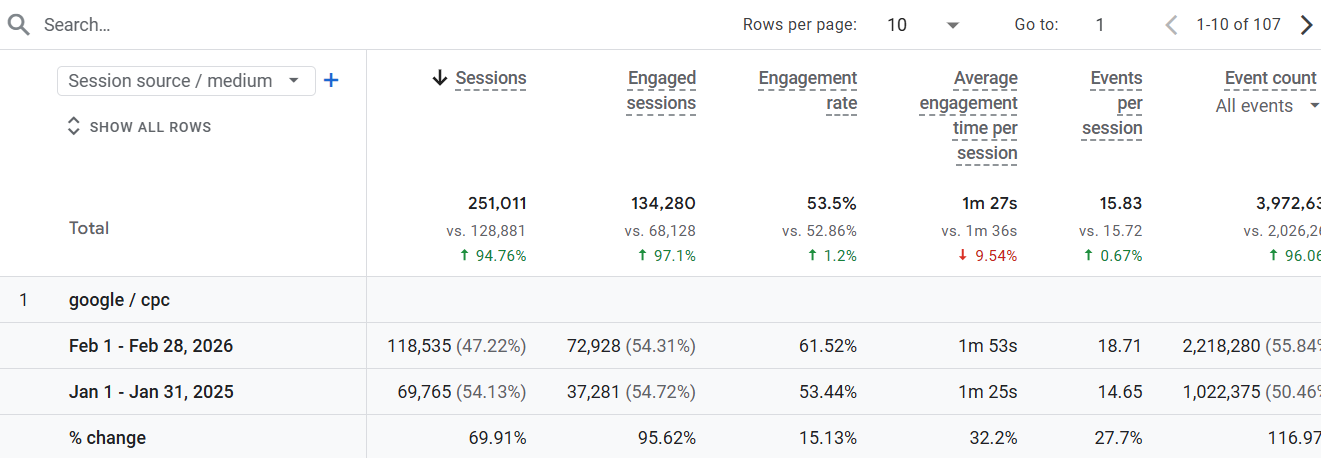
- +69.91% in sessions, demonstrating a significant expansion in reach. Crucially, all core quality metrics, including duration, events, and engagement, improved, confirming that this new traffic consists of high-intent target users.
- +15.13% in engagement rate, proving that paid traffic became both more scalable and higher quality, with users interacting with the site more frequently. This confirms that the user's post-click experience closely aligns with the ad's messaging.
- +32.2% in average engagement time, meaning users spend nearly 30 seconds longer on the site than before. This increase indicates that the landing page content and product offers now match user search intent much more accurately.
- +27.7% in events per session, reflecting a clear surge in active user engagement per visit. Visitors have become more interactive - frequently clicking, scrolling through image galleries, browsing product pages, and engaging with site forms.
GA4 data confirms the success of our strategy and the implemented Google recommendations: paid traffic efficiency has significantly improved. One out of every 13 sessions now results in a key event, compared to one out of 20 last year. The comprehensive optimization strategy succeeded, driving a higher volume of engaged users to the site. Both the overall average CPA and the category-specific conversion costs remain well within the client's target thresholds.