



The client approached us for SEO promotion of an online store selling electronic cigarettes and related components, relying on the successful experience of working with us on a previous project.
Our primary goal was to ensure fast and effective ranking of the newly created website at the top of search results immediately after its release. We focused on working with the test domain to fix as many issues as possible before migrating to the main domain. The comprehensive SEO optimization included technical improvements, semantic core collection, meta tag template configuration, creation of high-quality content, and development of a backlink-building strategy to maximize the store’s visibility for the target audience after launch.
About the Client
The company is an online store selling electronic cigarettes. Its assortment also includes liquids and components for e-cigarettes.
Client advantages:
- High-quality service.
- A wide selection of original products.
- Competitive prices and regular promotions.
- Various payment and delivery options.
The online store’s team offers expert assistance in selecting vape products, fast delivery, professional consultations, and attractive discounts. The store’s specialists are always ready to help customers navigate the assortment.
Niche and competitor analysis for the client’s website
The client provided a list of key competitors, which we analyzed according to specific parameters.
To research the semantic and backlink profiles of both the client and competitors, we primarily used Ahrefs and Serpstat. For the technical audit of the site, we used Screaming Frog along with various Google services. At the start of the cooperation, we were working with a nearly completed test version of the website. Therefore, we focused on technical analysis and error correction in the test environment to resolve all critical issues before launching the live website.
Conclusions and recommendations provided after the niche analysis:
- Working with the site’s semantics and structure is essential. Based on the collected semantic core, we prepared recommendations for expanding the site structure to cover all existing query clusters.
- It is necessary to optimize and further develop the site’s language versions to attract additional traffic.
- Technical optimization should be carried out on the test domain, which is closed from indexing, before the site’s release to ensure maximum results.
- Planned content optimization tasks:
- Implementation of human-readable URLs.
- Development of recommendations for product management within the client’s custom CMS.
- Creation of optimized content for categories based on the semantic core.
- Brand awareness activities: increasing social media presence to attract additional traffic.
- Taking into account the specifics of promoting in this niche (avoiding search engine filters), and remembering the restrictions on advertising tobacco-related products.
- Writing category content in accordance with the collected semantic core.
The comparative competitor analysis revealed the following insights:
- the domains range from 1 to 8 years old;
- competitor websites have between 5,700 and 44,500 pages indexed;
- competitor sites receive between 60,000 and 101,000 monthly users from organic traffic;
- competitors rank for 12,600-29,100 keyword phrases;
- the main social media platforms used by competitors are Telegram, YouTube, and Instagram;
- 60% of competitors maintain a Blog or News section on their websites.
The niche and competitive environment analysis shows that the market is fairly mature yet unstable due to the complexity of promoting websites in this category. This is reflected in the varying domain ages and the constant rotation of leading sites, where new players compete with established ones for visibility. Overall, competitor websites demonstrate a strong presence in search results and across social media platforms. Competitors actively use SEO, as indicated by the large number of indexed pages and ranking keyword phrases. They also maintain active social media profiles, highlighting the importance of these platforms for audience acquisition. Most competitors run a Blog or News section, which indicates their understanding of the importance of content marketing for SEO and traffic generation.
Expanding brand presence on social media and maintaining informational sections (a blog or news) has a positive impact on SEO. However, when promoting informational queries through a blog, it is important to avoid internal competition between site pages.
Technical audit
A technical audit in SEO promotion is a comprehensive assessment of a website to identify errors and shortcomings that may negatively affect its rankings in search engines.
Why is a technical audit is necessary:
- Improved search visibility: correcting technical issues helps the website rank better in search engines.
- Enhanced user experience: a fast and user-friendly site improves the customer experience, which also affects SEO.
- Issue detection and resolution: the audit helps identify and fix problems that may hinder the site’s promotion.
- Website optimization: a technical audit enables the site to be optimized for better interaction with search engines.
- Prevention of penalties: correcting technical errors helps avoid search engine sanctions.
Issues identified during the technical audit of the client’s website before and after release:
- problems with the formation of human-readable URLs (categories, product pages, brands, blog articles, service pages);
- presence of site duplicates;
- indexing restrictions applied to the site;
- incorrect pagination page generation;
- errors in H1 and H3 page headings;
- errors in the robots.txt file;
- missing alt and title tags for images;
- outbound links that pass link equity from the site;
- schema markup errors on site pages (breadcrumbs, product pages, language versions, images);
- issues with implementing on-site search;
- errors in product display during filtering and sorting;
- errors in hreflang="x-default" on filter pages;
- broken links in the footer;
- breadcrumb errors on brand pages and other sections;
- duplicate pages;
- non-functioning 301 redirects;
- malfunctioning cart;
- missing sitemap.xml file;
- errors in the sitemap.xml file (links from the test environment, pages returning 302, 404, 410 codes);
- presence of noindex and nofollow attributes on brand pages;
- incorrect banner links on the homepage;
- pagination errors;
- incorrect hreflang tags on certain pages.
At the beginning of the cooperation, the client also expressed concerns about page indexing, as the website was built using the Vue.js framework. As we know, websites developed in JavaScript require additional analysis and configuration to ensure proper crawling and indexing by search engines. Throughout the entire cooperation period, a large number of changes were implemented on the site, which also affected indexing, so this aspect required continuous monitoring. During the process, certain technical limitations on the client’s platform regularly arose, complicating the implementation of necessary optimization measures and directly affecting the project’s promotion.
After analyzing all issues, we identified what needed to be done, developed step-by-step instructions, and provided tasks to the developer for fixes. In most cases, the client implemented our recommendations, although challenges occasionally occurred. When technical constraints hindered progress, we worked together to find optimal solutions.
Semantic core
Work on the site involved continuous expansion of its structure, primarily through the optimization of filter pages. The site sections underwent minor changes, mainly through the addition or removal of product items. We began optimization with a semantic analysis of the categories. The client provided a list of priority pages for which we collected the semantic core and developed a promotion strategy.
While working with the semantics, we proposed structural changes to the site and identified additional query clusters, which we recommended for further optimization. However, our proposals for structural modifications aimed at improving the website’s visibility encountered internal issues related to the client’s data management and storage system, leading to reluctance to implement changes due to the significant potential workload. Despite our repeated attempts to emphasize the importance of these modifications, understanding was achieved only after the problem was raised from several sources. This made it possible to partially implement the necessary adjustments, although the full scope of planned improvements could not be realized.
Search promotion results
Let’s take a look at the SEO results achieved in promoting the online store of electronic cigarettes in search. This section highlights the concrete outcomes of our work - from the growth of organic traffic to the increased visibility of key queries in search results.
Link building
The specifics of the niche complicate link placement and require significant time to select appropriate donor websites. Due to the high likelihood of link loss, continuous monitoring and gradual backlink growth are necessary.
Since the client’s website is new and has only recently become open for indexing, we began with the most natural-looking links - submissions. Focusing on the homepage at the initial stage helps minimize risks and ensures the correct ratio of dofollow links.
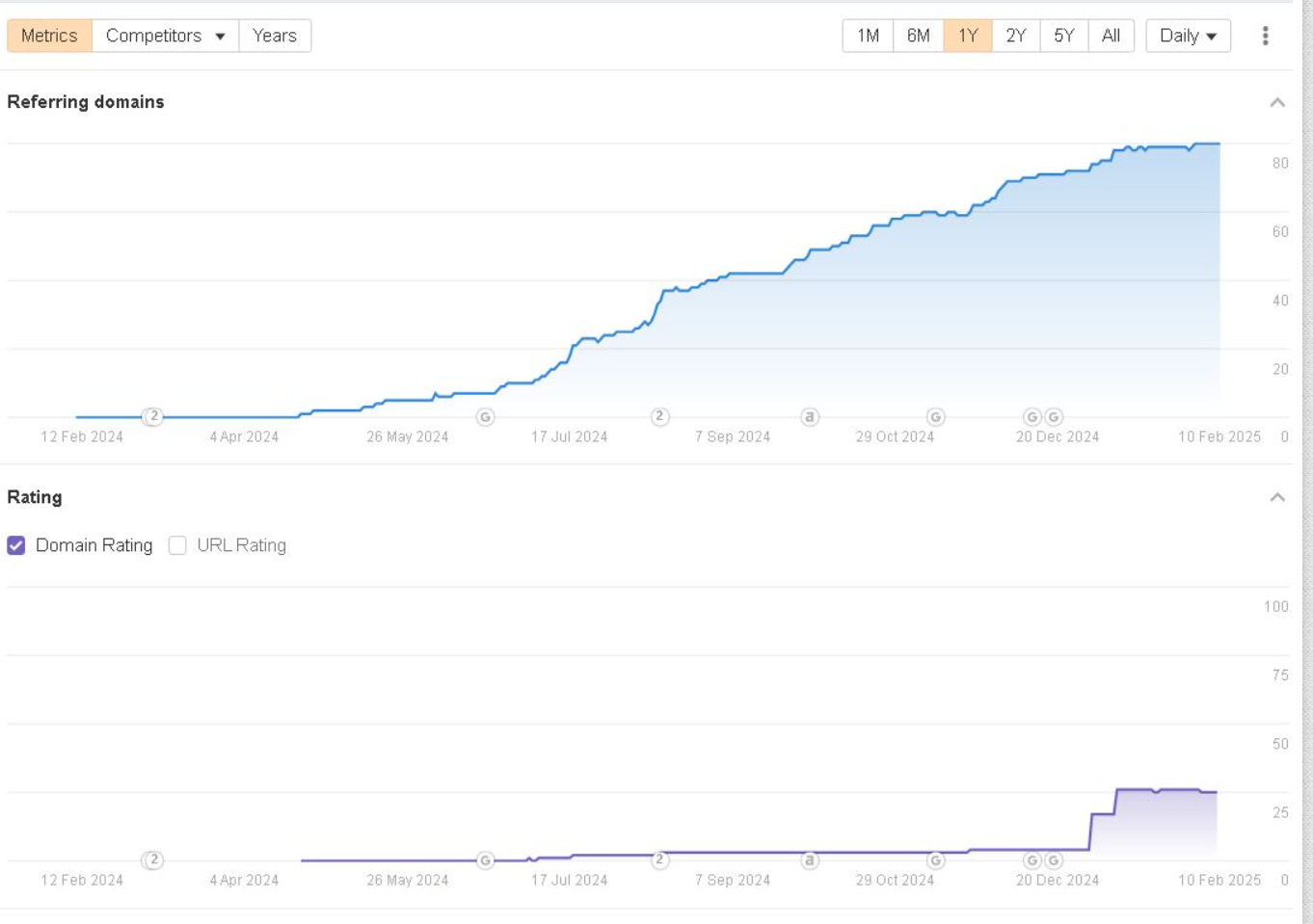
Considering the niche specifics and the nature of the product, natural backlink growth was minimal, as users typically do not actively link to such a site on their own.
Visitor time on the website
The time a user spends on the site reflects their level of interest and engagement with the content: the longer a user stays on a page, the more signals search engines receive about the relevance and quality of that content. This can positively influence the site’s search rankings, as Google aims to show results that meet users’ needs. Additionally, analyzing this metric helps identify issues with user retention, improve content, and increase conversions. Analyzing the average session duration graph, we can see that at the beginning of the period (June 2024), there were fluctuations with relatively high values. Later, the average duration gradually decreased and stabilized, while still showing periodic spikes. During other periods, the time spent on the site remains moderate.
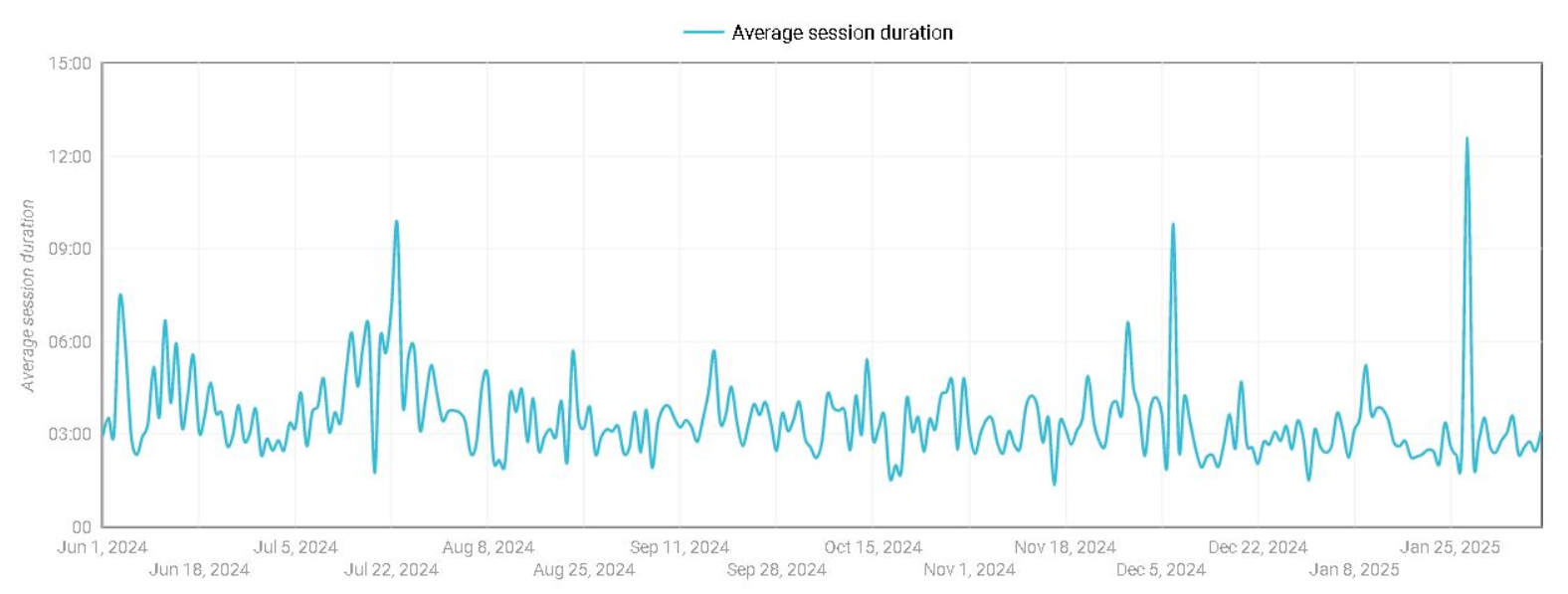
The overall session duration fluctuates, but there is no clear stable growth or decline. This may indicate that various events, content updates, and our SEO activities influence user behavior.
Number of events
From June 2024 to January 2025, the total number of events shows an overall upward trend. This means that users are becoming more active on the site and performing more actions (such as clicks, scrolls, navigations, etc.).
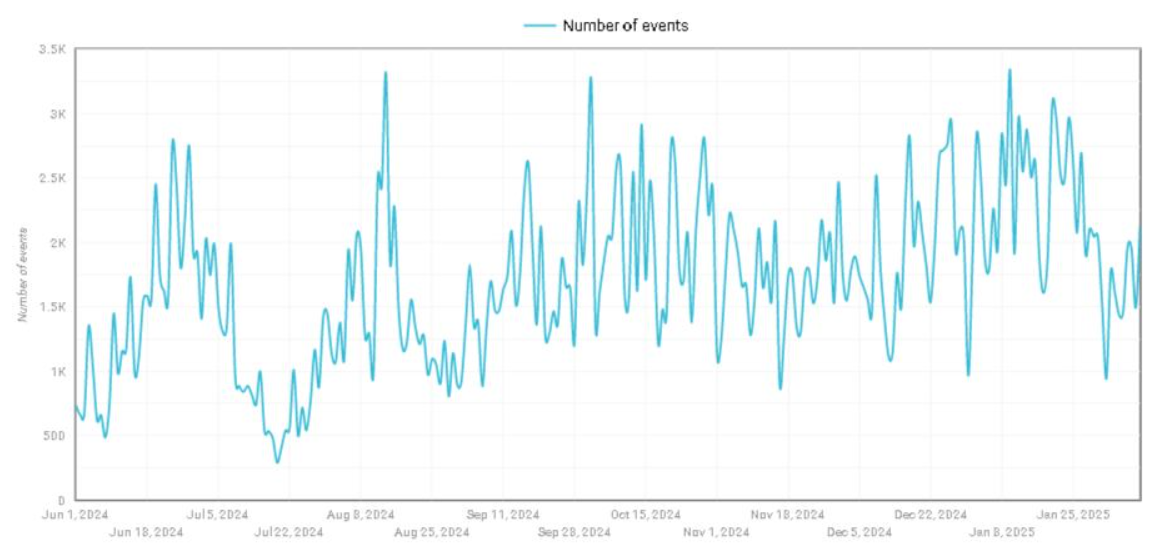
At the beginning of the promotion, the number of events was relatively low, followed by a gradual increase. From August to October 2024, we see a sharp rise in event volume, reaching its peak in October. In November–December, the number of events decreases slightly but remains higher than at the start of the period. The spike in events at the end of December and early January may be related to holidays, sales, or other external factors.
Comparing both screenshots, the “Time on site” graph shows that peaks in traffic often coincide with peaks in user activity. After these spikes, a decline is observed, a typical pattern in which user retention temporarily drops after significant increases driven by advertising activity.
Overall, the dynamics are positive: the number of events increases over time, indicating that users interact with the site more actively. At the same time, the average session duration does not decline and follows a similar upward trend. This means the site is attracting more users and encouraging their activity.
Semantic core
During our cooperation, we achieved significant progress across multiple keyword clusters for the client’s website. Below is an example for a priority category of a specific brand:

At the beginning of our work, the site had zero positions in search results because none of its pages were indexed. Now we observe positive dynamics: some queries have entered the TOP-1, TOP-10, and TOP-100 search results, which indicates substantial progress in promoting the site for the client’s priority keywords.
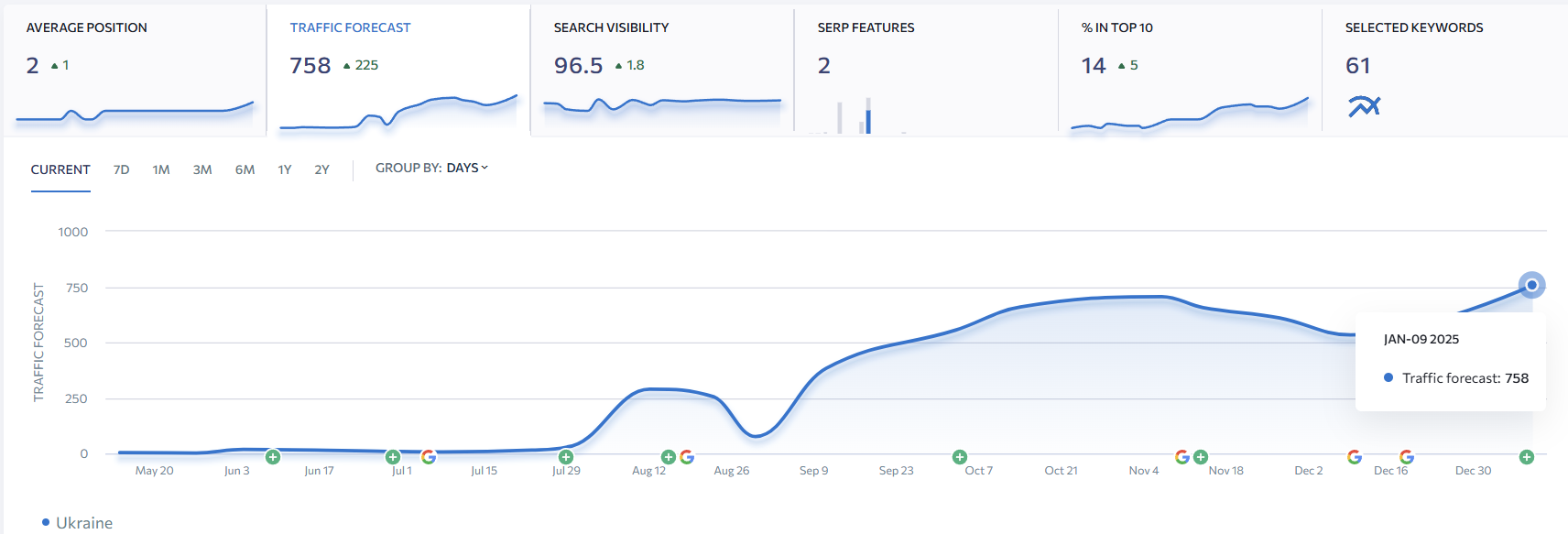
- 2 - the website’s average position in search results for priority queries (this corresponds to page 1 of search results);
- 758 - projected traffic for the site, indicating strong potential for user acquisition based on the existing semantic core;
- 96.5 - website visibility score in search (out of 100% visibility, the site appears in 96.5% of search results for priority queries);
- 2 - search elements (these are special Google SERP features detected in the results for the tracked keyword);
- 14% of keywords are in the TOP 10.
A portion of the content is already well indexed and meets search engine expectations. As the number of pages, external backlinks, and other SEO activities increases, the visibility score will continue to grow. At the current stage, the site demonstrates initial but promising visibility indicators in search engines.
Distribution of keywords in TOP results:
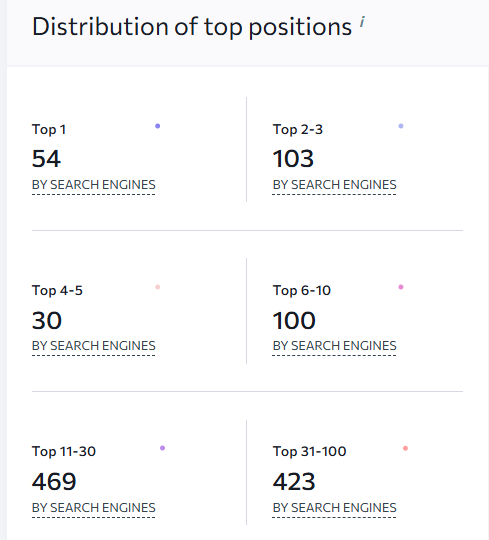
- 54 queries rank first in search (for 54 queries, the client’s site appears as the top result on the first page);
- 103 queries are in positions 2-3 on the first page of Google search results;
- 100 queries fall within positions 6-10 (still the first page of Google);
- 423 queries are within the TOP 100.
This is significant progress, as none of these keywords previously appeared in the search results. This means we successfully optimized the website content and acquired high-quality backlinks. It also indicates that many queries are now on the first page of Google (TOP 10), which substantially increases CTR. The number of queries in TOP 3 and TOP 10 shows that the site has strong potential to attract even more traffic.
Search traffic
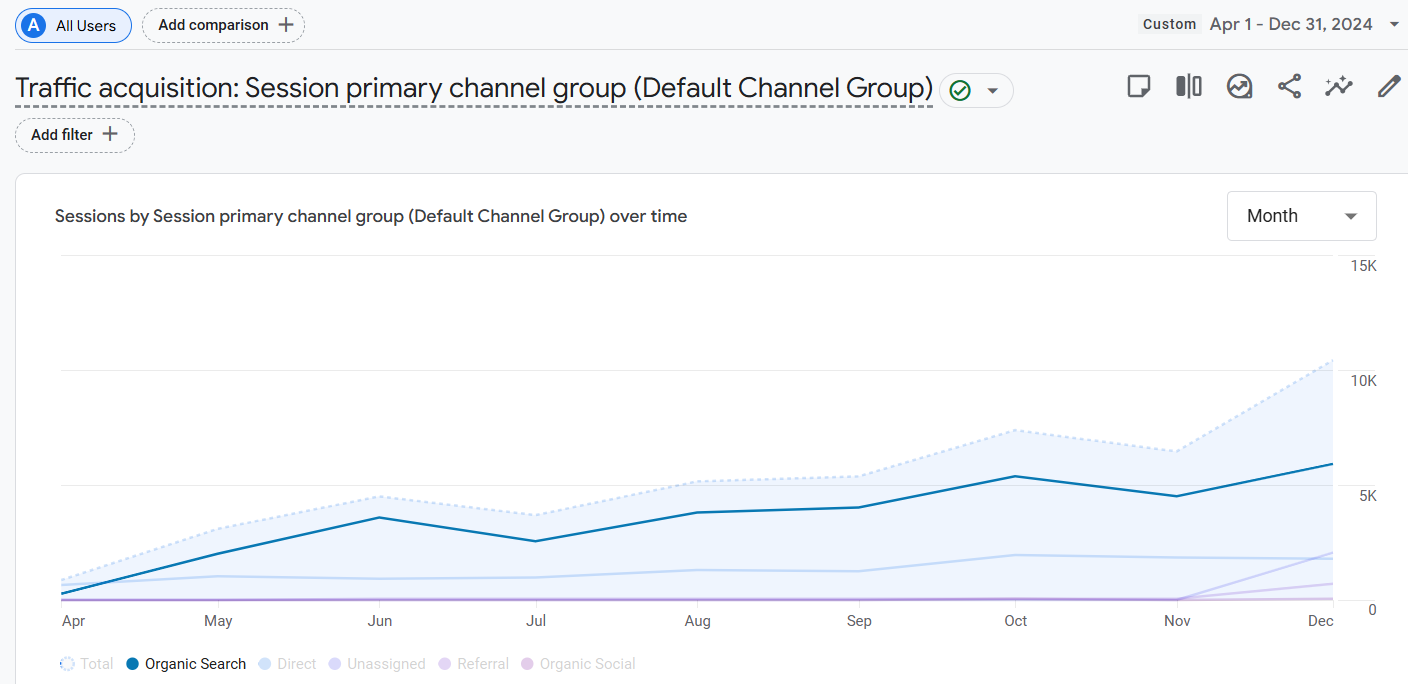
We observe a gradual increase in traffic: in June 2024, the first significant growth occurred, followed by a decline, which is completely typical for new websites. In autumn 2024, traffic remained relatively stable with minor fluctuations. At the end of 2024 (November-December), traffic rose sharply, reaching peak levels in January 2025.
Total traffic for the period April 2024 - December 2024:


The increase in organic traffic on the site indicates the effectiveness of SEO efforts aimed at attracting a new audience.
- 68,12% of visits come from organic traffic;
- 12,2 is the number of events per visit;
- 1,13 minutes is the average time spent on the site;
- 66,72% of key events come from organic sessions.
Organic traffic is the main source of website performance in terms of both visits (68.12%) and key events (66.72%). This indicates that the website offers high quality for visitors and that users are genuinely interested in its content. Visitors find the information they need quickly, as reflected in the average time spent on the site.
On average, a user performs 12.2 events per visit, and two-thirds of all target interactions (66.7%) come from organic traffic. This underscores the importance of SEO as a stable and productive tool for attracting a high-quality audience that actively engages with the site. The total number of visits is gradually increasing.
Overall dynamics are positive - the site continues to attract more users each day, which is the primary task of SEO promotion.