




The Evakuator24 project started with a basic problem: conversions weren't being tracked, and the budget was being spent on ineffective advertising. To fix this, we built a reliable web analytics setup with Binotel call tracking, restructured the campaigns by geography and ran a series of automated bidding strategy tests. The result is a manageable lead generation system that delivered a multifold increase in orders and a significant drop in their cost, with the budget almost unchanged.
Client
Evakuator24 provides a full range of towing services for all kinds of vehicles, including cars (sedans, hatchbacks, electric vehicles, crossovers and premium cars), SUVs, as well as minibuses, commercial vehicles and motorcycles. The company also tows trucks and special machinery (including tractors and forklifts) using specialised equipment – crane tow trucks and flatbed trucks with hydraulic platforms.
Advantages and USPs:
- Price: from UAH 1,300.
- Response time: urgent dispatch within 10–20 minutes.
- Payment: cash and bank transfer.
- Official business: receipts and certificates of completed work are provided (the company works with legal entities).
- Fleet: modern tow trucks with winches, hydraulic platforms and equipment for complex loading (including pulling vehicles out of ditches).
The company also handles difficult and non-standard cases: transporting non-running vehicles, towing after accidents, pulling cars out of ditches and moving vehicles with locked wheels.
Our work
Google Ads scope: managing and optimising advertising campaigns.
The client's goal: attract the maximum possible volume of targeted traffic and increase the number of conversions.
Work started in September 2025. The client was already using Google Ads before we began. The account had one Search campaign, but no conversions had been recorded. Account performance before we started:
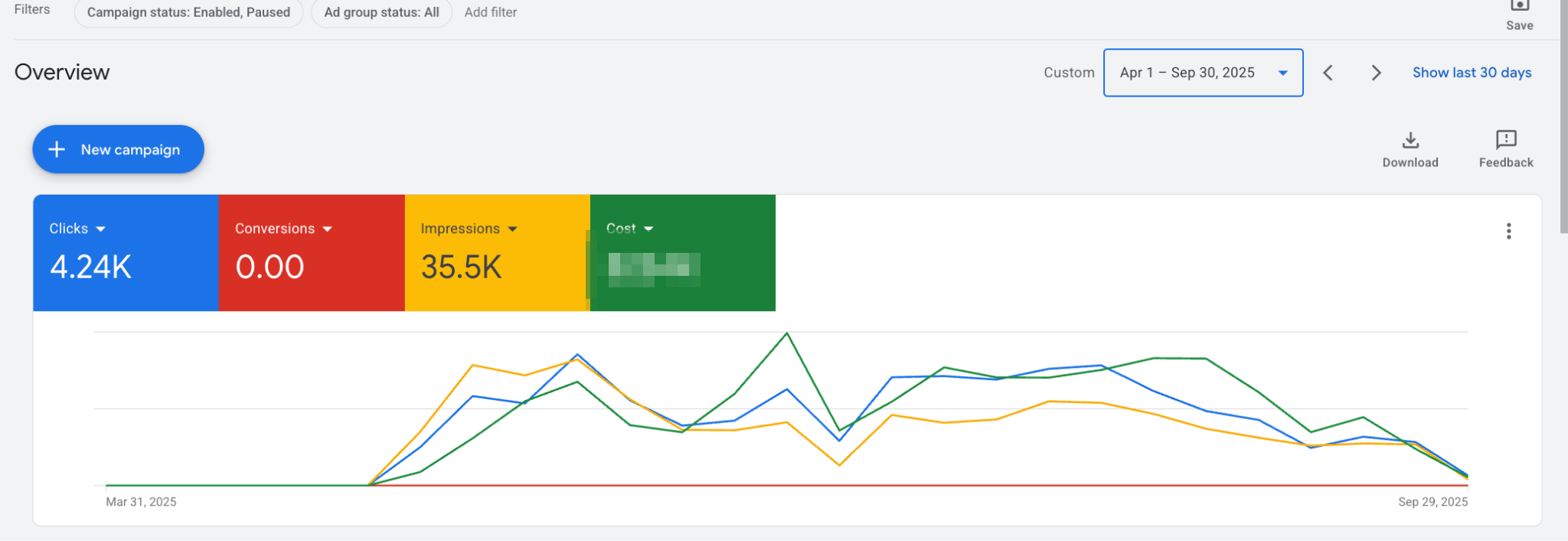
Despite the ad spend, the account recorded 0 conversions: Google Tag Manager and Google Analytics weren't set up on the site, and no goals were imported into Google Ads. Without data on target actions (calls, form submissions, messenger clicks), Google Ads couldn't learn or use automated bidding strategies. A significant ad budget was being spent blindly, with no understanding of the real cost of acquiring a customer or the return on advertising investment.
Account audit
Before starting, we audited the client's account. Audit findings:
Web analytics and conversion tracking
- No Google Analytics: neither Google Analytics nor Google Tag Manager was installed on the site (no tags found).
- Conversions not set up: the Ads account had no properly configured goals or conversions.
- No call tracking: since most orders in this niche are urgent, we strongly recommended connecting and configuring call tracking to collect real statistics.
Campaign settings
- Geotargeting: we recommended switching the targeting option to "Presence" (people who are physically in the target location) to avoid wasting budget on users outside the region.
- Audiences: add audiences in "Observation" mode (including those recommended by the system) to collect data and later use them as audience signals in Performance Max.
- Keywords: expand the keyword list based on converting search terms and add Ukrainian-language keywords.
Ads and assets
- Assets: we recommended adding all available asset types (structured snippets, callouts, promotions).
- Currency in prices: fix the error in the price asset.
- Headlines: add new headlines with compelling USPs and pin 3–4 keyword headlines to position 1.
Preparation before launch
- Analytics and tracking: we created GTM and GA4 accounts, linked them to Google Ads and set up conversion imports (phone number clicks, messenger clicks and form submissions).
- Keywords and ads: we expanded the keyword list with Ukrainian-language queries, added negative keywords, set up assets, fixed the currency in prices and pinned key headlines.
- Campaign settings: we set "Presence" geotargeting, added audiences in "Observation" mode and set up an ad schedule.
Google Ads covers all of the client's towing services and runs on 2 campaign types – Search and Performance Max. Ads are shown on mobile and desktop every day according to an agreed schedule. Geotargeting covers the city of Kharkiv and a 50 km radius around it, including towns such as Chuhuiv, Derhachi, Merefa, Pervomaiskyi, Zmiiv, Vovchansk, Valky and Barvinkove.
About 95% of enquiries come in as direct phone calls. So the focus was on accurate call tracking (Binotel/GetCall) and optimising campaigns for calls. Because towing is an emergency service, customers tend to call the first ad they see. The overheated auction required tight CPC control, filtering out irrelevant traffic and improving ad quality to keep the cost per lead at an optimal level. To maintain a constant presence in the top positions, we tested the Target Impression Share strategy.
Goals and KPIs
- Main goal: attract the maximum possible volume of targeted traffic and capture target demand within the allocated budget.
- Conversion volume: maintain and gradually improve results at no fewer than 100–115 conversions per month (at the current budget).
- Cost per conversion: maintain or improve.
Advertising performance is assessed within a range rather than against a fixed number, because demand for towing fluctuates seasonally and naturally (weather, accident rates, road conditions).
Call tracking and conversion tracking setup
In the first week, we set up Binotel call tracking and conversion tracking. The conversion goals in the Search campaigns were form submissions (callback requests) and calls (Binotel Call Received).
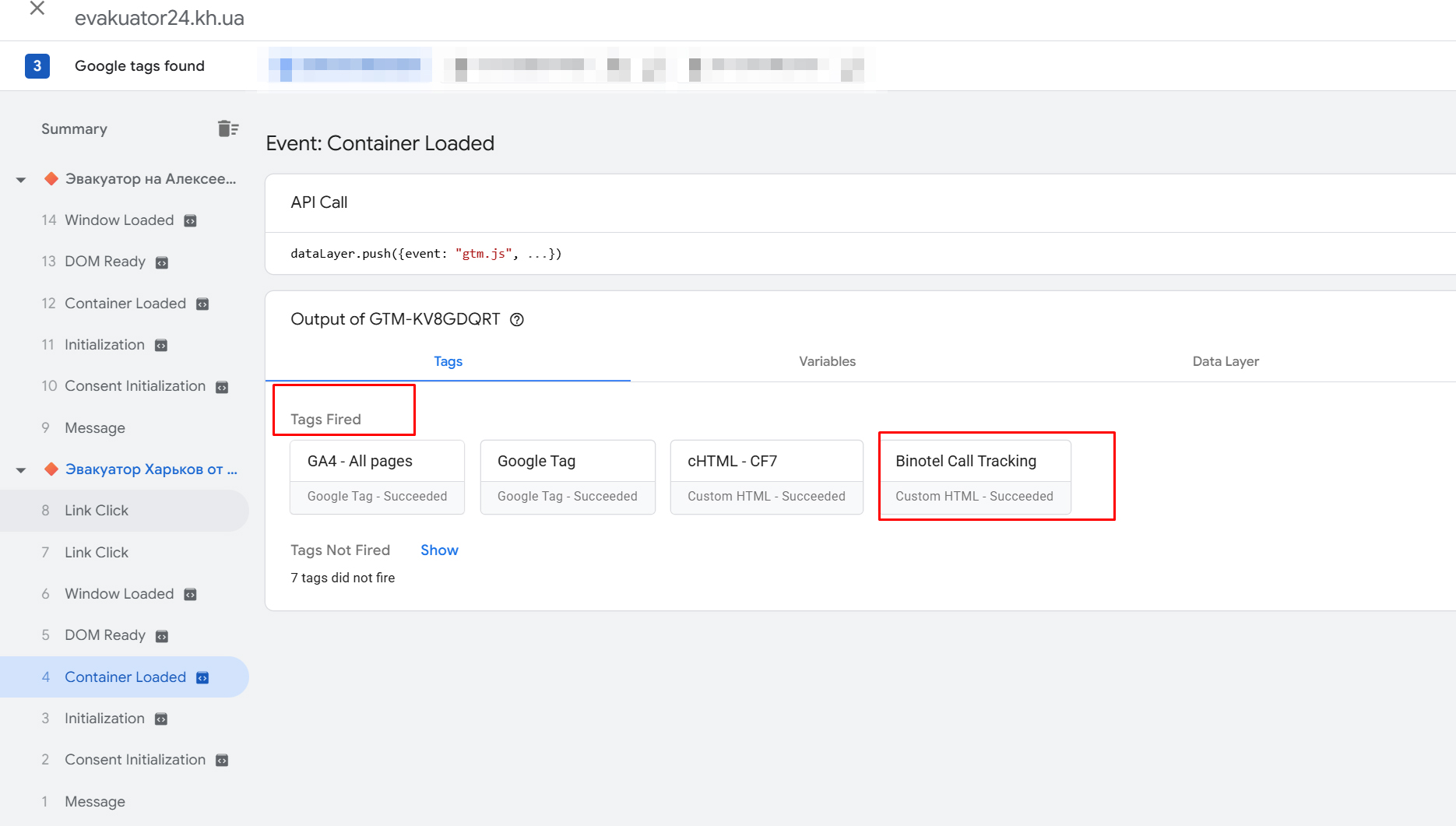
After the setup, we found a problem: there was no Binotel data, and number substitution on the site wasn't working. The GTM tag was firing correctly, so the issue was on Binotel's side, and we passed it on to the client to resolve.
In October 2025 we launched a test local campaign for Kharkiv. The next step was an experiment with the "Absolute top of page" Target Impression Share strategy. Budget split between the existing campaigns: 50/50.
Optimising campaign structure and geography
We found that the cost per conversion in the region was twice as high as in Kharkiv. We suggested splitting the campaigns into two separate areas: Kharkiv and the Kharkiv region. The experimental campaign was kept for Kharkiv only.
Tracking setup and conversion corrections
In November, to avoid double-counting goals, we removed the click_phone and binotel_ct_call_details conversions from the "Primary" category. We also found that events from Binotel's GetCall widget weren't being tracked in Google Analytics. We got instructions from Binotel support and successfully set up the GetCall event to be passed as a conversion.
New campaign types and Google Business Profile
Next, we registered a Google Business Profile on the client's work email. We then created and set up a test Local PMax campaign for Kharkiv focused on the "Calls" goal. We changed the ad schedule to 08:00–20:00. Over the New Year holidays, the campaigns were paused until 1 January inclusive and relaunched on 2 January. In January 2026 we also stopped showing ads on Sundays.
Budget allocation, priorities and experiments (Kharkiv and the region)
In February 2026 we ran a test with the automated "Maximize conversions" strategy for the regional campaign (50/50 budget split). Later, the priority shifted to Kharkiv (with a bigger budget), since trips out to the region were inconvenient for the client. The strategy experiment was then moved to the Kharkiv campaign, while the regional campaign kept the existing 50/50 split with a fixed, reduced budget.
Soon after, we launched an experiment testing the "Maximize conversions" strategy. Over the whole experiment, the test campaign brought in 50 conversions at an average cost of UAH 224, while the original (base) campaign got 56 conversions over the same period at a lower cost of UAH 193 per conversion.

Although the last 7 days showed a positive trend – conversions up 8% and their cost down 5% – the overall results didn't favour the new strategy, so we stopped the experiment. After 2 weeks of testing, the new strategy performed worse than the campaign's original settings. We also updated the ad schedule: ads ran every day except Sunday, from 07:00 to 19:00.
Analysing a performance dip (27 March – 6 April)
The client reported fewer calls. An initial review of the account showed a drop in clicks while impressions stayed at the same level.
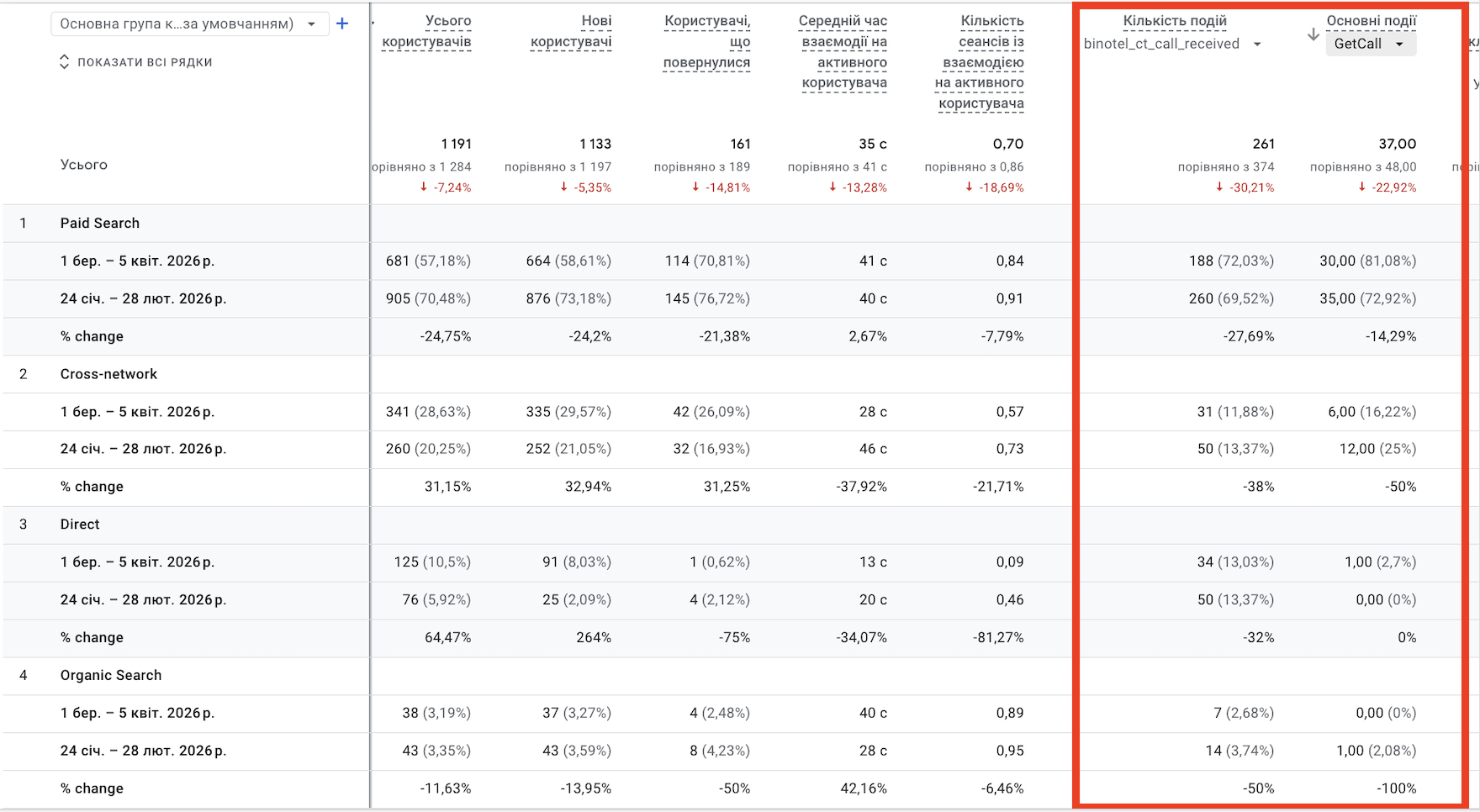
We found a general dip across all marketing channels caused by lower search traffic. Search impressions fell because of an overall decrease in market demand, while Search Impression Share (Search Impr. Share) stayed the same.
Later, the client again reported fewer orders. A check of the metrics showed a low share of impressions in the top position, so we needed to raise bids or change the bidding strategy for the Kharkiv campaigns. On 15 April we applied an experiment with a target cost per acquisition (tCPA) and launched an additional experiment with the Target Impression Share strategy for the Kharkiv region.

On 22 April we switched ads to a daily schedule (07:00–19:00), added the "Click to WhatsApp" asset, increased the Kharkiv budget and went back to the "Maximize clicks" strategy. After a series of CPC tests (from raising the bid limit and removing it completely to limiting it again because CPA was rising), we launched an experiment with Target Impression Share. We also cleaned up the keywords and added negative keywords. The May analysis showed that the Target Impression Share test campaign brought fewer conversions but had lower spend and a better CPA. Despite a slight increase in cost per conversion at the end of the month, we kept the campaign running for further monitoring.
Change of strategy
In June, the client asked us to get the maximum number of conversions, even if their cost went up. We agreed to increase the local campaign budget so that the Search ads were constantly in the top position and potential customers would call our client first.
New experiments (July)
In July the number of conversions fell by about 30%. After discussing it as a team, we decided to maximise the absolute top impression rate. For the "ITF - Search Область" (Kharkiv region) campaign, we launched a new experiment with the "Max Conversions" strategy and a higher budget to reach the top position (there was room to grow, since the current daily budget wasn't being fully used). We stopped the previous, ineffective experiment. For the "ITF - Search Харьков" (Kharkiv) campaign, we raised the maximum CPC. We are now monitoring the performance of these campaigns.
In August we agreed new KPIs with the client. Planned steps to reach the goals:
- Testing new campaign settings and strategies.
- Reducing lost impression share due to rank and budget.
- Analysing the performance of regions, ad times and other segments, followed by optimisation.
- Reallocating budget to the most effective campaigns.
- Analysing how traffic is distributed across PMax channels.
- Testing new audience signals in PMax.


Full list of account work
Optimisation and keyword work
- Regular search term analysis: adding relevant terms to the keyword list and irrelevant ones to negative keywords.
- Pausing ineffective and expensive keywords.
- Adding search themes to Performance Max campaigns.
Campaign structure and ad management
- Creating separate Search campaigns for the city of Kharkiv and the Kharkiv region.
- Adding new ad groups and asset groups (for the "truck towing" and "pre-booking" services).
- Creating and setting up a local PMax campaign and a separate PMax campaign for pre-booking.
- Pausing ineffective ad groups (including "ua - евакуатор") and the ITF - Local campaign (due to low efficiency).
- Improving ad quality, image assets and asset group quality in PMax.
- Adding the "Click to WhatsApp" asset.
- Enabling AI Max in the Search campaign.
Budgets, bidding strategies and experiments
- Regular adjustments to budgets and bidding strategies (including reducing budgets for "ITF - Search Область").
- Running and analysing experiments (Target Impr. Share, tCPA and Max Conversions strategies).
- Stopping ineffective experiments and applying the results of successful ones.
Targeting, audiences and geography
- Reviewing spend and excluding ineffective and irrelevant locations (including Chuhuiv for "ITF - Search Область").
- Adding audiences in observation mode.
- Setting up and updating audience signals in PMax (including search terms, competitors and geo lists).
- Analysing PMax placements and excluding irrelevant ones.
Ad schedule
- Regular adjustments to the ad schedule (24/7 mode, excluding Sundays, 08:00–20:00 and 07:00–19:00 time slots).
General maintenance and web analytics
- Reviewing Google Ads recommendations (applying relevant ones, dismissing irrelevant ones).
- Importing call tracking conversions into the ad account.
Google Ads results
January 2026 was the first fully stable period after the analytics fixes. The key technical work was completed in November–December: GetCall widget tracking from Binotel was connected, duplicate conversions were excluded and the Google Business Profile was registered. In December 2025 we also launched a test Local PMax campaign and changed the geographic structure. So to assess ad performance, we compare January 2026 with December 2025.
January 2026 results
Period: 01.01.2026–31.01.2026:
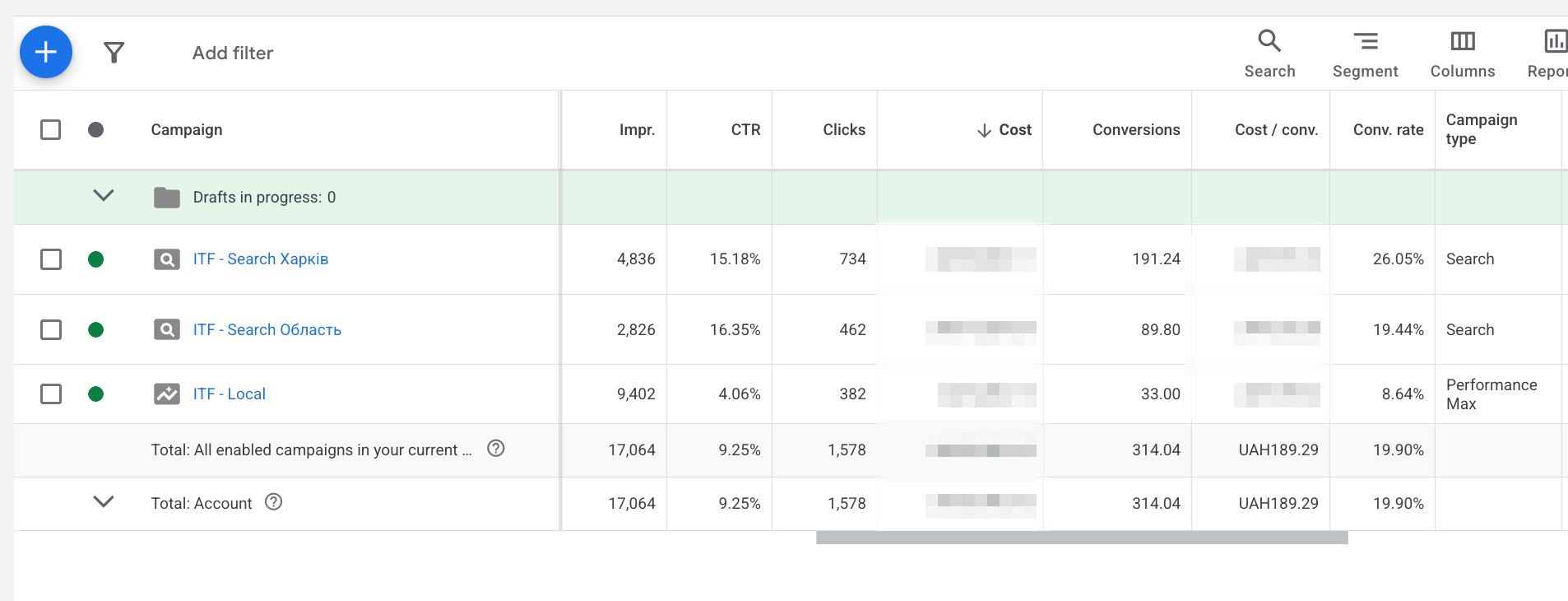
- 314.04 conversions;
- UAH 189.29 average cost per conversion;
- 19.90% conversion rate;
- 1,578 clicks from 17,064 impressions (average CTR 9.25%).
Every fifth visit to the site ends with a target action (average conversion rate 19.9%), which shows well-targeted keywords and relevant landing pages. The ITF - Local (PMax) campaign has the lowest cost per conversion (UAH 129.84). ITF - Search Kharkiv remains the main driver of lead generation, with a high conversion rate (26.05%).
Compared with December 2025
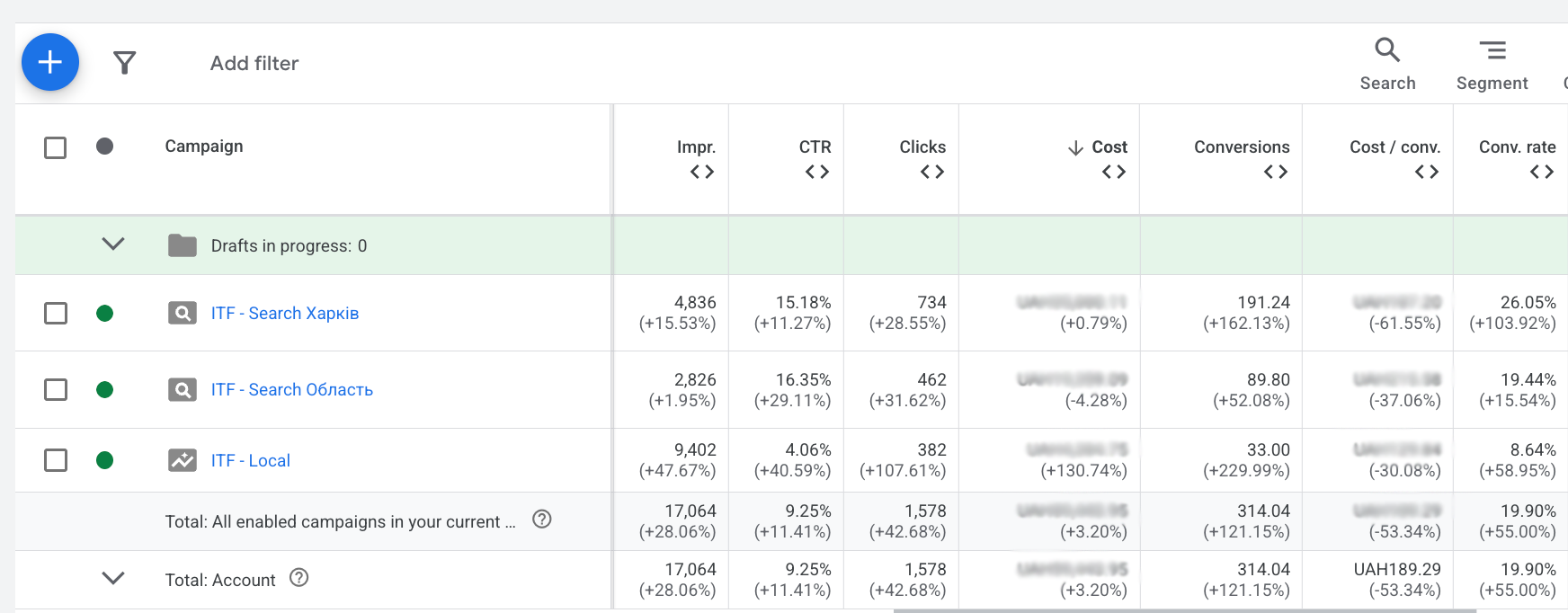
Conversions: +121.15% (from 142 to 314.04 leads).
Cost per conversion: −53.34% (more than halved, from UAH 405.68 to UAH 189.29).
Conversion rate: +55.00% (up from 12.84% to 19.90%).
Traffic and CTR:
- Impressions: +28.06% (17,064 impressions).
- Clicks: +42.68% (1,578 clicks).
- CTR: +11.41% (up to 9.25%).
Ad spend rose by just 3.2%.
The optimisation work (keyword cleanup, bidding strategies and ad scheduling) delivered 2.2 times more conversions (314 vs 142) at practically the same spend (+3.2% budget), and cut the cost of each lead by 53.3%. Spend in the two months was almost identical (UAH 59.4k in January vs UAH 57.6k in December), so the efficiency gain and the 53.3% lower CPA came without any effect from scaling the budget.
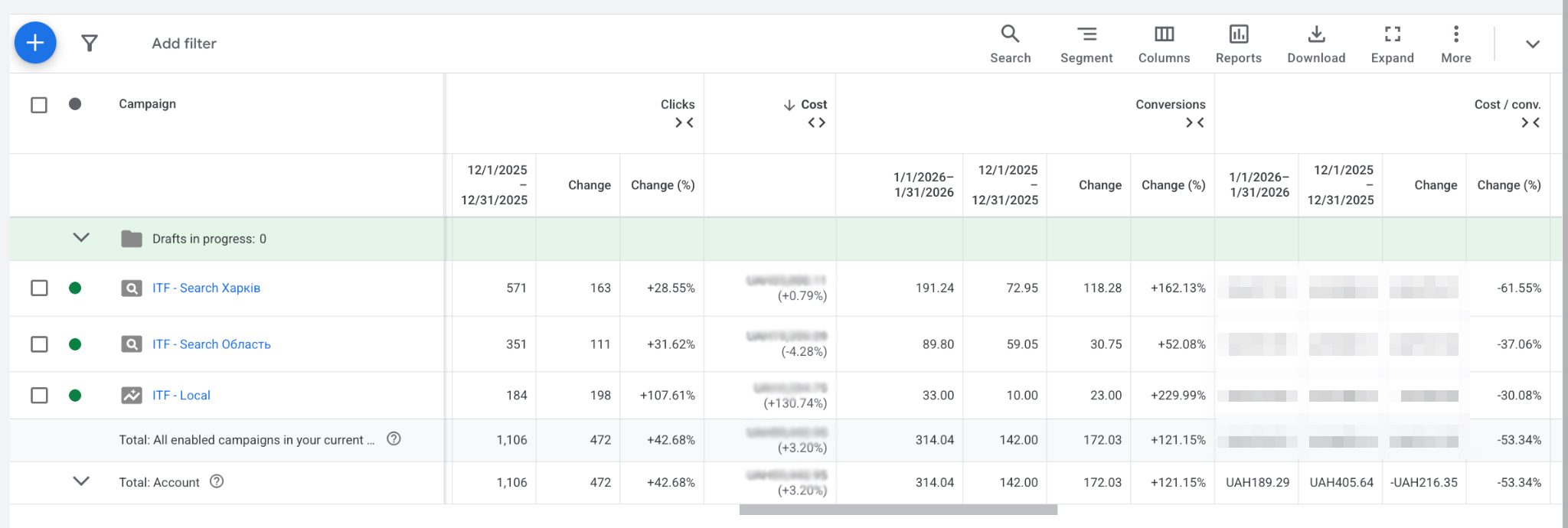
The ITF - Search Kharkiv campaign was the main growth driver, adding 118.28 conversions and cutting the cost per lead by 61.55%. The ITF - Local campaign delivered the cheapest conversions (UAH 129.84) and the highest relative growth in orders (+229.99%).
The client's goals were met on the key performance metrics:
- Targeted clicks grew by 42.68%, and CTR rose from 8.30% to 9.25%, confirming higher engagement from the relevant audience.
- Target actions (calls, form submissions and messenger enquiries) grew by 121.15% (from 142 to 314.04 conversions per month).
- The cost per lead fell by 53.34% (from UAH 405.68 to UAH 189.29) without increasing the ad budget (spend rose by only 3.20%).
We continue to work with the client, regularly optimising the campaigns to achieve the best possible performance.