

After a successful collaboration in the Ukrainian market, the client came back to us, this time to enter and scale in European markets.
Initial campaign setup for Europe
The main goals were:
- purchases;
- qualified traffic to the website;
- brand awareness.
We also planned a separate campaign for Ukrainians living in Europe (with a focus on promo codes), as this audience generated a large share of orders. Ads ran 24/7 on mobile and desktop, and the budget was flexible.
The campaigns targeted Germany and Europe as a whole. Targeting for Ukrainians abroad covered four key countries: Germany, Poland, the Czech Republic and Spain. Later we set up a separate ad account for Germany. The retargeting campaign used the Purchase objective with a product catalogue.
At a call in February we agreed on the following:
- Product visuals: banners should show what each product is for.
- Promo banners should carry less text, with bigger visual emphasis on discounts.
- Trust and recognition: we planned brand awareness ads with videos from the production facility.
With the budget too small for such a wide geography, the older campaigns stalled, so we switched off all inactive ones. For scaling we kept the two Sales campaigns with the most potential: ITF_продаж_товари (Germany) and ITF_продаж_укр (Europe). Scaling was to be done step by step.
In the German campaign (ITF_продаж_товари) we removed unnecessary interests to broaden the audience and raised the budget. For the campaign aimed at Ukrainians in Europe (ITF_продаж_укр) we agreed a higher budget and narrowed the geography to Germany, Poland, the Czech Republic and Spain, switching off the other countries. We also sent the client a new campaign with a fresh video under the Brand Awareness objective for approval.
In March 2024, due to a lack of conversions and creative fatigue, we proposed pausing three campaigns:
- ITF Європа (Ukrainian audience) cart
- ITF_продаж_товари (Germany)
- ITF_німеччина_трафік
Only ITF_video_traffic (with the video) remained active, running under the Engagement objective from 19 March.
In March we also switched to an "audience → product" strategy. With more than 300 products in the catalogue, it proved more effective to define an audience segment and its needs first, and only then offer relevant, related products to increase conversion.
Campaign structure for April. Four campaigns stayed active: one for awareness and three for sales.
Campaign for Ukrainians in Europe. We split the campaign into ad sets by country. Each country got two ads for priority products, with links to the site in the matching language.
In April the pixel setup for the German account became an issue. At that point there was only one pixel, linked to the Ukrainian account, which blocked Sales campaigns for Germany. A new pixel was installed, but the client's technical team had to check it again: it turned out the old pixel had been integrated by mistake instead of the new one.
We then also needed to adjust conversion event tracking. Since this could not be done through Facebook's standard interface (the conversion buttons were not highlighted), we brought in a developer. He added events for the product page and the buy button in code and also recommended:
- Replacing the old pixel with the new one directly in the Facebook app settings (to pass extended events).
- Changing the data level (Match Quality) from Enhanced to Maximum to expand optimisation parameters.
All technical tasks and recommendations were handed over to the client's team.
Later, the ITF_purchase_sport campaign and the women's product line were moved to automated Advantage+ settings. In the end we decided against entering the UK market. Instead we launched Austria (Vienna and surroundings), focusing on the multilingual site: first for awareness, then for purchases. Germany remained a focus. We added Switzerland and later the Netherlands, France and Italy. We agreed a total daily budget and set a target cost per purchase (CPA). We revised banners that had not passed Facebook review and optimised the campaigns by replacing expensive, unprofitable items. To expand the geography, a Lithuanian version of the site was added, and we decided to test Georgia with Awareness campaigns, as orders from there were growing.
Before the Christmas holidays, when demand drops, we cut all campaign budgets by 30%. The Czech campaign was switched off as it brought no purchases. The client also switched off the campaign for the Baltic states.
In January 2025 the budget was cut, sales fell and the cost per purchase (CPA) rose. To optimise spend, we proposed switching off the underperforming campaign for Poland and moving its budget to Germany: either splitting it between the two active campaigns (ITF_purchase_kreatin_germany and ITF_purchase_germany) or using it for dynamic catalogue retargeting. These proposals were sent to the client for discussion and approval. All ads that had not brought a single purchase were switched off. To improve performance, we decided to diversify the content format and create carousels combining banners and video.
In May 2025 Germany, Poland and the Czech Republic were set as the main markets to grow traffic and sales. Our task was to check the current campaigns (objectives, budgets, geography) and prepare a scaling strategy for the Czech Republic and Poland. The audit showed that the current campaigns should stay as they were. Of the new countries, only the Czech Republic was taken on. Retargeting for Germany was added to the plan for testing.
In July 2025 we decided to bring in a developer to check that purchase data was passed correctly from the site to the Facebook pixel. Retargeting for Germany was put on hold, but the "Vienna + 10 km" location was added to the main German sales campaign. Bratislava was added to the language-audience campaign, and the B2B direction stayed paused until late August or early September.
At the same time we relaunched the campaigns for the Baltic states (Israel was also added in July). We then launched a sales campaign in Poland using an Advantage+ audience in key cities (Kraków, Łódź, Warsaw, Gdańsk, Wrocław + 40 km) and the catalogue format.
For scaling, we agreed to add a lookalike (LAL) audience and launch an additional sales campaign (banners + video). In parallel we launched a campaign to grow followers and awareness of the Czech Instagram page. In the Baltic region we agreed to switch fully to English-language ads. The strategic focus for the quarter was set on three key markets: Germany, Poland and the Czech Republic.
Advertising recommendations agreed with the client's marketer
1. Budgets and quick decisions.
A number of less effective and traffic campaigns were stopped. The key conversion campaigns stayed in rotation.
2. Targeting, segmentation and geography.
Sports nutrition is a universal product, and a unisex approach is standard in Europe, so we decided not to split the audience by gender. According to Meta's report for the last quarter, women made up more than 40% of purchases in most campaigns, which confirmed that unisex banners were the right choice.
Advantage+ algorithms find buyers effectively on their own, and account analytics already show who is buying. Targeting is strictly limited by the language settings of users' devices.
3. Creatives, positioning and audience pain points
Ads focus on the product. We agreed to use emoji more sparingly. We asked the client for specific examples of briefs and criteria for future ad banners.
4. Tracking, analytics and metrics
The client's marketer planned to rely on the client's accounting data and the business's bottom-line return (ROI). We had no influence on the internal metrics he proposed, as our area of responsibility was limited to ad settings and ad results. All technical questions about ad account metrics were passed to the client's technical department.
Agreed goal for March 2026: reduce the cost per conversion in the Czech Republic.
For the halal products campaign, we planned to expand the geography to all of Germany for the 18–40 age group and add Arabic to the settings (if Meta's technical options allowed it). The campaign's daily budget was to be increased. In parallel we planned to launch a new Active audience, for which we were waiting for a product list from the client to prepare a brief and new creatives. After that we planned to relaunch the halal campaign with the newly agreed audience. Website visitors who had not made a purchase were added to the Abandoned Carts campaign. The "Neuropump" products were approved for rotation.
For the Czech Republic we proposed moving one step up the funnel and switching the objective from Purchase to Add to Cart for better optimisation.
Meanwhile, the client was testing promotion on TikTok. As of July 2025, the account audit showed four active campaigns:
- 1 campaign built to drive traffic;
- 2 campaigns aimed directly at conversions and sales (covering the Czech Republic and Germany);
- 1 campaign launched directly through TikTok or Shopify, so its settings were not accessible in the ad account.
1. Traffic campaign (Germany). The campaign performed well and its audience was well built. We recommended leaving the current ad as it was and scaling the campaign by adding new videos. The existing video bank was almost exhausted, so scaling required new videos for products not yet used in the campaign (without several videos for the same product). We sent this request to the client.
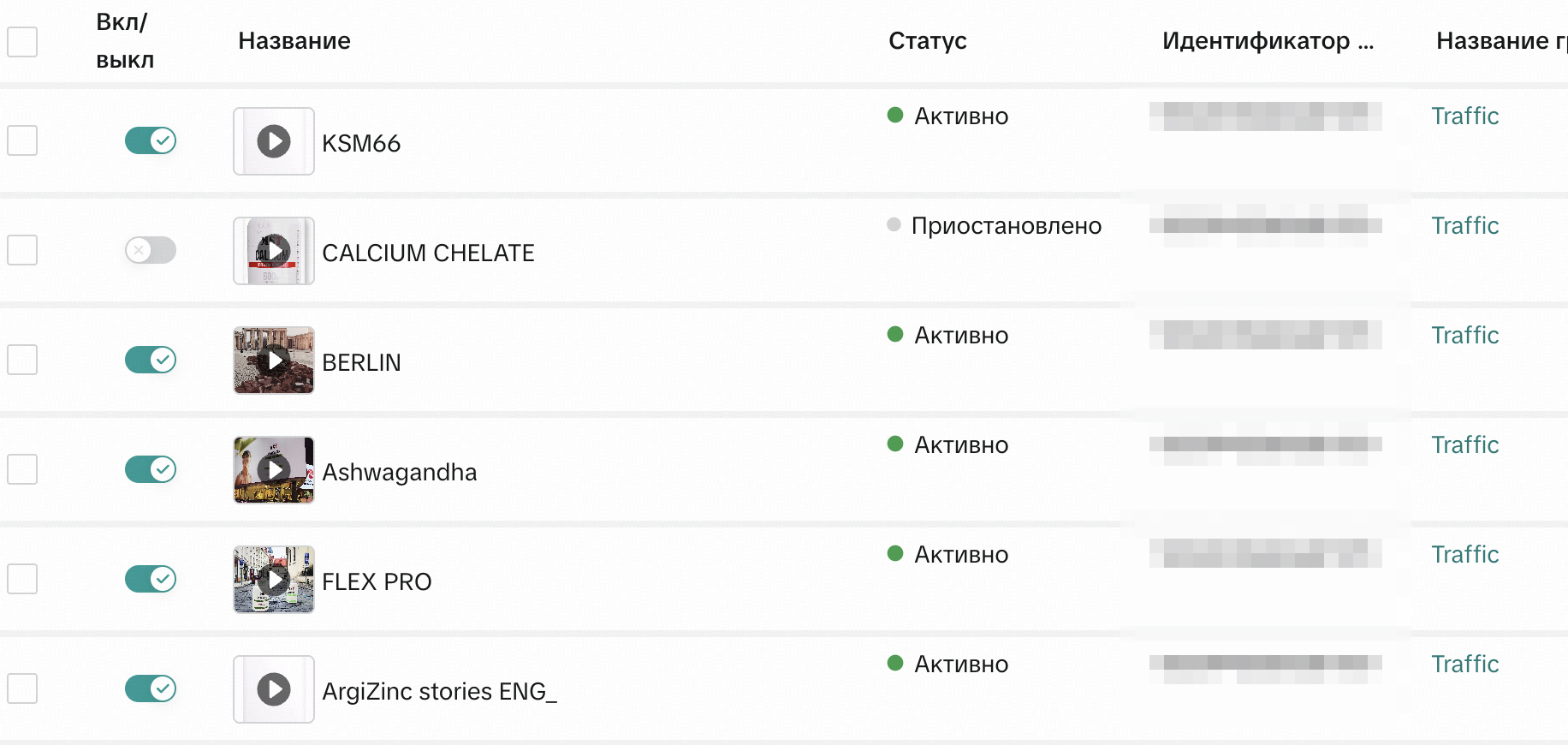
2. Sales DE campaign (Germany, Smart+). The campaign ran on the automated Smart+ audience, but we found an error in the ad: it used a Czech-language video. It had to be replaced as soon as possible with an existing German-language video. In parallel we planned a test: an additional sales campaign in Germany with a simple manually built audience instead of the automated one. New ads were to be added there as new video content became available.
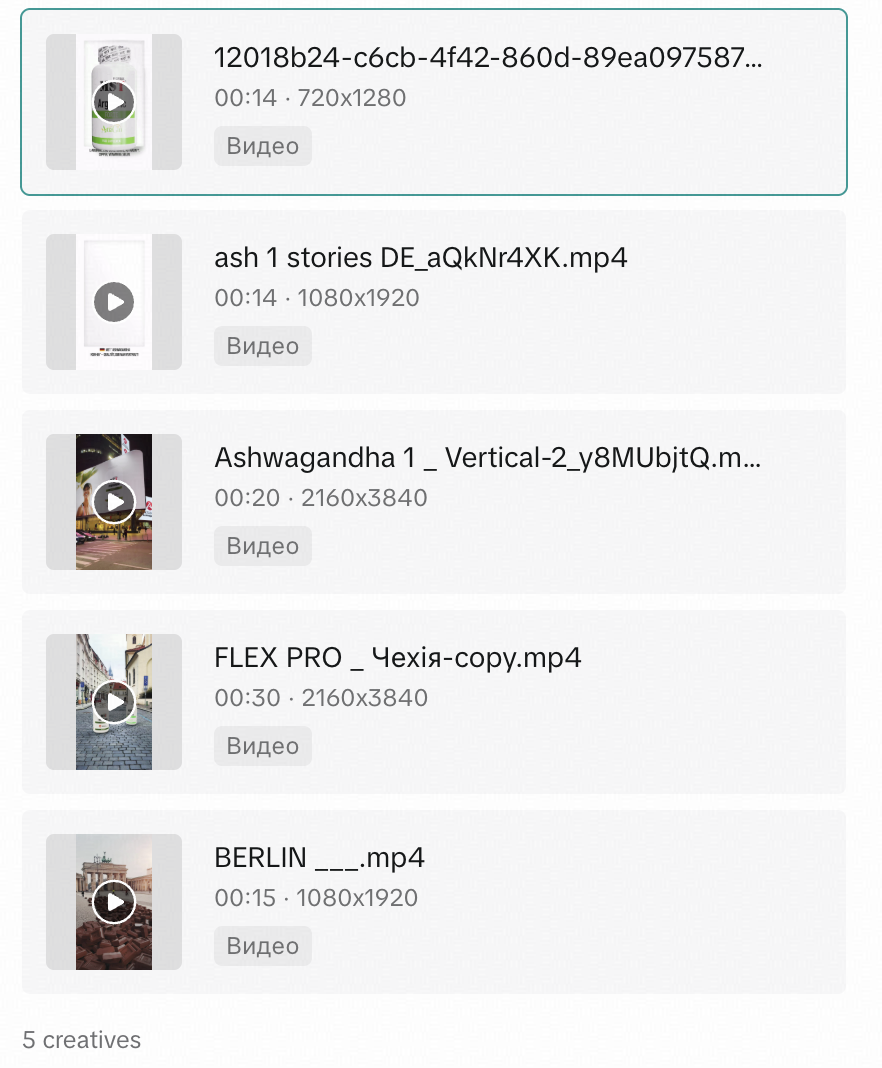
3. Sales CZ campaign (Czech Republic, Smart+). In this campaign, with the ads shown below, we found a language mismatch: most videos ran in German, which did not match the targeting. We recommended replacing all German-language ads with videos in Czech or Ukrainian, according to the audience settings. New products and videos were to be added to the campaign as soon as they appeared.


4. Promote campaign. Analytics and detailed settings for this campaign were not available, as it had been launched directly from the mobile app (via the Promote button) rather than from the ad account.
The requirement for new videos was not to overlay text directly on the footage. Without burned-in text, the videos could be used for targeting any country.
From June the client decided to run paid social with its own in-house team.
Paid social results
Let's look at the results of paid social for May 2026. We also compared them with April to assess the effect of optimisation, which took place during the low season for this niche.


- 15.88 – average ROAS (return on ad spend).
- 411 – total purchases.
- €7.71 – average cost per purchase (CPA).
- 1,370 – add-to-carts.
- 5,358 – link clicks.
- 277,592 – reach (unique users who saw the ads).
- 887,554 – impressions (total number of times the ads were shown). On average, each unique user saw the ads just over 3 times.
In health food and vitamins, customers often have a high LTV, so a first purchase at €7.71 is an excellent result. Every euro invested brings in almost 16 euros of revenue. One in four users who clicked was interested enough to add a product to the cart, and the cart-to-payment conversion rate is 30%. About 70% of users who added vitamins to the cart did not complete the purchase, which is normal for health products, as people often go off to read the ingredients or compare alternatives.
Two campaigns led in efficiency, delivering the highest return and the largest profit for the whole account. ITF_purchase_ukr/rus (pl) achieved a ROAS of 48.49 and the lowest cost per buyer (€3.97), while the product catalogue campaign in the Czech Republic (ITF_purchase_catalog_CZ) generated the highest value with a ROAS of 33.87. These two campaigns drove much of the account's commercial success in the reporting period.
The German direction showed high stability and balanced performance across all three campaigns. Together they brought 77 purchases, with the cost per acquisition (CPA) holding between €6.49 and €7.15.
Georgia
- ITF_purchase_GE: the campaign generated the most purchases – 116 – while keeping a good cost per purchase (€7.16).
- ITF_purchase_halal_ge: weaker performance – only 19 purchases at the highest cost in this category, €8.99.
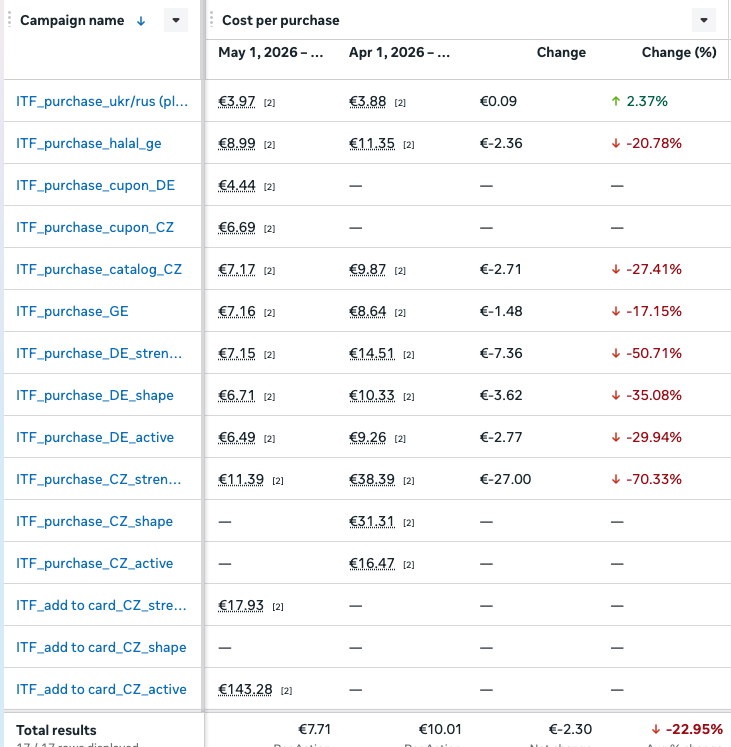
The overall trend is positive: despite the seasonal market decline, the average cost per purchase in the account fell by 22.95% (from €10.01 in April to €7.71 in May). Acquiring buyers became cheaper, which shows that the current campaigns were optimised successfully and the creatives improved.
The German direction showed the most consistent and even drop in acquisition cost. Optimising the three main campaigns cut the cost per conversion by 29.94% to 50.71%. The Czech campaign showed the best single optimisation result: a 70.33% drop in cost per purchase took it from deeply unprofitable to an acceptable €11.39. The Czech product catalogue campaign also improved (−27.41%). Coupon campaigns performed very well from the first days: the cost per purchase was only €4.44 in Germany and €6.69 in the Czech Republic, well below the May account average (€7.71).
The account updates and settings paid off: in almost all active markets (the Czech Republic, Germany, Georgia), buyers were acquired much more cheaply in May than in April. The only exceptions were test campaigns optimised for add to cart, which weigh on the account with an expensive cost per conversion.
TikTok results
Two campaigns were launched on 3 September, for the Czech Republic and Germany. ITF_Sales CZ performed poorly and brought no purchases. Over its lifetime it received 123,413 views (CPM €0.82) and 190 clicks (CPC €0.53). With no conversions, the campaign was switched off and its entire budget moved to Germany.
ITF_Sales DE kept running and showed positive results. We recorded 6 sales with an average cost per purchase (CPA) of €34.58. The campaign received 50,184 views (CPM €4.13) and 162 clicks (CPC €1.28).
Optimising ads in the German campaign
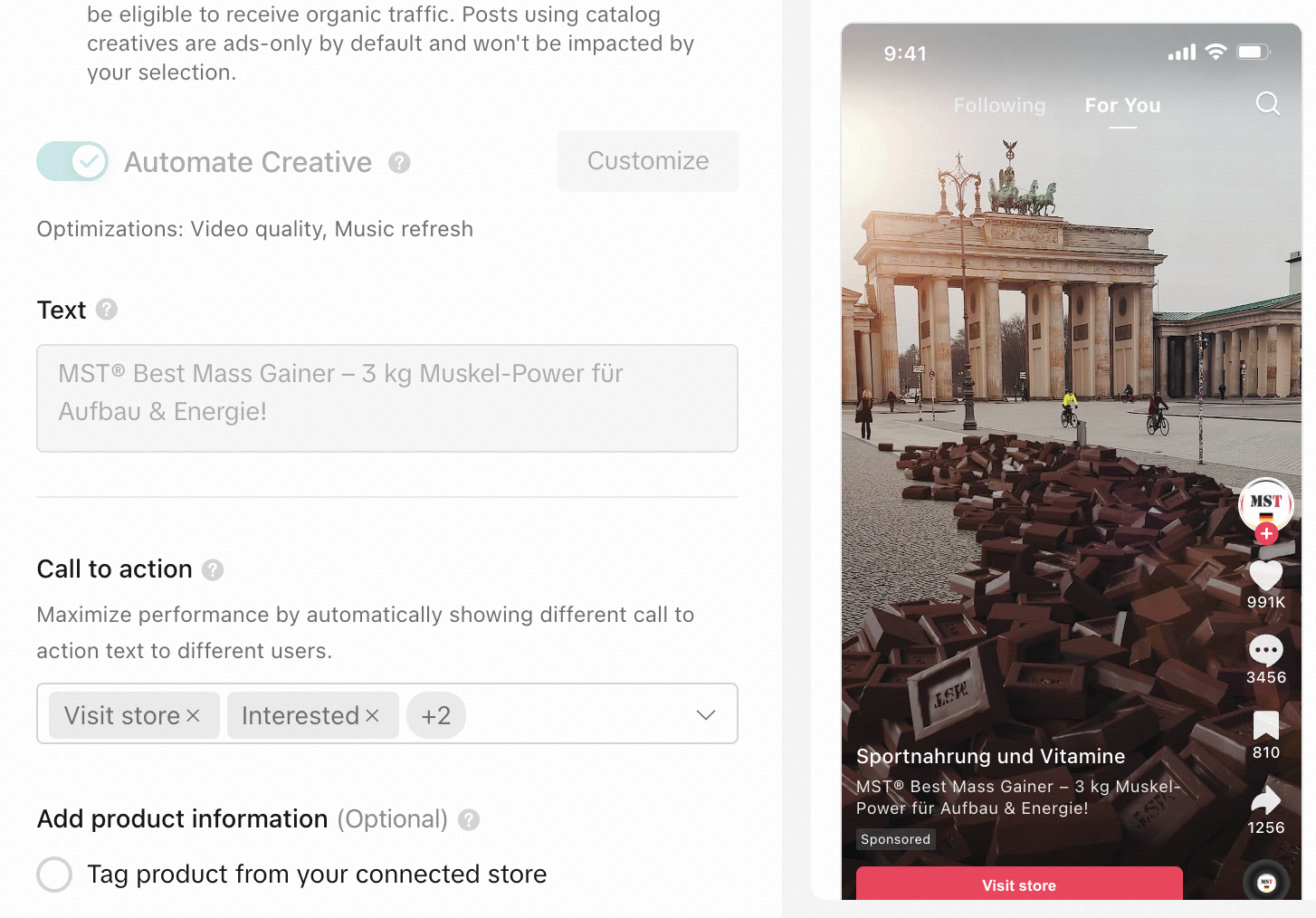
The German campaign initially ran two ads, and their performance was optimised. The ads were switched off because they brought no purchases.
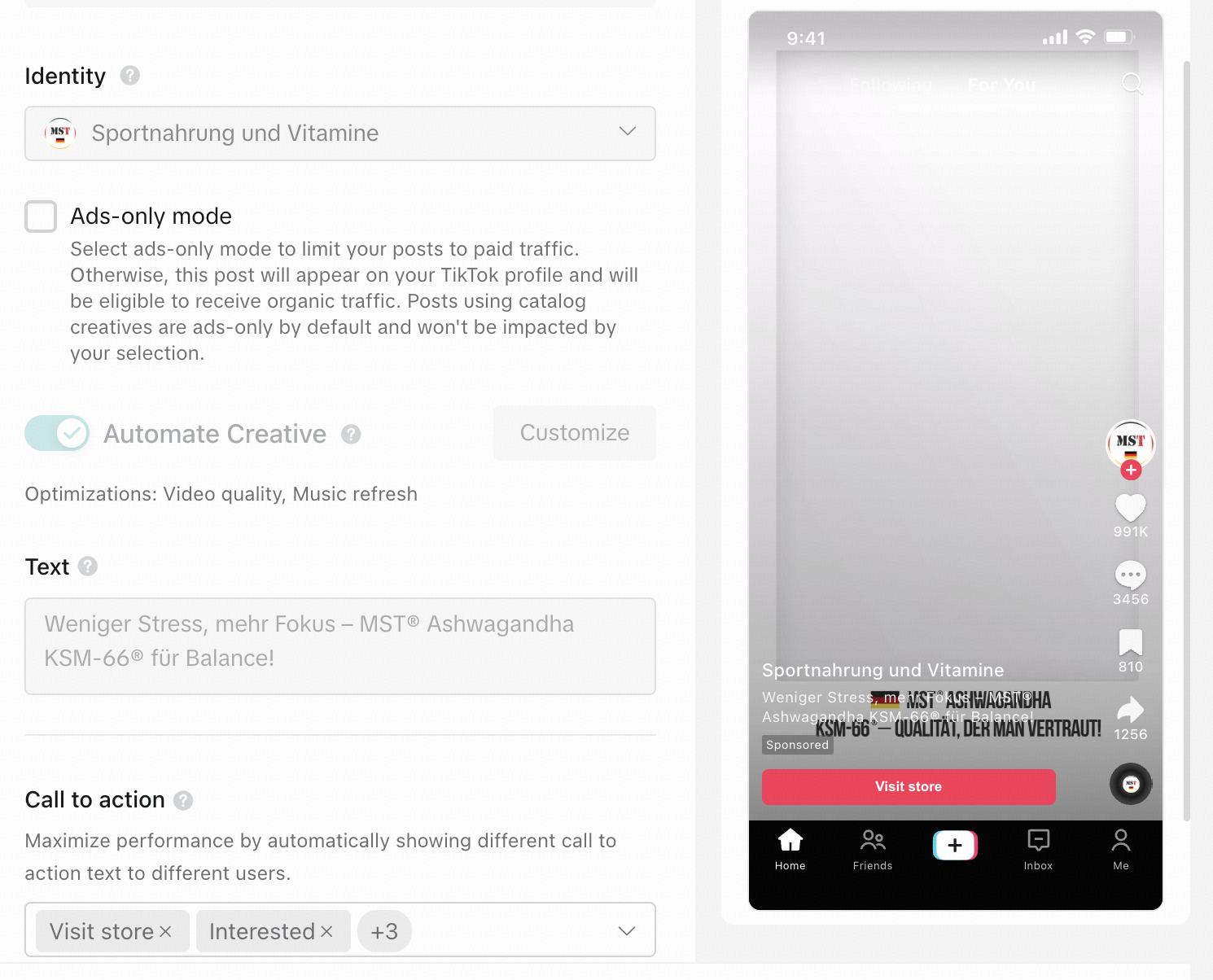
All work and budget were focused on the successful ad, which kept generating sales.
Overall, successful campaign optimisation and better creatives cut the average cost per purchase by 22.95% in May and delivered a high return (ROAS 1588%) despite the seasonal market decline.