



Previous work on ad setup and optimization for a refrigerator and refrigeration equipment repair service.
This case covers the period starting October 2023. The client's primary requirement is to maintain the cost per conversion (CPA) at or below $30.
The initial account work involved analyzing and adjusting bidding strategies and budgets to hit target metrics. In October 2023, we also encountered a Google My Business account suspension.
GMB reinstatement timeline:
1. Problem analysis and information gathering
- Profile suspension was documented. Reason stated by Google: "suspicious activity".
- Confirmed that access existed only to the FridgeFix profile.
- Information requests submitted to the client:
- Clarification on any recent changes made to profile descriptions.
- Verification of whether the client had submitted reinstatement requests independently (to avoid duplicate submissions).
- Campaign continuity discussion: it was proposed to keep active PMax campaigns driving traffic to the website, as these can continue running even with a suspended map listin.
2. Profile preparation and optimization (in line with Google's guidelines)
- The profile name was changed from FridgeFix | Refrigerator Repair to the concise FridgeFix, removing excess information that may have triggered the suspension.
- The profile description was trimmed to a minimum - repetitive and incoherent sentences were removed. Similar changes were applied to the DryerFix profile.
- The general "Appliance Repair" category was removed, leaving only the specific "Refrigerator Repair" category.
3. Submitting appeals. An official reinstatement request for the FridgeFix profile was submitted following all adjustments.
As a result of this work, the profiles were brought into compliance with Google's guidelines (names, descriptions, categories), and the reinstatement process was initiated.
From December through April, the account's ads were paused. During this time, the Fridgefix website underwent a technical restructuring, and new landing pages were added. For the relaunch, we prepared:
- a general search campaign targeting broad keywords (Search — General KWs);
- a branded search campaign with geographic targeting (Search Brand + Geo);
- a local Performance Max campaign (Local PMax).
Next, we worked on optimizing conversion tracking and call tracking.
1. Implementing a new macro-conversion
- Tracking for successful booking form submissions (booking_form) was created and tested (booking_form).
- The conversion was imported into the Google Ads account and set as the primary conversion, allowing Google's algorithms to optimize bidding strategies directly toward this action.
- A static value of $150 was assigned to the new conversion for accurate return on ad spend (ROAS) calculation.
2. Changes to call tracking (Google Call Tracking). The site was using Google's standard call tracking, which replaced the client's original phone number with a dynamic tracking number.
- Тhe Google call tracking tag was temporarily paused.
- Site visitors now see the company's direct (original) phone number instead of the tracking number.
- The "Calls from website phone number" conversion is no longer being recorded. The account is currently missing one key target action, which complicates campaign performance evaluation in terms of direct calls.
In January, we relaunched PMax | FridgeFix 2025 with a focus on the booking form. Phone calls and click-to-call actions were subsequently added to the campaign goals. New asset groups were then created to test different audience signals and search themes (themes + audiences, geo themes). A series of bidding strategy changes were implemented, from Maximize Conversions (tCPA $38) to Conversion Value (tROAS ranging from 110% to 140%), with adjustments to target metrics in search of the optimal cost per lead. However, in May 2025, this campaign was paused due to unsatisfactory results (see the section below).
Non-targeted calls issue
In April, the client reported receiving a high volume of non-targeted calls over the previous month or two. The situation appeared to be a fraud bot attack or aggressive spam. The client was running ads exclusively through Google Ads, and their number was most likely being scraped directly from ads or ad extensions.
How it manifests:
- Bots or competitors intentionally click "Call" ads to drain the ad budget.
- Short calls (2 sec) are robocalls checking whether the number is "live" for further spam targeting.
- Spam robots offering to add the business to Google Business listings for a fee. This is 100% fraud (Google does not make such calls).
We suspected that PMax was the root cause: from our experience working with this campaign type, there have been cases where PMax algorithms went off track and behaved erratically, attracting users with no interest in the service whatsoever.
We therefore conducted a campaign audit to determine whether it was responsible for the fraudulent calls.
1. Analytics limitations. Currently, only clicks on the phone number on the site (which do not always equal an actual call) and calls from ads are being tracked. Detailed information about the calls themselves, including whether a conversation took place and its duration, is unavailable within Google Ads (this data is only accessible through the client's CRM).
2. Data for 13.04.2025:
- 3 conversions recorded: 2 clicks on the site and 1 call from an ad extension.
- Calls occurred between 9:00 and 10:00 (GMT-7) across Search and PMax.
- Analytics for the past 30 days confirms that the majority of traffic is coming from target cities. Spend is distributed evenly.
3. Hypotheses and actions.
- Hypothesis 1 (PMax malfunction): Performance Max algorithms may have started attracting irrelevant audiences. The PMax campaign was temporarily paused for testing. Only Search is currently running.
- Hypothesis 2 (external sources): the phone number may have been scraped into third-party services or databases, resulting in inbound calls arriving directly, without any site visit.
4. Recommended action: to accurately identify the spam source (campaign/keyword) and improve Google Ads learning, call tracking needs to be implemented to verify call data feeding directly into Google Analytics.
To gain deeper insight into the sources of non-targeted calls, we proposed that the client integrate their existing OpenPhone call tracking with Google Ads — this would allow identification of the specific campaigns and keywords driving irrelevant traffic, enabling more precise spend optimization. The proposal is currently under review by the client.
OpenPhone Integration with Google Ads
We subsequently relaunched the PMax campaign with a Conversion Value strategy. Additional work was carried out on audiences and asset groups - updated audience signals, a new asset group with search themes and updated banners, a separate asset group for commercial refrigerators, and further signal optimization.
In October 2025, we encountered a PMax crawling issue: page rejections were detected in the feed (e.g. /walk-in-cooler-freezer-repair/) due to a "Destination not crawlable" error. What this means: the Google bot attempts to scan pages for verification, but is unable to access them. Possible causes:
- the robots.txt file is blocking the crawler;
- the landing page URL is missing or incorrect;
- the page contains too much content for the crawler to process;
- incorrect tracking URL or slow page load speed.
We provided the client with a recommendation to check the robots.txt file for AdsBot-Google permissions and to verify that the page is not being blocked by ad server intermediary calls or other crawling restrictions.
A GTM installation issue was also identified. We detected errors in the Google Tag Manager setup using Tag Assistant. We provided the client with the following recommendations to resolve the issue:
- Obtain the correct, official snippet from the Tag Manager container or the relevant Google measurement product.
- Compare the official snippet with the code currently installed in the website's HTML source. Check for discrepancies, errors, and redundant code, and insert any missing characters where applicable. Replace the incorrect snippet on the website with the correct, unmodified version provided by Google.
- Ensure the snippet is placed after the opening HTML tag in accordance with Google's guidelines.
The client's team took ownership of the implementation. As of now, all systems and configurations are functioning correctly.
AI Max
Following the release of the AI Max feature, we initiated a testing phase for this tool within the Search Common campaign.
Launch and initial setup
- Experiment configuration - a test campaign, Search Common 2024 AI Max, was created to evaluate the performance of the AI Max feature.
- Ad optimization - a new ad variant was added to the refrigerator repair ad group.
- Strategy adjustment - the target CPA was reduced, and subsequently removed entirely, transitioning to a pure Maximize Conversions strategy).
Expansion and scaling
- Keyword work - new keywords based on search query data were added directly to the experimental campaign.
- Reach expansion - a new ad variant was added to the freezer repairs ad group.
- Budget scaling - campaign budget was adjusted.
Testing limitations and moderation
- Reinstating tCPA - target CPA was set at $45.
- Traffic cleanup - high-spend, zero-conversion keywords were paused.
- Settings adjustment - tCPA was increased, and the text customization feature for AI Max was disabled.
- Strategy change - target CPA was removed again.
Implementation and finalization
- Feature discontinuation - a decision was made regarding AI Max's ineffectiveness, and the feature was fully disabled within the Search Common campaign.
- Final adjustment - campaign budget was reduced following the AI Max feature being switched off.
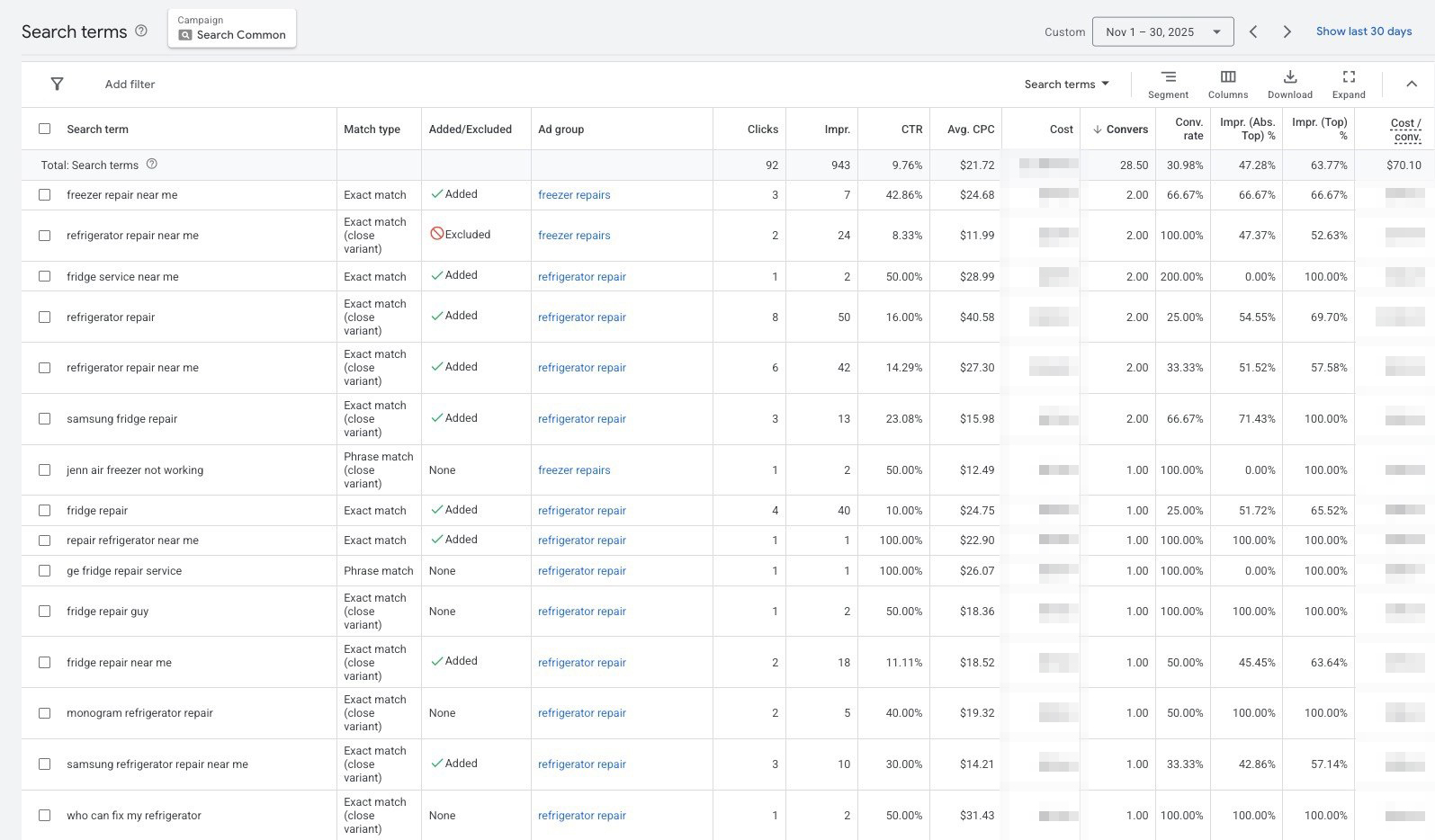
Conversions came from keywords with match types other than AI Max: most queries were matched as Exact match (close variant). This is Google's AI at work, showing ads not for a specific keyword, but based on user intent. The screenshot shows that the query "who can fix my refrigerator" was matched to "refrigerator repair", resulting in a conversion at a high cost ($31.43). The auction is highly competitive - cost per click is elevated ($21.72). The average conversion cost is also too high at $70.10. As of September 2025, the feature has been disabled in the search campaign.
Full list of advertising work
Bidding strategies and budget management
- Adjusting campaign bidding strategies and budgets.
- Changing Performance Max campaign goals from local to standard.
- Disabling the AI Max feature for the search campaign.
- Setting up and subsequently applying the AI Max experiment for the Search Common 2024 campaign.
Search query and keyword management
- Search query analysis: non-targeted queries added to the negative keyword list.
- Adding new keywords based on target search queries.
- Pausing low-performing keywords (high spend with no conversions or high cost per conversion).
- Collecting semantics and launching a search campaign for the "commercial refrigeration repair" direction.
- Migrating keywords from paused campaigns into active ones.
- Adding keyword groups for the True and Turbo Air brands with corresponding landing pages.
Performance Max (PMax) optimization
- Analyzing search queries and auction insights in PMax.
- Adding new asset groups with updated audience signals and search themes.
- Pausing underperforming asset groups and re-enabling previously paused ones.
- Reviewing placements: excluding irrelevant websites, mobile apps, and videos.
- Configuring and adding a page feed to PMax.
- Adding scripts to monitor search queries in PMax.
Ads and extensions
- Improving ad quality: adding new headlines and descriptions.
- Adding new ad variants to search campaigns.
- Adding and updating extensions: Promotion, Image, Sitelinks, Structured Snippets, Price.
- Creating new images for asset groups.
Conversion tracking and technical setup
- Setting up conversion tracking for the booking form.
- Enabling and configuring Enhanced Conversions.
- Adjusting static conversion values (phone click, calls from ads, booking_form).
- Configuring conversions directly within the Google Ads account and setting them as primary.
- Excluding outdated conversions from the primary conversion list.
- Setting up an ad schedule.
Audiences and general account management
- Adding new audiences in observation mode and adjusting bids accordingly.
- Working with system recommendations: applying relevant ones and dismissing irrelevant ones.
- Relaunching and segmenting campaigns (Performance Max, search, and local campaigns).
- Submitting GMB (Google My Business) profile reinstatement requests).
Google Ads Optimization Results
Comparison of the November 2025 - January 2026 period against the previous period:
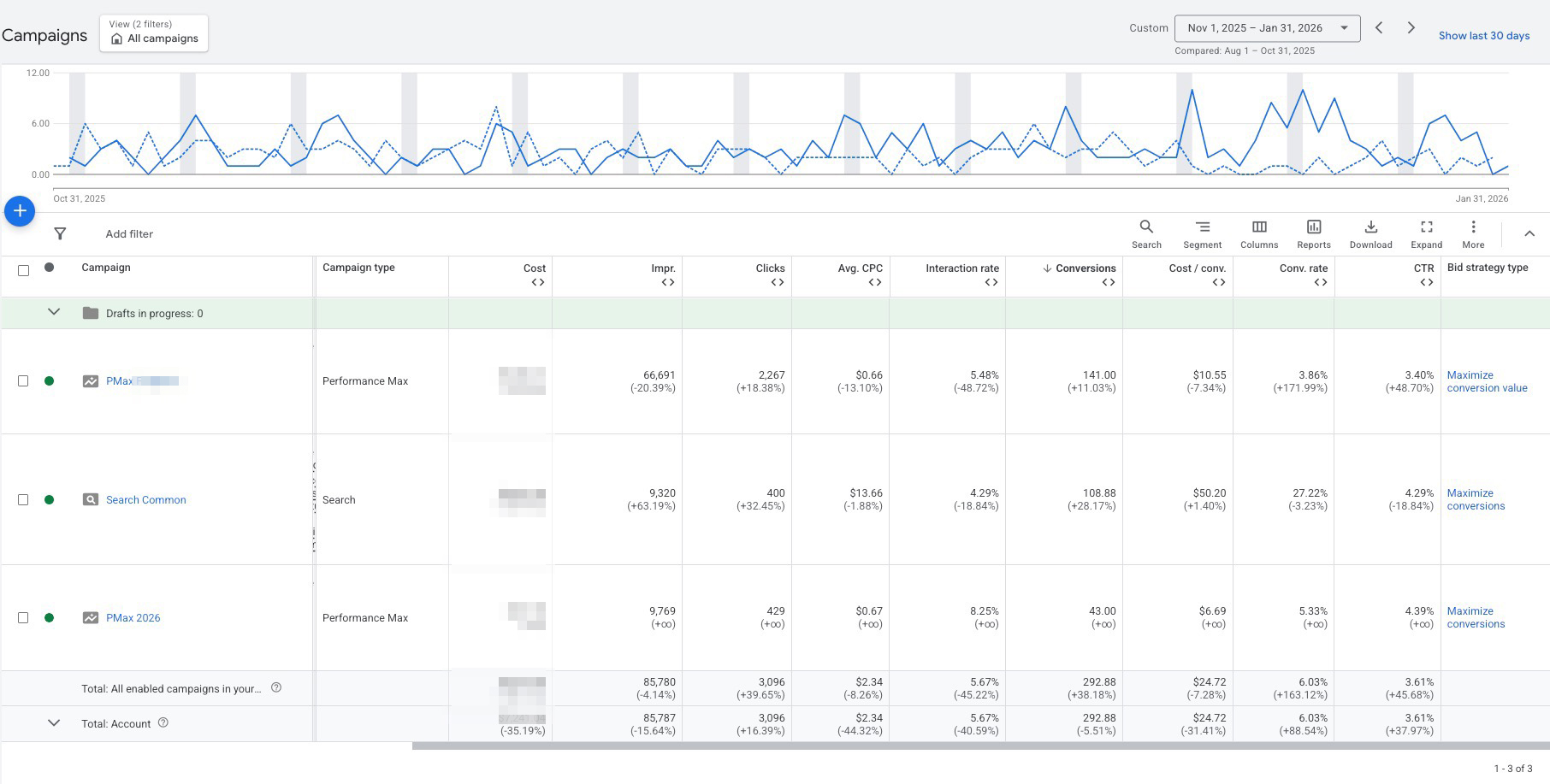
Total account spend decreased by 35.19%. Despite the reduced budget, click volume grew by 16.39%, and CTR improved by 37.97%, indicating higher ad relevance. The account-level conversion rate increased by 88.54%. Cost per conversion dropped by 31.41% to $24.72. Average cost per click fell by 44.32%, allowing more traffic to be acquired at a lower cost.
The work on the account demonstrated strong performance: despite a significant budget reduction, lead volume was maintained while cost per lead improved substantially. The primary gains came from optimizing cost per click and growing the conversion rate, indicating that traffic has become more targeted and campaigns are performing more efficiently than in the previous period.