



Getting started with the project. February 24, 2022 - May 2022 – the project was fully halted. Advertising campaigns were paused due to the full-scale invasion, as promotional services lacked relevance at that time.
May 2022 – activity resumed. The project was officially reactivated, and work began on restarting ad accounts and updating the promotion strategy.
Post-resumption activities 2022
To increase promotion efficiency, we implemented the following priority measures:
1. Optimization of current campaigns
- Configuration review – an audit of active campaigns to reflect budget changes and geo-targeting adjustments.
- Geo-targeting – temporarily occupied territories and active combat zones (specifically the Kherson, Mykolaiv, and Zaporizhzhia regions) were excluded from ad delivery.
- Budget – budget reallocation to align with the company's current capabilities.
2. Competitor strategy
- Competitor campaigns – ad campaigns based on competitor queries were activated to test performance in the current environment.
- Testing – a two-week test with a dedicated budget was planned to gather preliminary statistics.
3. Promoting new products and categories
- "Born in Kyiv" collection – the new catalog category was integrated into search campaigns.
- "Be Brave like Ukraine" candle – a distinct focus was established in the advertisements. Direct links to the product page were configured to drive targeted sales.
To boost relevance and reach, we created a Ukrainian-language product feed and utilized client-provided customer lists (emails and phone numbers) as audience signals to optimize algorithmic precision.
During the optimization process, we eliminated ineffective tactics: in July 2022, we disabled competitor campaigns that were not yielding the expected results. A critical milestone occurred in March 2023, when we fully updated our analytics alongside the website redesign: GA4 and GTM were installed, and we conducted testing to verify accurate conversion reporting. The primary goal for campaign optimization became the "purchase" transaction. Additionally, in June 2024, we set up form submission as a secondary conversion directly in Google Ads to gather supplementary statistics without interfering with primary bidding strategies.
Ad campaign audit
At the client’s initiative, an independent audit of the ad account was conducted, the results of which they openly shared with our team.
Based on the audit results, we planned the re-implementation of the Target Return on Ad Spend (tROAS) strategy with gradual increases. Previously, ad campaigns were switched to "Maximize Conversions" due to a drop in sales volume, but the client needed to return to margin control. In addition, we tested the launch of a separate search ad campaign for a specific product category, but later, based on performance analysis, we decided to disable it.
Furthermore, to enhance Google Ads algorithm learning and enable flexible management of different campaign types, we created custom goals (grouped conversion sets):
- Transaction (website purchase) + Successful contact form submission.
- Transaction + Form submission + Micro-conversions (Add to cart and Begin checkout).
Local campaigns (August 2024 - February 2025)
In conjunction with opening a new location in Lviv, we agreed to test a local campaign aimed at driving offline traffic directly to the physical store.
1. Test launch: Lviv (August 2024)
- Geo-targeting: 1 km radius around the store address (data synced via Google My Business).
- Target actions: tracking of driving directions and click-to-call interactions.
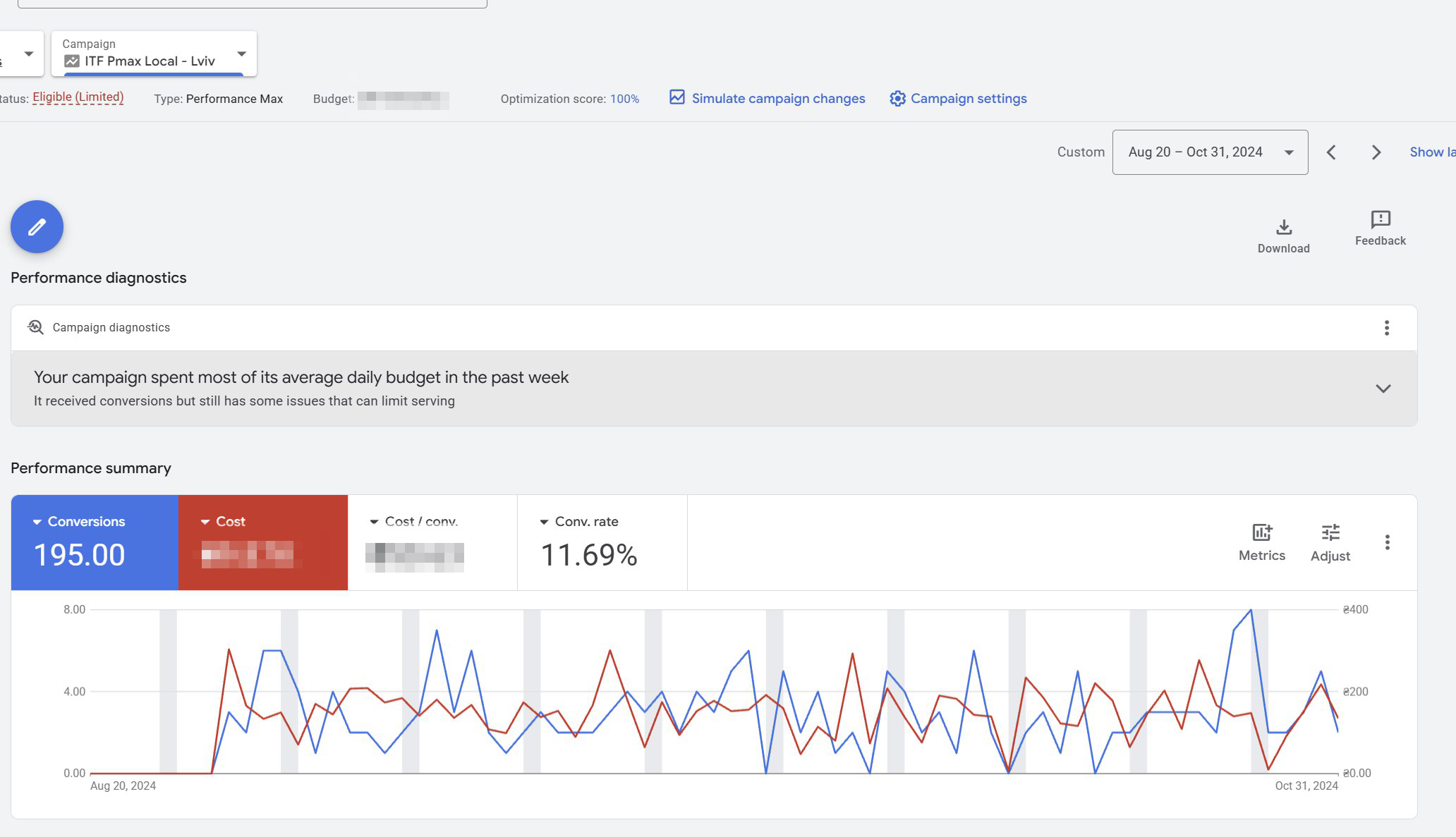
- Conversion count: 195.
- The 11.69% conversion rate is strong (every 10th user who clicked the ad completed a target action). This confirms the relevance of the ads and the user-friendliness of the landing page.
The ad campaign delivered a highly cost-effective cost per target action - the conversion cost remained fully acceptable for the client. The local campaign precisely hit the target audience, demonstrating a high conversion rate and low acquisition cost. The algorithm identified a high-intent audience ready to engage, without requiring significant warm-up investment. On the performance graph, the blue line (conversions) closely follows the red line (ad spend) and even surpasses it at certain peak moments. This indicates that the traffic is high-quality and converts consistently - not randomly.
2. Scaling phase: Kyiv and Dnipro
Building on the successful launch and stable performance metrics of the Lviv campaign, we subsequently deployed similar local ad campaigns for stores in Kyiv and Dnipro. The strategy of a narrow radius around retail locations validated its effectiveness.
3. Expansion to metropolitan coverage (February 2025)
- An expanded local campaign was launched across Kyiv.
- Instead of pinpoint radii around individual stores, the campaign now covers the entire city by utilizing the full list of the chain’s store addresses. This allows us to increase brand reach within the capital while maintaining a direct connection to physical locations.
Furthermore, for the branded ad campaign, we set up an experiment using a manual bidding strategy to control cost-per-click, and this approach proved exceptionally successful compared to automated strategies.
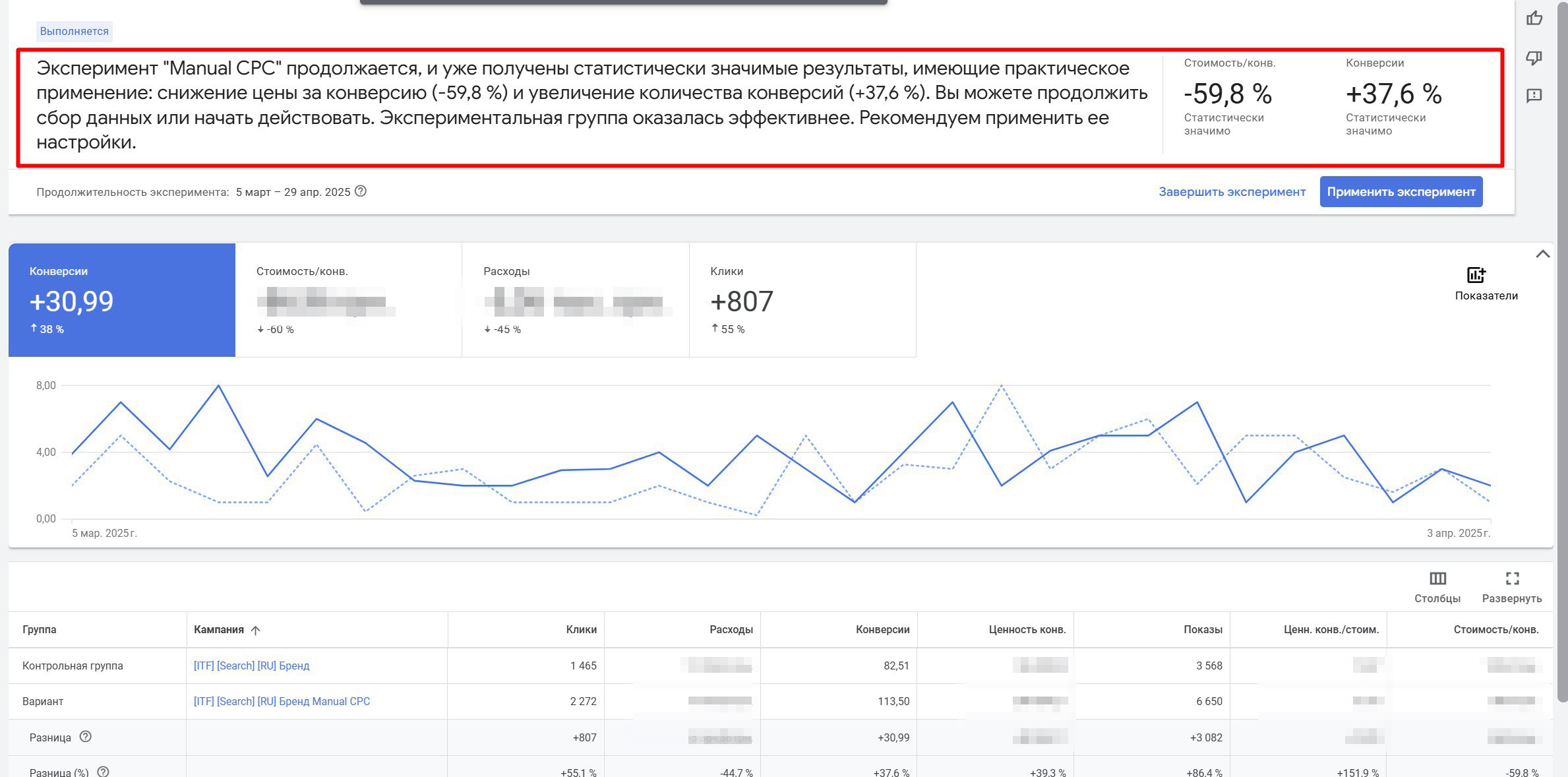
Cost per conversion decreased by 59.8%. Conversion volume increased by 37.6%. With a 55.1% increase in clicks, total campaign spend decreased by 44.7% - by securing a lower cost-per-click, the ad campaign captured significantly more relevant traffic. Conversion value rose by 39.3%. The ROAS reached 3115%. Consequently, manual bidding helped the system focus on the most profitable queries. These successful settings were fully transferred and applied to the main ad campaign, which stabilized performance metrics at a higher traffic volume.
Development and optimization plan for the advertising account – 2025
Based on the analysis of the advertising account, a set of recommendations has been prepared for further optimization and strategic growth.
1. Merchant Center feed optimization
- Content Optimization: Ongoing refinement of product attributes. Integrating relevant keywords into titles and descriptions to amplify search visibility.
- Visual Refresh: Updating product imagery. We are currently evaluating the use of AI to generate high-quality backdrops for product photos to boost CTR.
2. Brand awareness strategy
- Audience analysis: given the premium nature of our products, prospective customers typically require prior brand familiarity before proceeding to purchase.
- Awareness campaign launch: implementing video and Demand Gen campaigns to effectively target lookalike audiences.
- Leveraging multi-format ad assets to drive acquisition and reach new users.
3. Current structure and expectations
- Sales-focused approach: Currently, our campaigns (specifically Performance Max) are configured in a feed-only format to maximize Google Shopping visibility while minimizing placements on irrelevant Display Network inventory.
- Expected results: A growth in the share of branded traffic, which directly correlates with improved sales performance.
- Performance measurement: Since Google’s Brand Lift tool has a high barrier to entry ($5,000 over 10 days), brand awareness will be evaluated via proxy metrics such as the growth in branded search volume and overall traffic).
4. 1st-Party data management
- It is essential to ensure regular updates of customer data (at least once per week). This is critical for the proper functioning of remarketing algorithms and lookalike audience targeting.
Examples of client ad creatives:


Throughout our engagement, we also tested image generation within Merchant Center. We developed and tested a series of holiday-themed creative assets for the New Year, enabling us to tailor our product visuals to peak seasonal demand. Examples of ad creatives:


Leveraging unique, AI-generated images helped differentiate our ads from generic competitor product listings and boosted brand awareness.
In April 2025, we activated first-party data collection by enabling audience list generation via enhanced conversion tracking. This allows the system to identify users more effectively and enhances the precision of our remarketing efforts.
AI Max for Search
On August 14, 2025, we initiated testing of the AI Max for Search tool (AI-driven search ad automation) within the [ITF] [Search] HoReCa_B2B and [ITF] [Search] Aromatization_B2B campaigns. Concurrent with the AI Max activation in the Aromatization_B2B ad campaign, we switched the bidding strategy from "Maximize Clicks" to "Maximize Conversions" to prioritize target actions.
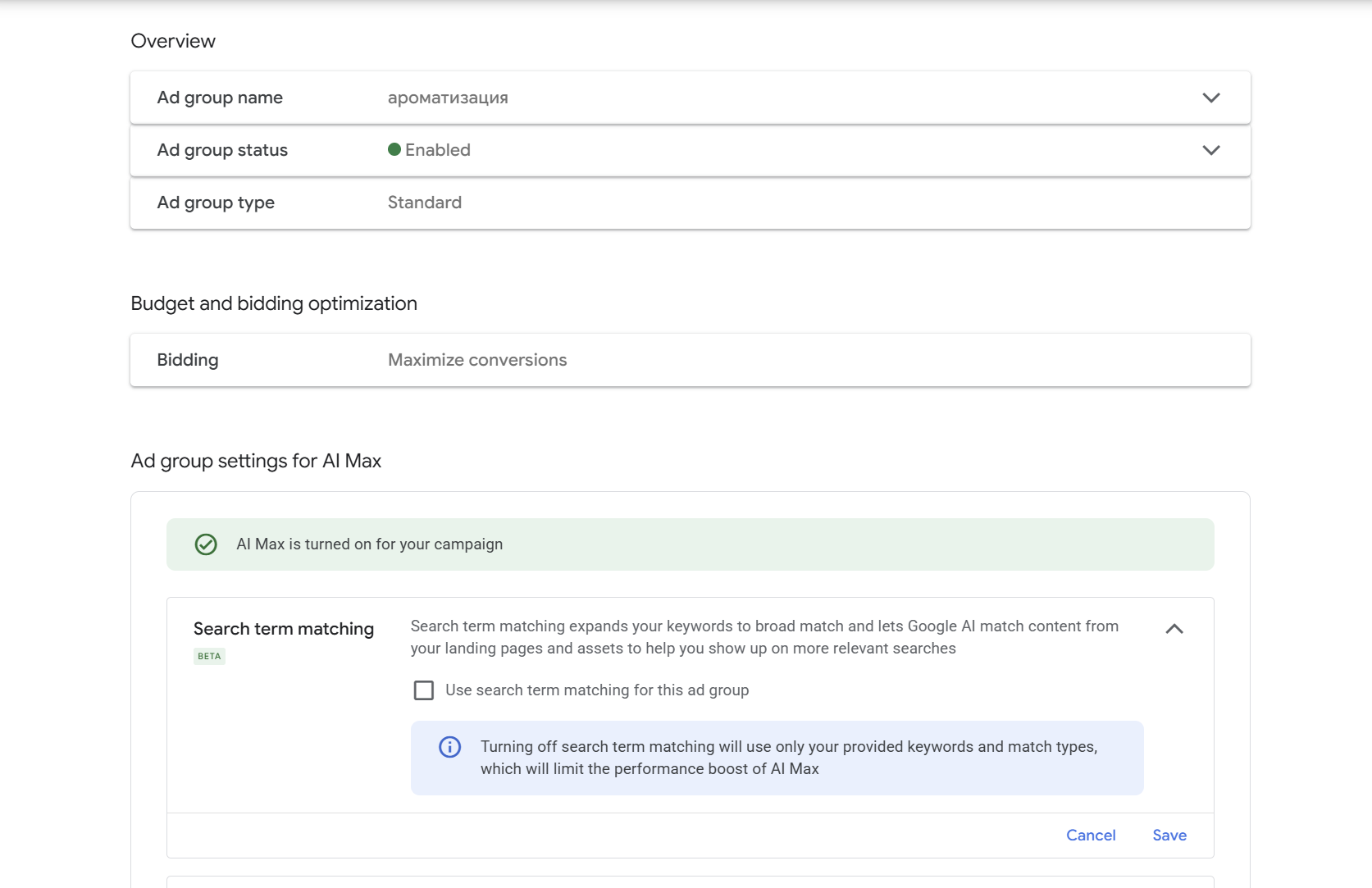
Subsequently, we applied an ad-group level setting to restrict the system from automatically discovering new keywords, which allowed us to balance AI flexibility with traffic quality control by mitigating irrelevant broad match queries.
Examples of queries generated by AI Max for Search:
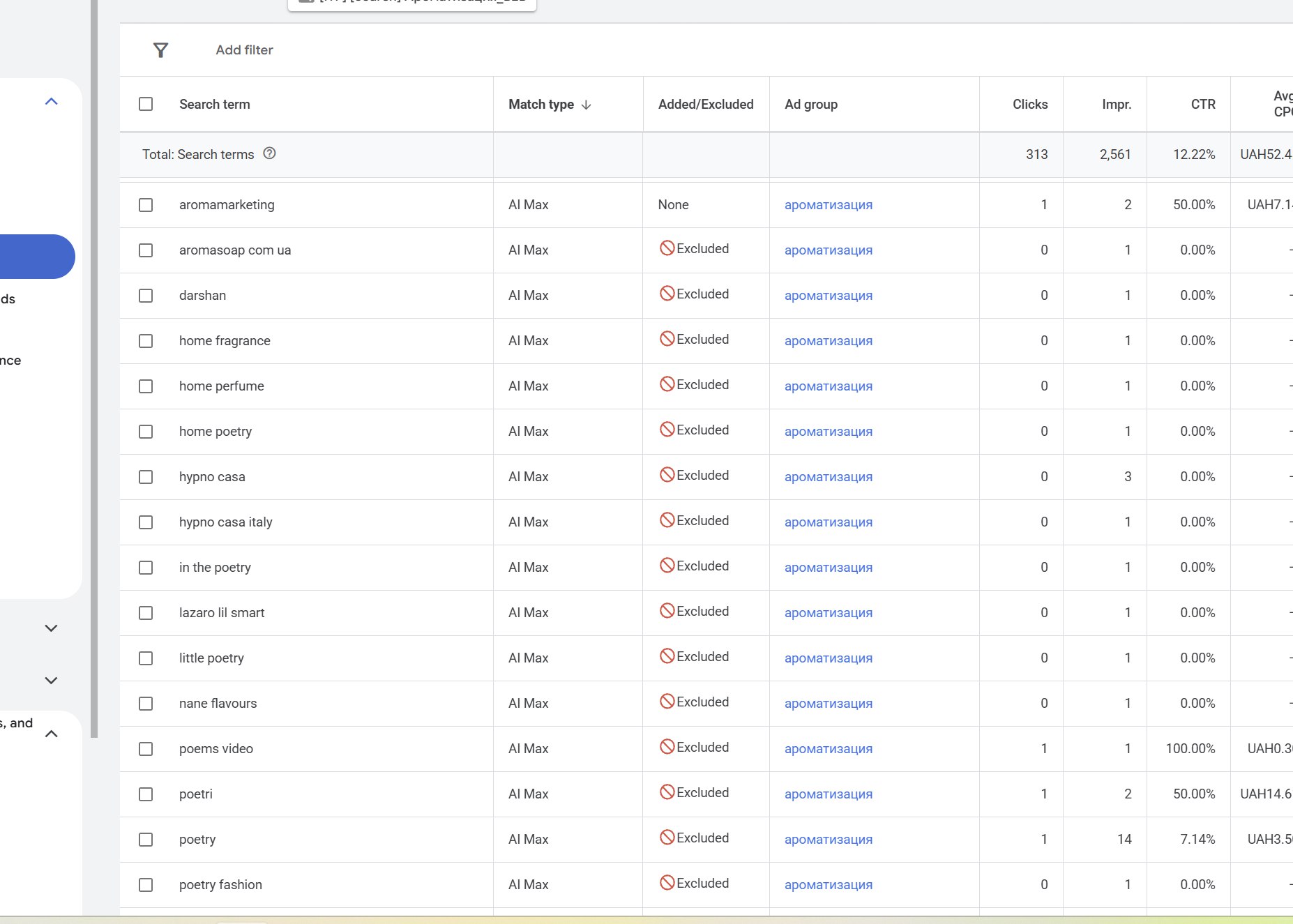
Analysis of the search queries report indicated that the AI Max tool’s performance was misaligned with our strategic objectives:
- Irrelevant search queries. Значна частина запитів, за якими показувалося оголошення, не стосувалася прямих комерційних інтересів (наприклад, poems video, poetry fashion), що призвело до неефективного витрачання бюджету.
- Overreliance on branded traffic. The system consistently targeted branded keywords (e.g., "home poetry"), which were already being effectively captured by our dedicated brand campaign.
- Mass exclusions. The high volume of queries marked as "Excluded" in the report confirms that we were forced to manually purge a substantial amount of low-quality traffic generated by the algorithm.
Given that the search queries turned out to be either irrelevant or purely branded, we decided to discontinue the use of AI Max.
Demand Gen
In September 2025, the client set a goal to increase branded traffic and overall sales. To achieve this objective, we proposed and test-launched a Demand Gen campaign aimed at stimulating demand and expanding audience reach beyond existing high-intent users.
Why Demand Gen:
- Enables leveraging lookalike audiences based on customer lists, site visitors, and social media engagement.
- Generates brand demand rather than merely capturing existing intent.
- Provides broad reach through high-impact visual formats (video, discovery, carousel) that drive brand recall.
- Operates at the middle and upper funnel, amplifying branded search and remarketing efforts.
A key characteristic of Demand Gen is its high entry threshold; our experience with prior campaigns confirms that insufficient budgets hinder Google’s algorithm from learning effectively, inevitably leading to poor performance. Accordingly, we aligned with the client on an optimal budget required for the campaign to function correctly and initiated launch preparations.
1. Preparatory phase and launch (September 2025)
- Created a Demand Gen campaign targeting a lookalike audience of Purchasers.
- Adjusted the initial budget in line with system recommendations.
- Conducted a placement audit and excluded irrelevant inventory.
2. Initial testing and optimization
- After spending 6,000 UAH with zero conversions, the campaign was temporarily paused to review our strategy and await high-quality creative assets.
- We excluded the 65+ age demographic from targeting to improve spend efficiency.
3. Creatives revitalization and refresh (October 2025)
- The campaign was subsequently reactivated. New ad variations were implemented:
- Incorporated provided graphic assets (banners).
- Added new image-based ad variations.
- Scheduled the production of AI-generated video assets.
DDemand Gen is not a tool for cost-efficiency; it is a driver for brand scaling.
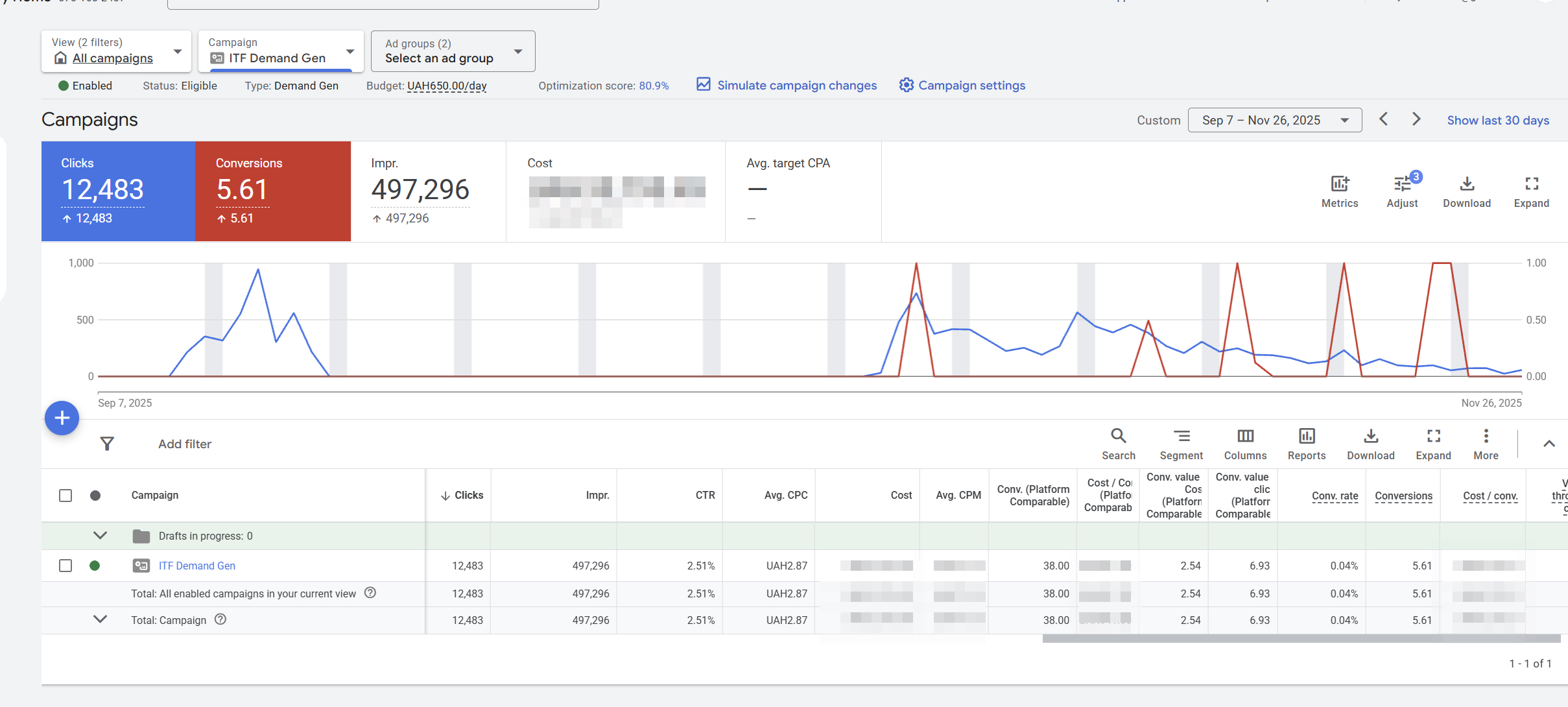
The "Conversions (cross-platform)" column accounts for both click-through and view-through conversions. This allows for a comparative analysis of different campaign types - including video - across various stages of the customer journey.
Key characteristics of the "Conversions (cross-platform)" column:
- View-through tracking: Unlike the standard "Conversions" metric, this column includes conversions attributed to impressions, where a user views an ad without clicking but later completes a target action.
- Demand analysis: Its primary purpose is to evaluate the efficacy of campaigns designed to boost brand interest, where value is derived beyond a direct click.
- Distinct attribution: It helps isolate the performance of specific formats (e.g., YouTube or Discover) from standard search campaigns.
While the account reports 5.61 standard conversions, the "Conversions (cross-platform)" column totals 38 (a 577% increase), as this metric incorporates view-through conversions - instances where a customer views an ad without clicking but later proceeds to purchase. There is also a significant disparity in revenue, suggesting that our advertising drives deferred purchases that the standard attribution model does not capture. With a ROAS of 0.57 versus 2.54, the campaign proves profitable (generating 2.54 UAH in revenue for every 1 UAH spent).
The "Conversions (cross-platform)" column is ideal for Demand Gen because:
- It accounts for format specifics—Demand Gen frequently runs on YouTube and the Discover feed, where users tend to view content rather than instantly clicking through.
- Objective assessment enables comparing video ads with search campaigns on equal terms by viewing the full customer journey, rather than just the last click.
- Real impact - the column confirms that the ad influences the customer's final decision, even if the interaction did not result in an immediate click.
The 38.00 conversion figure proves that the campaign effectively drives sales by warming up the audience. Given the allocated budget, the campaign delivers over 500k impressions, representing a strong result for brand awareness. The ROAS under the cross-platform model stands at 2.54, indicating that the campaign has the potential for daily budget increases to scale and reach further.
Overall account activity since February 2022
1. Analytics setup and technical work
- GA4 and GTM: Created the GA4 property, configured eCommerce tags and event tracking ("Add to Cart" button, form submission, cart abandonment) via GTM.
- Conversions: Configured dynamic value transmission for contact forms; imported micro-conversions; enabled Enhanced Conversions.
- Feed and Merchant Center: Configured automated inventory updates; adjusted the feed update schedule; optimized product titles (added brand name) and descriptions; activated ID transformation rules.
- Scripts: Deployed the Performance Max analysis script.
2. Strategic campaign management and optimization
- Bidding strategies: transitioned from "Maximize Clicks" to "Maximize Conversions/Value"; tested manual bidding strategies in branded campaigns; adjusted target ROAS (tROAS).
- Budgets and Geo: executed regular budget reallocation; excluded inefficient locations and geos (specifically in PMax Ukraine).
- Account quality: systematically addressing Google recommendations to improve Quality Score.
- Merchant Center management: regularly submits requests for review of disapproved products.
3. Performance Max Campaign management
- Segmentation: organizing campaigns by product type, category, and region (Kyiv/Ukraine).
- Creative and signals: updating display and video assets; adding Search Themes; testing asset groups without creative assets to benchmark performance.
- Optimization: pausing underperforming asset groups and audience signals.
4. Search and Shopping campaigns
- Semantics: continuous search query refinement, adding new keywords and negative keywords (specifically at the account level for PMax).
- DSA: added new targets for dynamic ads.
- Branded ads: added ads in Ukrainian; added "Be brave" ad group.
- Product feed: excluded non-converting products or those with high CPA; added new product categories to the listing.
5. Seasonal and Local activities
- Promotions: setup and optimization of campaigns for February 14, March 8, Mother’s Day, and Easter (Easter Edition).
- Local Campaigns: launch and optimization of campaigns for Kyiv, Lviv, Odesa, and Dnipro.
- New Segments: launched campaigns for "Room Fragrances," "Corporate Gifts," "Discovery sets," and "Shampoos" (some were paused based on performance).
- Demand Gen: launched a new campaign with creative testing.
6. Ads and Extensions
- Copy and Language: translated ad copy into Ukrainian; updated shipping information in ad copy and callouts.
- Extensions: added company logo, updated images, and created thematic sitelinks (gift sets, maps, holiday merchandise).
Recommendations and Observations:
- Website form: The "notify me" (back-in-stock) form was removed following the site redesign; we strongly recommend reinstating it to capture conversions.
- Discovery: We have decided to discontinue Discovery campaigns utilizing a feed, given the low performance seen in comparable accounts.
- Exclusions: We have excluded the period of technical downtime, when transactions were not being recorded properly, from our conversion data.
As part of our optimization efforts, we are focusing on feed quality: enriching titles with relevant keywords, refining descriptions, and updating Google Product Category mapping to improve the precision of product listing impressions.
Project promotion highlights
Growing reseller activity and price-dumping practices negatively impact PPC efficiency. When reseller prices in Google Shopping are lower than official ones, the brand loses its competitive advantage in visual search results. We encountered this in early 2025: market saturation by competitors led to auction "overheating." Consequently, advertising costs increased due to the need to maintain brand positioning amid an oversupply of the same product from various sellers.
We occasionally face instability in product distribution by the product_type attribute. Since our campaign structure is strictly tied to this metric, any changes in the site hierarchy lead to products disappearing from ad placements. Furthermore, we experienced certain technical issues following the site redesign, as incorrect data transmission from the contact form occurred. This complicates campaign performance evaluation and the training of automated bidding strategies. In such cases, urgent technical intervention is required to restore tracking.
The client demonstrates high engagement in project development, promptly implements proposed changes, and expects new expert advice. Periodically, we prepare a list of UX/UI improvement recommendations. The goal is to make the site more user-friendly, which should increase conversion rates and mitigate some of the issues caused by the redesign and subsequent troubleshooting.
SEO
We initiated the reactivation process with a comprehensive niche analysis and competitor monitoring to align our strategy with market shifts that occurred during the hiatus.
Niche and competitor analysis
- Domain age: 1-4 years
- CMS: WordPress, Bitrix24, and custom-built sites
- Pages indexed: 351-1,960
- Monthly traffic: 1,340-5,700
- Number of keywords: 1,191-37,000
- Competitor social media: YouTube, Facebook, Instagram, and Telegram.
- Blogs: 2 out of 3 competitors maintain a blog.
The main competitor leverages their domain age and massive keyword footprint. This company dominates through strong brand recognition and aggressive content marketing. Traffic stems not only from technical SEO but from high demand for the brand itself. The youngest competitor has outpaced the client's site in traffic by nearly threefold. This indicates highly effective management of rapid traffic channels: social media, advertising, and potentially active influencer collaborations, given their heavy reliance on Instagram for brand promotion.
- Language Versions. Key competitors continue to drive organic traffic by leveraging bilingual site structures and promoting language versions in parallel. At the time we resumed our engagement in the spring of 2023, the decision to drop the Russian-language version was limiting growth potential and preventing us from regaining previous traffic levels or matching the current performance benchmarks of our primary competitors.
- Brand Awareness. For our competitors, branded search terms consistently rank among the top 10 traffic-driving keywords. Poetry Home needs to increase its efforts to strengthen overall brand awareness.
- Promotion Strategy. Our page analysis revealed that effective niche promotion requires a balanced focus on both category and product pages, as both drive a significant portion of search demand. Furthermore, an effective niche strategy must encompass not only commercial pages but also blog content and informational articles.
- Technical Fixes. The sharp drop in traffic in March 2023 is likely due to migration errors during the site move. We need to implement 301 redirects from old URLs to the new ones to resolve these technical issues.
Since the site had been dormant for over a year, we conducted a technical audit and reviewed Google Search Console for any errors that might have adversely impacted the site's search visibility.
Google Search Console
Critical issues identified that require immediate remediation:
1. Heading hierarchy violation
- We identified multiple <h1> tags on pages within the Russian-language version. According to SEO standards, each page must contain exactly one unique <h1> header that defines its primary topic.
- The redundant <h1> tag was discovered in a banner prompting users to switch to the Ukrainian version of the site.
- Solution: remove the header tag from the pop-up banner elements. Instead of using an <h1> tag, apply a standard CSS class for the window title to maintain the visual design without creating errors for search engine crawlers.
2. Critical error in structured data
- A new critical error has been identified in the structured data markup, which may prevent rich snippets from appearing in search results.
- Solution: This error has been added to the general list of technical tasks for developers. The code must be validated using the Rich Results Test tool after the fixes are implemented.
Technical site audit
A list of errors hindering proper site indexing and the growth of organic search engine traffic.
1. Critical technical errors
- Cyclic redirects - redirect chains have been detected that loop search crawlers (e.g., in the "Sachets" and "Clothing care" sections). This blocks page indexing.
- Broken navigation (404 errors) - the site contains internal links leading to non-existent pages. This negatively impacts the crawl budget and user behavior metrics.
- Sitemap.xml errors - the sitemap includes pages with 404 errors or redirects. It should only include active pages with a 200-OK status code.
2. Indexing and duplicate content issues
- Page duplication – a significant volume of duplicate pages exists due to URL casing inconsistencies and trailing slashes. This dilutes page authority; implementing rel="canonical" tags is essential to consolidate equity.
- robots.txt file – directives require adjustment to exclude technical sections (e.g., filters, shopping cart) from indexation while ensuring full crawl access to critical site content.
3. Content and metadata optimization
- Meta tags (Title/Description): On many category pages, meta tags are either missing or duplicated. This prevents Google from determining a page's relevance to user queries.
- H1–H6 headings: The heading hierarchy is broken. Some pages lack a main H1 heading, while others have multiple H1 tags simultaneously.
- Alt attributes: Most product images lack text descriptions, which excludes them from Google Images search results.
4. Performance and Speed (Core Web Vitals)
- Loading speed: the site suffers from poor performance metrics on mobile devices. The primary drivers are unoptimized (heavy) images and excessive JavaScript execution.
- Microdata: schema.org markup (for products, reviews, and breadcrumbs) is either missing or improperly configured, which prevents the site from leveraging rich snippets in search results.
The consolidated list of technical remarks was forwarded to the client's team for implementation and resolution. Following their deployment, we re-analyzed the data from Google Search Console.
Follow-up Google Search Console analysis
1. Schema.org markup fixes: errors in the markup prevent the formation of rich snippets (stars, price, availability), which lowers CTR in search results.
- Description attribute: A unique description must be added for all products (aroma diffusers, perfumes, sets) in the Product schema.
- JSON-LD syntax: Remove the extra comma after the "description": "" field in the code. This makes the script invalid for Google bots.
- B2B pages: Correct the WebPage markup on the "Room Fragrance" and "Corporate Gifts" pages by filling in all empty required fields.
- Images in markup: Add the missing image for the 'box-red' product, as this is a critical validator error.
2. Indexing and technical response codes
- Response Codes (404/Redirects): Process the list of pages with incorrect response codes as outlined in the working spreadsheet.
- Broken Links: Identify and replace all internal links that point to non-existent pages (404).
- Canonical Links: Correct the rel="canonical" attribute on pages where it is improperly configured to prevent content duplication.
3. Content and meta tag optimization
- Title and Description uniqueness: Eliminate duplicate titles and descriptions for the pages specified in the report. Every page must have unique meta tags.
- Populating empty tags: Add metadata to pages where it is currently missing entirely.
4. Page speed and performance (Core Web Vitals). This is the most critical area for improving mobile search rankings.
- Image optimization:
- Compress heavy product and banner files.
- Convert images to modern formats (e.g., WebP).
- LCP (Largest Contentful Paint) Metric: Reduce the render time of the largest content element on the page.
- Eliminate Render-Blocking Resources: Optimize the loading of uncompressed files that obstruct page rendering and impede user interaction.
It is crucial to emphasize that every implementation of our recommendations requires rigorous verification, as technical execution does not always align perfectly with the original specifications. For this reason, we maintain continuous oversight via Google Search Console and conduct recurring technical and usability audits to promptly identify and resolve any potential issues.
Recommendations for implementing language versions for poetryhome.ua
The primary objective is to implement a Ru-language version of the site as a supplement to the primary Ukrainian version (a manual language switcher is not mandatory, but structural separation must be clearly defined).
1. URL-adress structure
- Ukrainian version (primary): remains at the site root.
- Example: https://poetryhome.ua/
- Ru version: Implemented in a /ru/ subdirectory.
- Example: https://poetryhome.ua/ru/
- URL generation: page addresses (slugs) must correspond to the language of the content.
- Ukrainian: /product/parfumovanyj-dyfuzor...
- Ru: /ru/product/parfumirovannyy-diffuzor...
2. Content and metadata
- Full translation: Every page must feature a unique, localized translation. This applies to all copy, headers, call-to-action buttons, and navigation elements.
- Meta tags: Title and Description tags must be translated and optimized specifically for language-specific search queries.
- Alt attributes: Image descriptions must also correspond to the language of the page version.
3. Technical SEO configuration
To ensure Google correctly identifies the relationship between pages in different languages, we must implement hreflang attributes..
3.1 Page-level tags (in the <head> section) – Every page must contain links to all its localized versions:
- <link rel="alternate" href="URL_UA" hreflang="uk" /> — for Ukrainian.
- <link rel="alternate" href="URL_RU" hreflang="ru" /> — for Russian.
- <link rel="alternate" href="URL_UA" hreflang="x-default" /> — default version.
3.2 Sitemap.xml – It is recommended to include information regarding language versions directly within the Sitemap file using xhtml:link tags to accelerate the indexing of both language versions.
4. Redirect configuration (Redirect map)
Since the site structure is subject to change, it is essential to prepare and implement a redirect map to:
- Preserve the link equity of legacy pages.
- Prevent 404 errors during transitions between language versions.
- Automatically route users to the appropriate version (if dictated by site logic).
After deploying the multilingual functionality, we conducted a follow-up site audit to verify that all changes were implemented correctly. This also allowed us to identify potential issues that could impede a seamless user experience across the new page versions.
Usability audit
Usability audit report
1. Navigation and Breadcrumbs
- The breadcrumb navigation items are written in lowercase, which appears unpolished and hinders readability.
2. Logo behavior
- On the homepage, the logo is clickable and directs to the current page, which creates unnecessary circular navigation.
3. Product filtering and sorting
- In the mobile version, the filter button may be obscured or obstruct content. We recommend transitioning the most frequently used filters to a horizontal scroll (Top Filters) and adding a display counter for selected parameters on the filter button.
4. Blog optimization
- The product page and landing page content areas are often overly elongated, forcing users to scroll excessively.
5. Оптимізація блогу
- Long-form content currently lacks internal navigation, which complicates the user journey. We recommend implementing a Table of Contents (ToC) at the beginning of each article and utilizing the H2/H3 header hierarchy as anchor links to facilitate rapid navigation to specific sections.
6. Cart and Checkout
- Implement a progress indicator (step indicator) to improve clarity during the purchase flow.
7. Work with Cookie
- Optimize the cookie banner design to ensure it does not obscure critical navigation elements, particularly on mobile devices, and include a clear, accessible link to the Privacy Policy.
To analyze behavioral factors and identify latent technical issues, we also conducted a user interaction audit using Hotjar.
Hotjar analysis report: behavioral factors and technical errors
1. Tracking code
- Data collection (session recording) has been completely halted since March 25th due to the deactivation of the Hotjar tracking script on the site. The system has not received any data over the last 7 days. We must re-integrate the tracking code into the <head> section of the site.
2. Funnel analysis: Blog and Conversions
- Blog posts are failing to serve as effective sales entry points. Session analysis indicates that the landing pages and exit pages for blog articles frequently overlap. Users read the material and immediately leave the site without navigating to commercial pages (products or categories).
- Recommendations:
- Implement internal linking from articles to relevant products.
- Integrate "Recommended products" or "Products from this article" blocks directly into the publication text.
- Utilize banners or calls to action (CTAs) within the content.
3. Transition analysis
- A significant portion of sessions focused on the article regarding product manufacturing secrets, yet traffic to actual product items was minimal or non-existent. We suggested verifying the presence of active links to the soap catalog within this article and ensuring they are visually highlighted.
4. General UX recommendations
- Теплові Heatmaps - After restoring the code, we must analyze click heatmaps on the homepage and product pages to identify which elements users are ignoring.
- Session recordings - We should monitor for instances of rage clicks, where a user repeatedly interacts with a non-clickable element.
Continuing our ongoing efforts to improve promotion results, we conducted a new cycle of technical audits and GSC analysis.
GSC analysis and technical verification
The audit is based on Google Search Console data and additional technical verification to identify barriers that hinder organic traffic growth.
1. Google Search Console (GSC) analysis
- Pages were detected that Google cannot crawl due to server errors or incorrect access settings.
2. Robots.txt file configuration
The file requires optimization of directives to improve crawl budget management:
- Disallow: Technical pages must be blocked from indexing, including search (?s=), login pages (wp-login.php), the cart (/cart/), checkout (/checkout/), and the user account area.
- Allow: Access to system style files (.css) and scripts (.js) is enabled, as well as access to images, which is critical for the search bot to render pages correctly.
- Sitemap: The correct path to the sitemap index is specified as https://poetryhome.ua/sitemap_index.xml.
3. Redirect verification
- Pages were identified where redirects are still functioning incorrectly or lead to broken links (404).
4. Loading speed and Core Web Vitals
- LCP (Largest Contentful Paint), where primary content loads too slowly, especially on mobile devices.
- CLS (Cumulative Layout Shift), where visual layout shifts occur during page load, negatively impacts Google's UX assessment.
5. Internal linking
- Pages were identified with a low volume of internal links, making them difficult for search engine crawlers to discover. It is recommended to strengthen the internal linking structure to improve domain authority distribution.
Usability analysis
This analysis is based on a comprehensive benchmarking of the site metrics against direct market competitors. By doing so, we evaluate current visibility and identify latent growth opportunities and technical barriers hindering effective search engine rankings.
1. Contact information
- The phone number is hidden in the site footer. This forces the user to scroll excessively, especially within the catalog. We recommend moving the phone number to the header so it is available on every page, as implemented by most competitors.
2. Checkout
- On mobile devices, there is an empty block beneath the header that consumes valuable screen real estate. We recommend removing unnecessary spacing. Combine the First Name and Last Name fields into a single field to streamline the form completion process.
- Cart optimization. Blocks featuring additional products and the promo code field should be moved one step back to the cart page to avoid distracting the user during the final payment phase and to conserve screen real estate on the checkout page.
3. Product card and specifications
- Enhance the visual clarity of product specifications. For instance, clearly display dimensions (width, height, length) for gift bags to minimize selection errors.
4. Filtering and navigation
- Competitors utilize clearer menu segmentation, such as dedicated sections for car scents, candles, and diffusers. We recommend reviewing the usability of the product configurator and filtering system to ensure users can locate their desired fragrance in the fewest possible clicks.
During the redesign planning phase, we prepared a technical specification detailing key recommendations. This was essential to minimize traffic loss risks, preserve site structure integrity, and ensure the stable operation of all analytics systems following the interface update.
SEO recommendations for the poetryhome.ua redesign
The primary objective of these recommendations is to minimize the risks of losing organic traffic, search rankings, and link equity during the migration to the new design.
1. Staging domain workflow
- Development confidentiality: All work on the new design must be carried out exclusively on a staging domain.
- Indexing restrictions: The staging website must be fully shielded from search engine crawlers. The most reliable method is to implement server-side password protection (via .htaccess) to prevent raw content from being indexed by Google.
2. Preserving the URL structure. This is a critically important requirement for maintaining the site’s current rankings:
- URL consistency: The URLs for all key landing pages must remain identical to the legacy versions. Search engines interpret any modification as the creation of a new page, resulting in a loss of accumulated 'link equity'.
- Priority pages:
- Homepage.
- Category and subcategory pages.
- Product pages and other landing pages.
3. Technical and content requirements for the new design. The new site version must adhere to the following standards:
- Clean code: A logical and streamlined HTML structure for all pages.
- Asset Migration: The following must be fully ported over from the legacy version:
- H1-H6 header hierarchy.
- Internal linking (all interlinking blocks between pages).
- Established metadata (Title, Description).
- All existing SEO copy.
4. Control and release
- Pre-launch SEO audit: Before the final release to the main domain, a specialist must conduct a comprehensive review of:
- Language version accuracy.
- Structural integrity.
- Presence of all critical SEO elements.
- The migration to the live domain should only be executed following official sign-off from the SEO specialist.
We have also developed a set of recommendations for blog architecture and technical optimization to enhance article indexing and strengthen internal linking to priority product categories.
Blog workflow
Current page optimization
- Optimized page copy by integrating relevant keywords.
- Adjusted keyword density and placement to prevent keyword stuffing.
Blog / Content
- Conducted a thorough audit of existing blog posts.
- Mapped semantics for existing articles (RU and UA versions).
- Drafted optimization briefs covering:
- incorporating missing keyword opportunities;
- content enhancement recommendations;
- adding table elements;
- developing FAQ section content.
- Updated and refined page metadata where necessary.
Tools used
- Ahrefs – for competitor analysis, backlink profile, site architecture, and organic traffic trends.
- Screaming Frog – for comprehensive site crawling, identifying indexing errors, redirects, duplicate content, canonical issues, and architectural flaws.
- Microsoft Clarity – for user behavior analysis, identifying interface friction points, and evaluating UX factors that impact conversion.
- ChatGPT – for systematizing audit results, formulating optimization hypotheses, and preparing structured recommendations.
Throughout the project, the client demonstrated a high level of engagement. The only limiting factor was the implementation cycle duration, which was driven by the scale of the changes.
Results. PPC
The metrics indicate significant account scaling and a substantial budget increase, accompanied by improvements in key performance indicators.
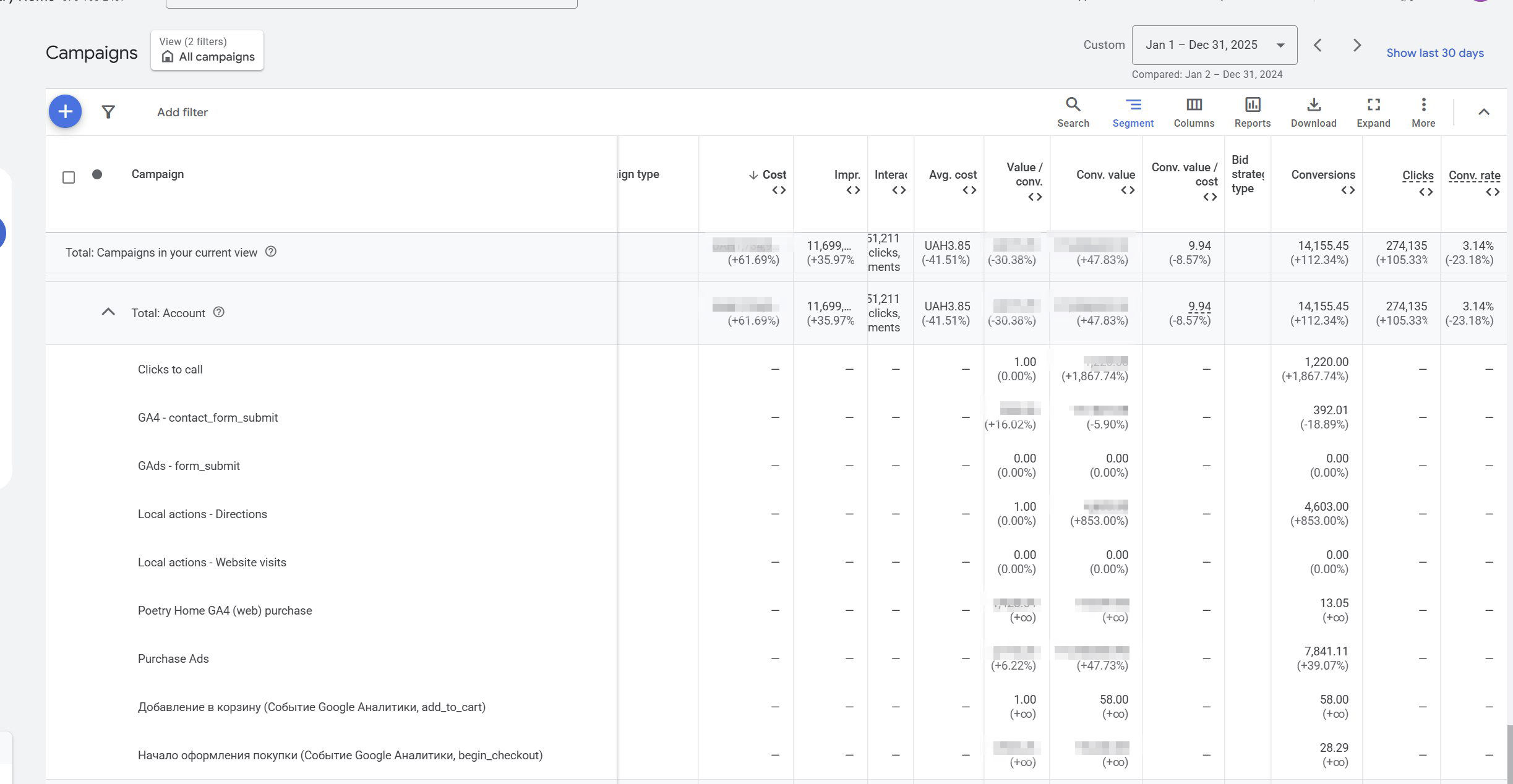
- Conversions (purchases + contact forms + click-to-call + local actions - directions):
- 2025: (+112,34%)
- Purchase volume: 2025: +39,07%
- Cost: +61,69%
- Purchase value: 2025: +47,73%
105% increase in clicks with a lower CPC - traffic acquisition has become both more cost-efficient and broader. Total conversions grew by 112%. The most significant growth occurred via auxiliary goals (calls, forms, store directions). This indicates that our advertising has begun working more actively, not just for direct online sales, but also for local queries (store visits) and phone consultations. This positively impacts the brand's omnichannel presence.
Purchase efficiency and ROAS
- Revenue grew by 47,7%, while purchase volume increased by 39.1% this indicates an increase in the average order value (AOV) driven by advertising.
- Ad spend increased at a faster rate (+61,7%) than purchase volume, indicating that the cost per acquisition (CPA) has risen slightly due to heightened competition or expansion into new audience segments.
The ROAS is approximately 9,8, which is an exceptionally strong performance for the fragrance industry.
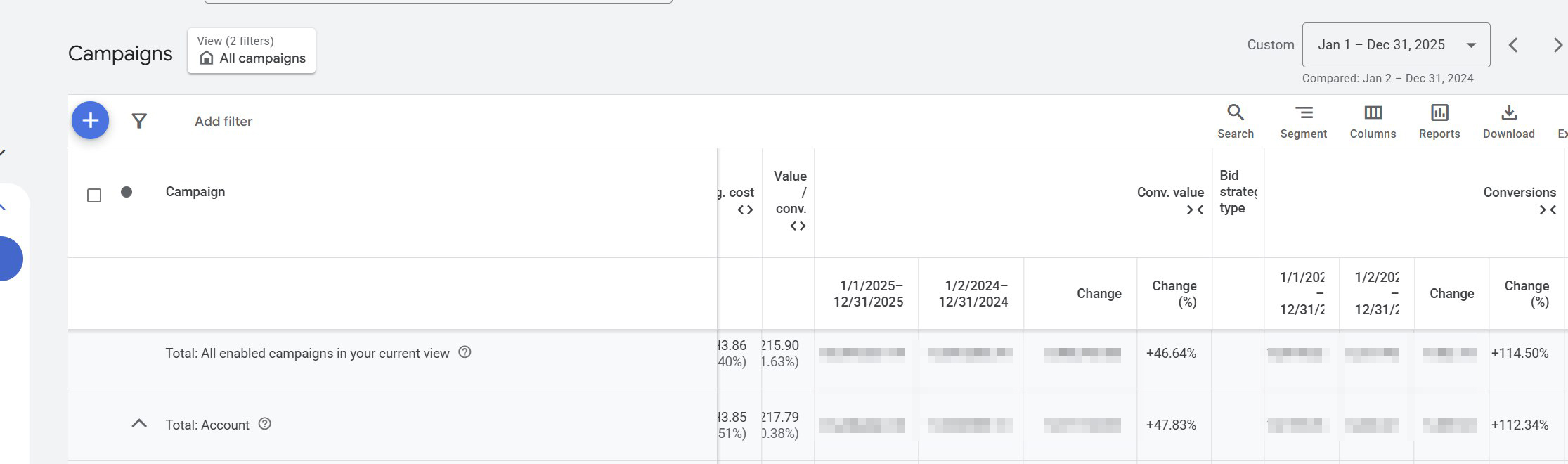
Conversions have more than doubled, demonstrating that our ads are driving genuine target actions. Revenue growth is trailing behind conversions, and the average order value has dipped slightly; this is a direct result of campaign scaling (broader queries, audiences, and Performance Max). At the same time, the account structure is free of campaigns that spend budget without generating conversions - every UAH invested is results-oriented, ensuring maximum return from active ads. The difference between the "Account" total and "All enabled campaigns" is minimal, meaning active campaigns are generating virtually all results.
The most profitable campaigns are PMax and Branded.
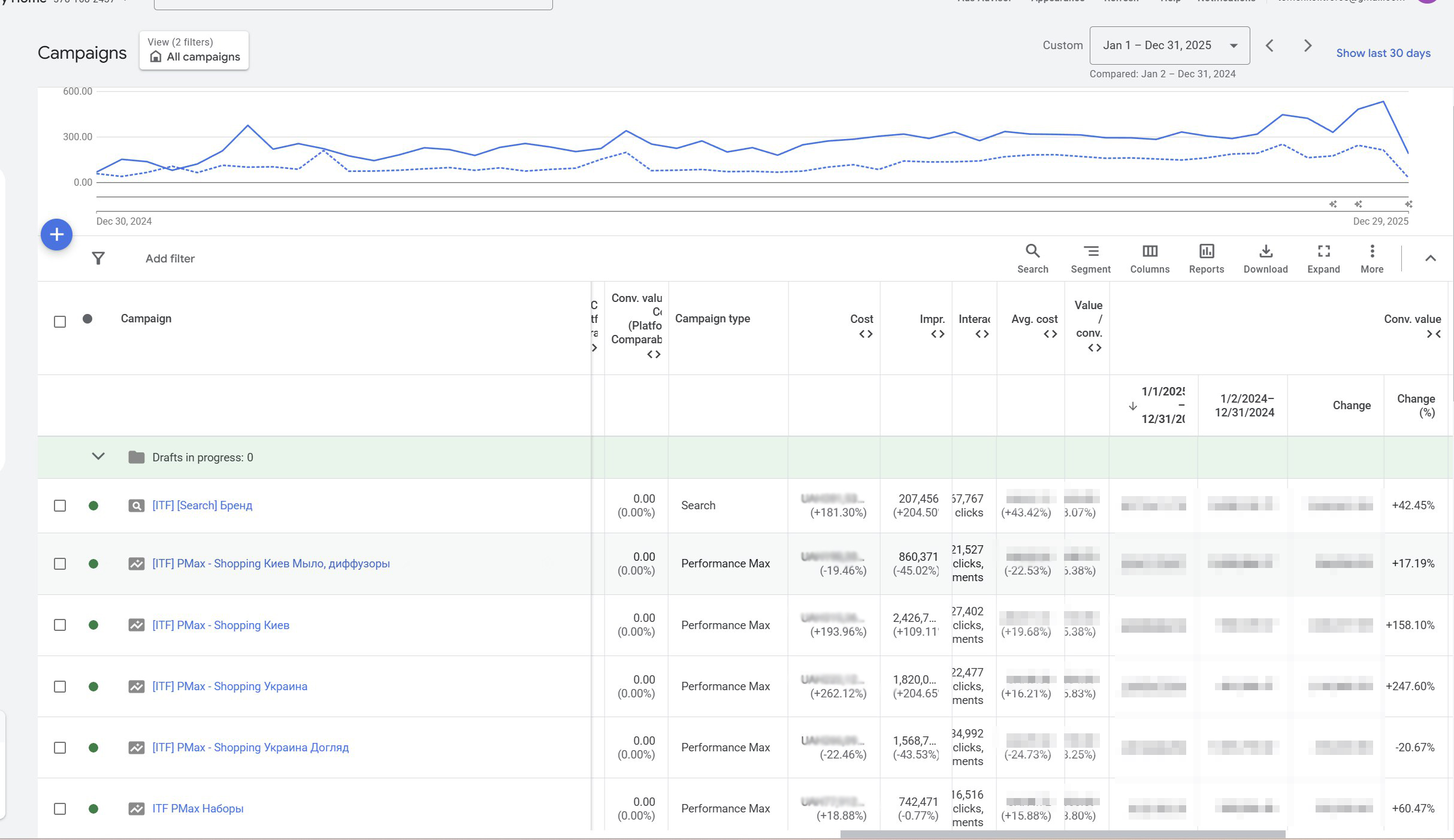
The chart indicates that the blue line (2025) remained consistently above the dashed line (2024) for the majority of the year, signaling steady revenue growth with peak performance in November and December.
PMax - Shopping Kyiv (+158,10%) is our highest-performing campaign, delivering substantial revenue growth and serving as the primary growth driver in the Kyiv region.
PMax - Shopping Ukraine (+247,60%) demonstrates the fastest growth rate; national scaling delivered significant results, despite the 262% increase in spend. The chart clearly displays a sharp post-holiday dip at the end of December, which is typical for the season.
Through continuous optimization and the implementation of new tools, we are systematically enhancing promotional results and securing a consistent client pipeline. Our collaboration facilitates business scaling and robust revenue growth, converting every advertising investment into tangible profit for the client.
SEO performance outcomes
A standard backlink acquisition strategy is well-suited for this niche. It is based on a mix of crowd marketing for a natural link profile, directory submissions for a solid foundation, and guest posting to build high authority.
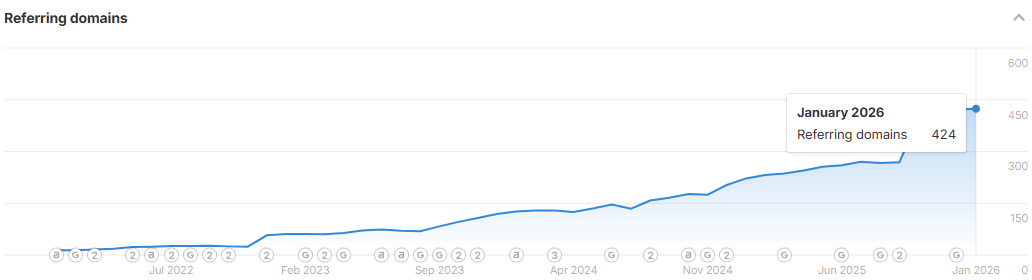
Referring domains:
- January 2022 - 14
- January 2026 - 398
Net increase: +384 domains. Unpaid links are difficult to track, as they often closely resemble crowd marketing links.
Ahrefs traffic data:
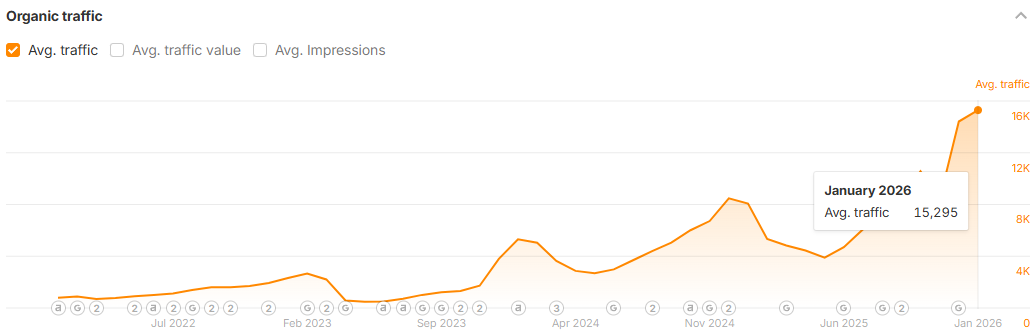
Analytics data from 02/01/2023 (no data available before this date). Dynamics for the period 02/01/2023–01/22/2026:
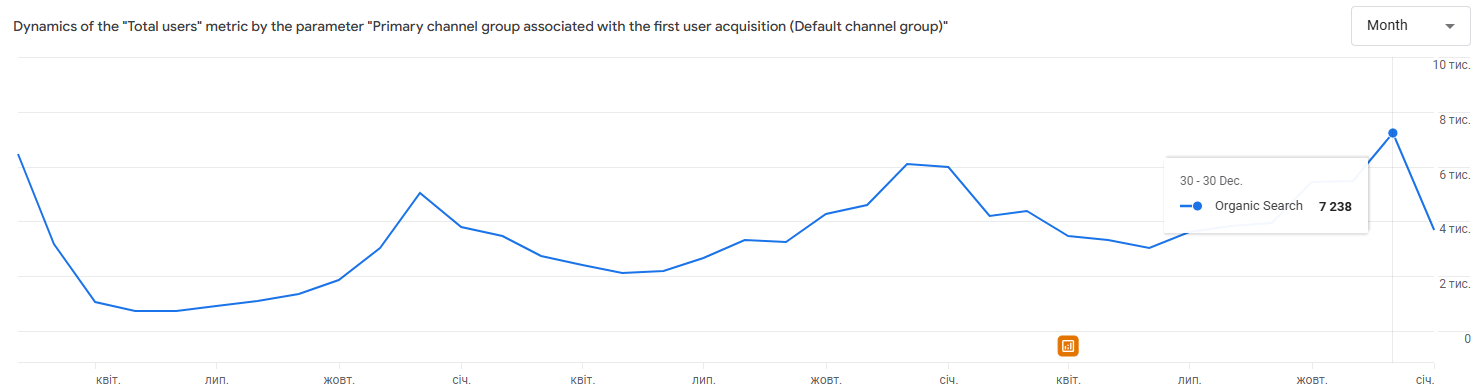
It is important to note that seasonal activity peaks during the winter (holiday period); however, we have gradually mitigated off-season traffic attrition while consistently increasing peak traffic volume during our most lucrative periods year-over-year.
Comparing metrics against December figures does not accurately reflect underlying trends, as this period is characterized by an anomalous seasonal demand spike that serves as the industry’s traditional peak. In February 2023, behavioral metrics were as follows:

And the metrics for partial January 2026:
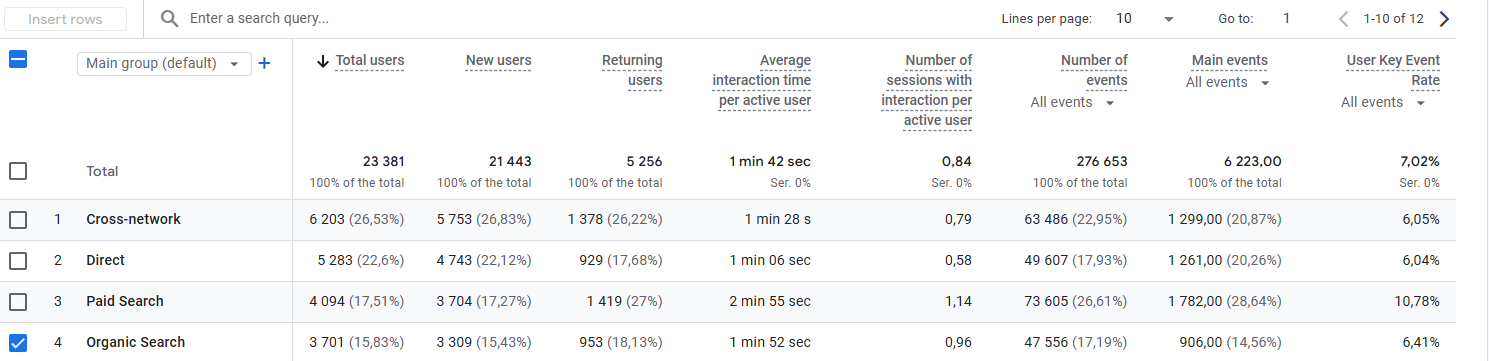
Comparing Google Analytics data indicates a significant improvement in traffic quality and audience engagement in 2026 compared to 2023, despite a quantitative decline in new users.
Engagement and time on the website
- Average engagement time increased from 1m 15s to 1m 52s, a nearly 50% increase, indicating that content has become more engaging and relevant to visitors.
- The number of engaged sessions per active user rose from 0.62 to 0.95. In other words, users are interacting more actively with site functionality during their visits.
Audience retention
- Returning users: Despite a decline in new visitor volume, the number of returning visitors grew from 810 to 936.
- This loyalty indicates the formation of a core, recurring audience. The site has evolved from a one-time information source into a resource that users consciously revisit.
Conversions and target actions
- Key events: In 2023, this metric stood at 0, whereas 887 key events were recorded in 2026, demonstrating that the traffic has become conversion-oriented.
- The total event volume remained nearly stable (48,242 vs. 47,054), which, despite a decrease in new users, confirms a significant increase in the action intensity of each visitor.
Overall, we have succeeded in qualitatively transforming the organic traffic structure.
Semantic component
Ukrainian-language queries:
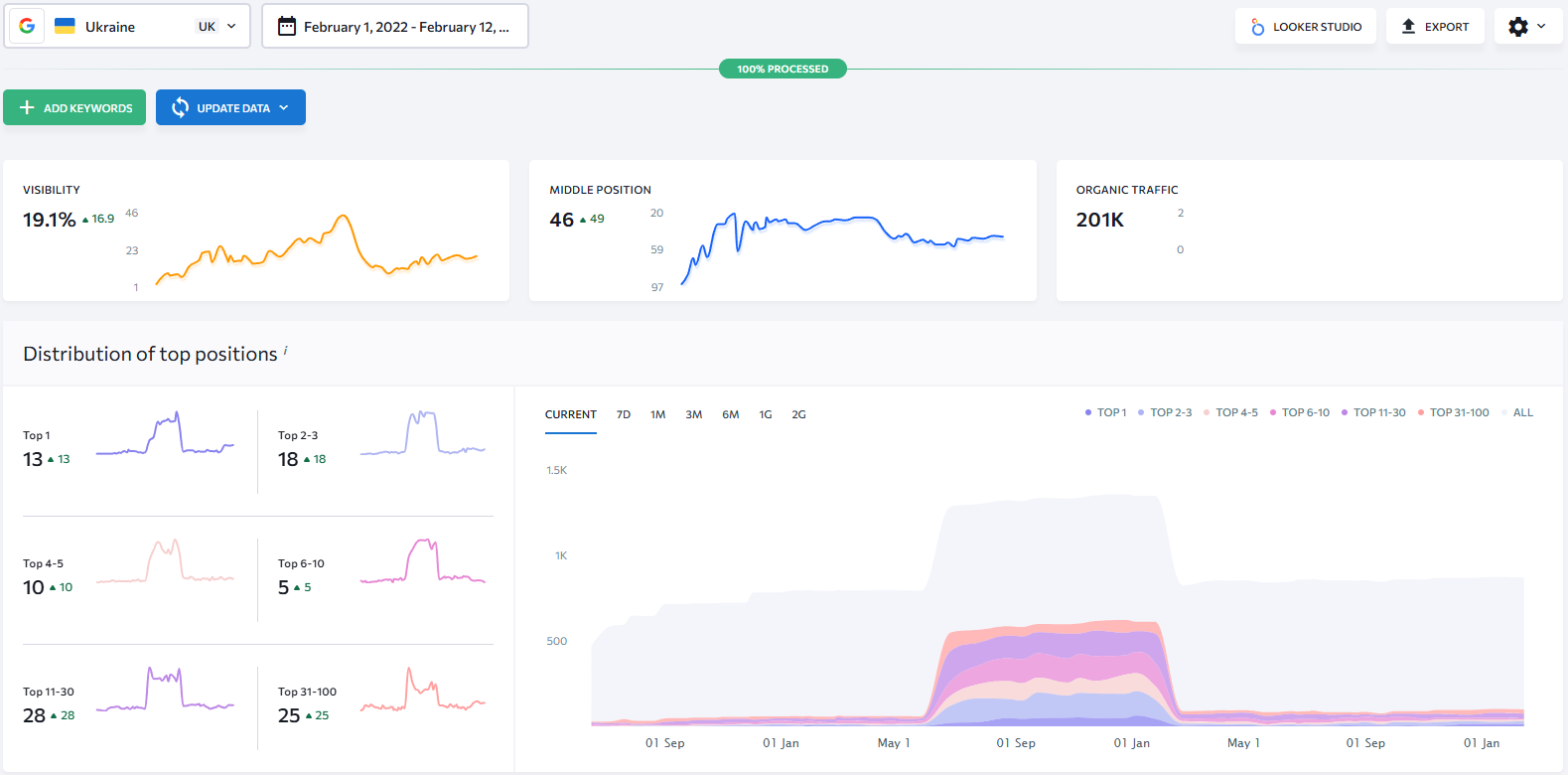
The screenshot demonstrates a significant qualitative improvement in site performance, reflecting successful optimization and the acquisition of a more targeted audience.
- 46 - average keyword position (an increase of 49 positions).
- 12 new keywords in the Top 1.
- 13 keywords in the Top 2-3.
Site visibility is at 16.1%, representing a significant increase of +13.9%. The chart shows a peak in activity mid-period, followed by a period of stabilization.
Organic traffic: 193K, representing the total volume of visits from search engines.
Between approximately July and January, there was a surge in the number of keywords ranking in the Top 100. Following this peak, the total keyword count decreased significantly; however, high-value metrics (Top 1-10) remain stable compared to the baseline period. All metrics show an upward trend, confirming the success of the SEO optimization efforts over this timeframe.
Russian-language queries:
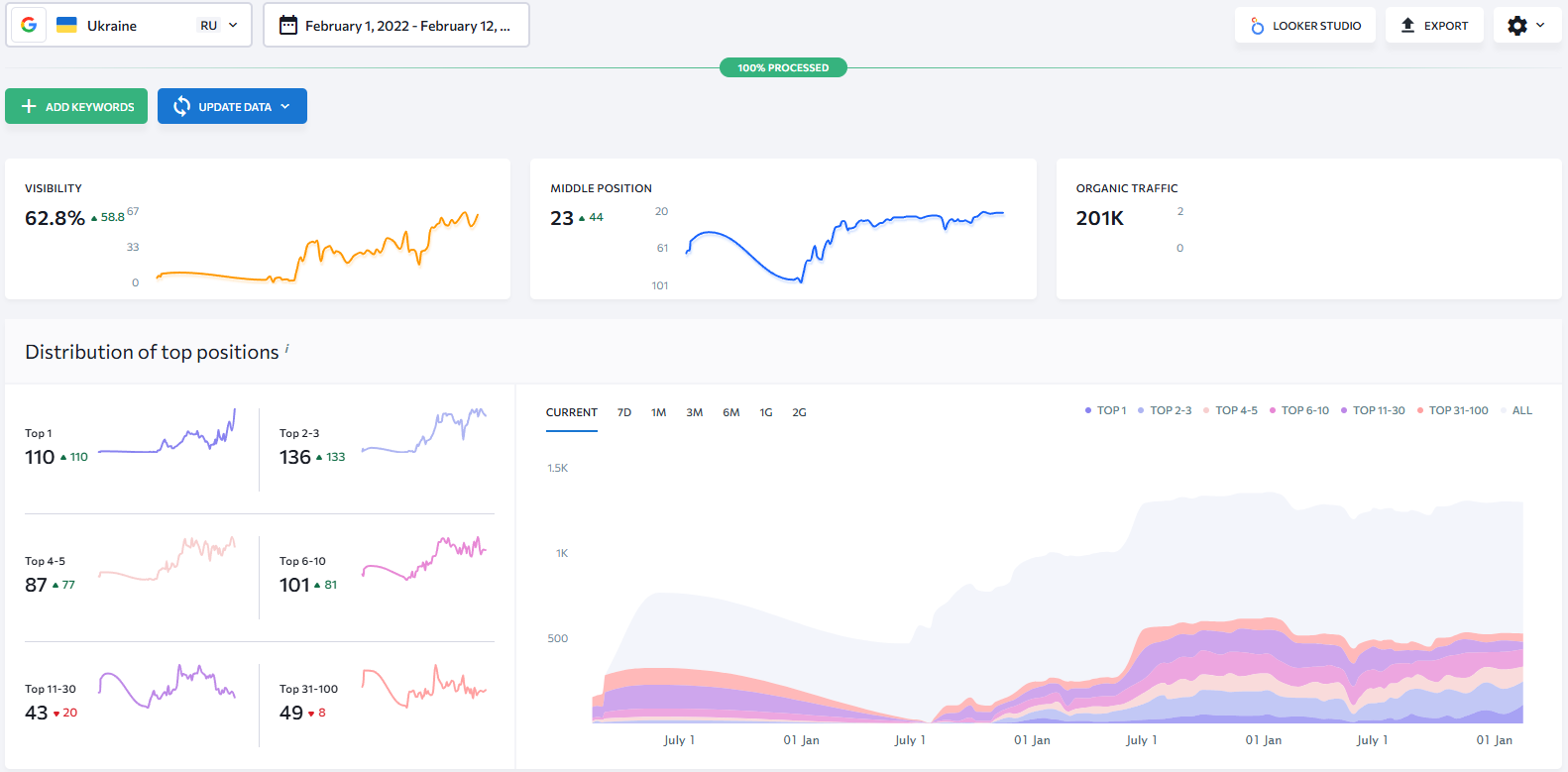
These metrics are significantly stronger than those of the Ukrainian-language version. The Russian-language version demonstrates a consistent upward trend.
- 23 - average keyword position (an improvement of +44 positions).
- +55 new keywords in the Top 1.
- 144 keywords in the Top 2-3.
- 52.2% visibility (an increase of +47.4% over the indicated period).
The number of keywords in the top three results (Top 1-3) is 8 times higher here than in the Ukrainian version (202 queries vs. 25).
Throughout the analyzed period, the project has demonstrated steady positive momentum. Over four years, the number of referring domains has increased 28-fold. This growth of +384 domains has provided a foundation for stabilizing our rankings. In the Russian-language segment, the site holds 55 keywords in the Top 1 and over 200 keywords in the Top 10, whereas the Ukrainian version currently has 12 keywords in the top position. Total organic traffic is recorded at 193K. The performance metrics for the Ukrainian version indicate massive potential for growth through the optimization of Ukrainian-language content. This case serves as an example of successful authority and visibility building.
We have a long-standing history of collaboration with this client, throughout which we have regularly and systematically improved results in both paid search and organic search. Over years of partnership, we have built a solid and reliable relationship based on trust and transparency.
We share a common strategic goal - the continuous development of the site and the achievement of a leadership position in the niche. Every stage of our work is aimed not only at maintaining the high metrics already achieved but at constantly exceeding them as we adapt to new market challenges. We continue to move forward.