



Google Ads offers powerful tools for reaching and engaging new customers. In this case study, we will demonstrate how a local Performance Max campaign can help a small business increase the number of leads from advertising. The project we are working on involves a local business specializing in the repair and maintenance of refrigerators and freezers in California, USA.
Key Aspects and Advantages of Using Google Ads to Promote a Local Business:
- Local ads include the business address, phone number, and a map with directions, making it easier for potential customers to find and contact the service provider
- Ad scheduling allows you to display ads at specific times, such as when customers are most likely to search for services
- Ads are shown to users who are physically near the business or searching for local services, increasing the likelihood of attracting nearby clients
- Responsive ad formats automatically adjust to different devices and ad placements across all Google platforms
- Local targeting ensures that ads are shown to a relevant audience, increasing the chances of conversion and maximizing return on investment
Let’s start.
Refrigerator and Freezer Repair Project
The client for our Google Ads setup service is a company specializing in the repair and maintenance of refrigerators and freezers in Orange County, California, USA.
The company’s founder contacted ITForce at the end of 2021 with a request to set up a new digital sales channel for a website offering household refrigerator and freezer repair services. The goal was to generate as many leads as possible, with a cost per conversion not exceeding $30.
Previously, the client had not used paid search advertising to promote the business online and intended to test this channel for attracting new customers.
Company advantages:
- Same-day repair and maintenance services are available;
- Fully licensed and insured technicians;
- 90-day repair warranty (standard for all repairs) and 6–12 months for compressor and sealed refrigerator systems;
- Discount program is available for specific groups, including veterans and seniors;
- Additional service discount for cash payments.
Let’s move on to the ad setup.
Google Ads Setup for the Service Client
The initial preparation tasks before setting up the ad campaign included installing Google Analytics and Google Tag Manager on the website.
Installing Google Analytics and Google Tag Manager is essential for collecting analytics data and accurately tracking advertising metrics. GTM manages JavaScript tracking codes (tags) on the website, including those needed for remarketing, while Google Analytics is one of the tags managed through GTM. Google Analytics tracks and reports website traffic, user behavior, site performance, and overall marketing effectiveness. It helps identify how visitors interact with the website and whether the content on the pages is clear and user-friendly. Based on insights from Google Analytics, website owners can make informed decisions to strengthen their online presence and achieve marketing goals.
Next, our Google Ads setup work included the following:
- configuring advertising goals for tracking;
- collecting keywords to craft ad copy;
- setting up local and search ad campaigns, as well as a GDN campaign;
- adjusting bounce rate settings (a page view lasting more than 15 seconds is not considered a bounce);
- creating a custom audience segment targeting visitors of websites similar to competitors.
In the ads, we emphasized the company’s local presence and listed the cities where refrigerator and freezer repair services are available. After collecting the audience data, we launched a remarketing campaign to bring visitors back to the website.
Overall, the next steps in ad optimization included:
- analyzing search queries and adding non-targeted or irrelevant ones to the negative keyword list;
- expanding the keyword list based on high-intent queries;
- adding responsive search ads to the search campaigns;
- pausing underperforming keywords and ad groups;
- reviewing recommendations to improve the account quality score;
- adding audiences for observation, analyzing them, and adjusting bids if needed;
- adjusting campaign budgets when necessary;
- setting up additional conversions;
- running a test launch of a Performance Max campaign.
The client’s main KPI was the number of service requests generated by each campaign at a set cost per conversion, not exceeding $30. We had to meet this target and continuously optimize for it. The initial advertising budget was around $1,000 for all configured campaigns. As the ads scaled, the budget gradually increased.
Linking the Google My Business profile to the ad account allows for the use of ad extensions with the company’s address and enables ads to appear on Google Maps. We took advantage of this feature to expand ad placements and enhance visibility within the local campaign setup.
Conversions tracked in the account (Standard PMax, Search, Local PMax):
- phone calls made through the number listed on the website (Google Call Tracking);
- calls from ads (users tapping the phone number extension directly in the ad);
- two contact forms on the website: request for consultation and service request;
- clicks to call — taps on the "Call" button in local ads or Google services after ad interaction;
- local actions – Directions — taps on the "Get directions" button in local ads or Google services after ad interaction.
We continued working on optimizing and improving the performance of the ad campaigns. Our collaboration with the client was temporarily paused at the beginning of the full-scale invasion, but resumed in the spring of 2022. During the next phase, we focused on refining the existing campaigns: analyzing search queries, adding keywords and negative keywords, pausing expensive keywords with no conversions, adding audience segments for observation, adjusting campaign budgets, implementing system recommendations, and running experimental tests. The configured campaigns ran smoothly and consistently generated leads for the client.
In March 2023, as part of ongoing optimization efforts, our team decided to add new campaign types alongside the existing search campaigns—specifically, a Local campaign and a standard Performance Max campaign. We assigned a static value to all conversions and applied the tROAS bidding strategy to both Performance Max campaigns. Additionally, we created personalized banners and a short presentation-style video, incorporating all ad assets into the creative set.
What the final ad creatives looked like:
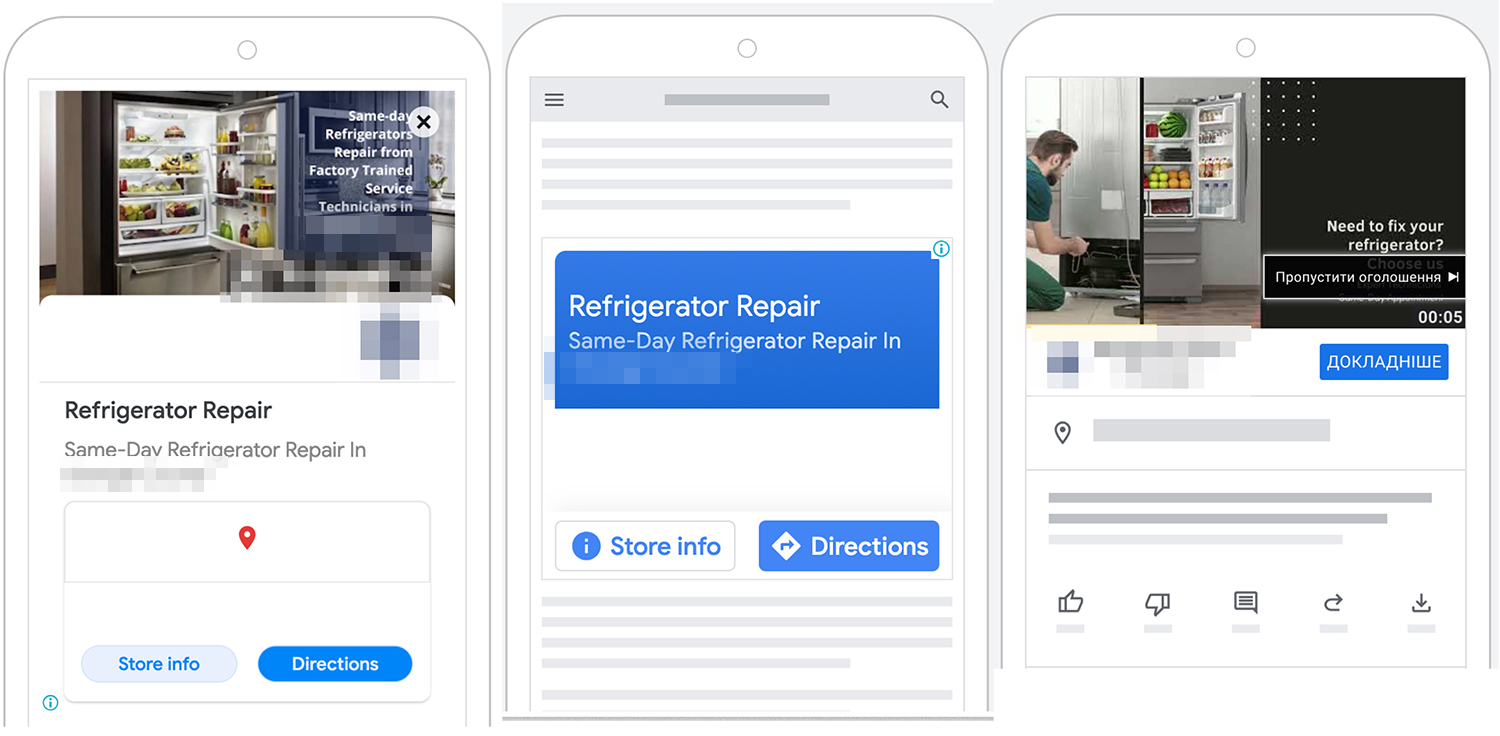
Fig. 1 - Examples of the client's ads
Let’s take a look at the advertising performance results, with a clear breakdown by cost per conversion:
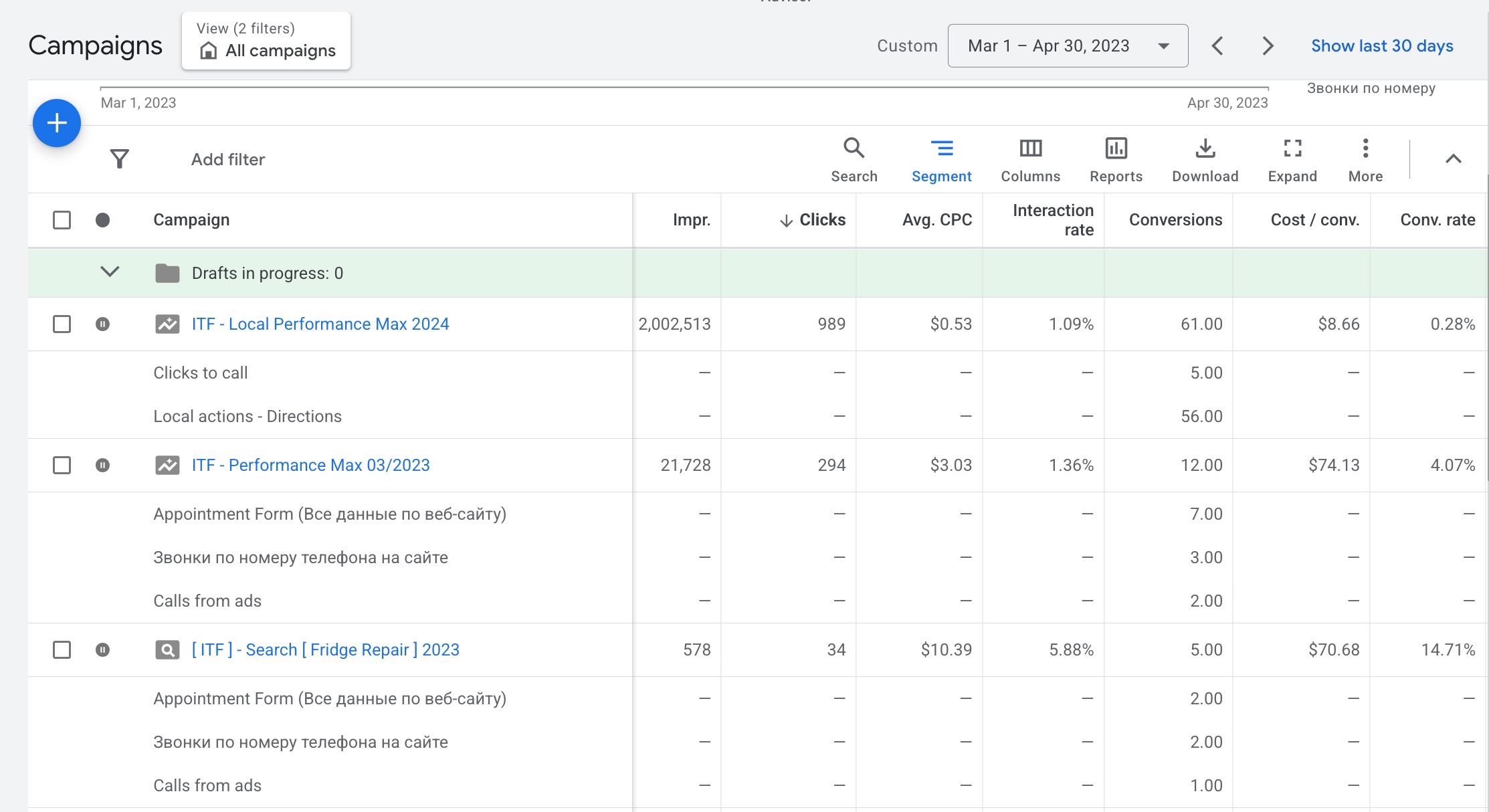
Fig. 2 - Campaigns by Cost per Conversion
- 3 campaigns were running in the account;
- the most effective was the local Performane Max (989 clicks, 61 conversions);
- $8.66 was the cost of conversion;
- $0.53 was the average cost per click.
Performance Max campaigns delivered significantly better results than search campaigns, so in the next phase of the case (July–August 2023), we decided to discontinue search campaigns and increase the budget for Performance Max for two main reasons:
- the campaigns generated more conversions at a lower cost
- the overall budget for all campaigns was limited and predefined
The PMax campaign has great potential because ads are shown on all Google platforms, which allows you to reach all potential users. To do this, the advertising campaign needs to provide certain initial data for analysis: objects and attributes, geographic and demographic data of users, audience signals, ad elements, etc. All the information provided by specialists is analyzed by Google Performance Max artificial intelligence, after which combinations of creatives are tested and adaptive ads are placed in search, Gmail, Maps, the Display Network, Discover Feed, and YouTube. Thus, one campaign reaches users on all available platforms of the Google system. We focused on local campaign goals.
In June 2023, we switched to tracking metrics in Google Analytics 4, where we set up advertising goals and imported conversions from GA4 into the Google Ads account.
Tasks completed in July–August 2023 included:
- applying system recommendations to improve the account quality score;
- analyzing search queries and adding keywords and negative keywords;
- pausing underperforming keywords;
- adjusting bidding strategies and budgets;
- adding a general (non-geo) query group to the search campaign;
- adding new asset groups (without audience signals, since campaigns had; already collected sufficient data) to the existing Local and Standard PMax campaigns;
- pausing the search campaign;
- reallocating the search campaign budget to Performance Max;
- adjusting target ROAS settings;
- also during this period (June), conversion tracking was migrated from Universal Analytics to GA4.
Let’s review the advertising performance results and, for clarity, break them down by cost per conversion:
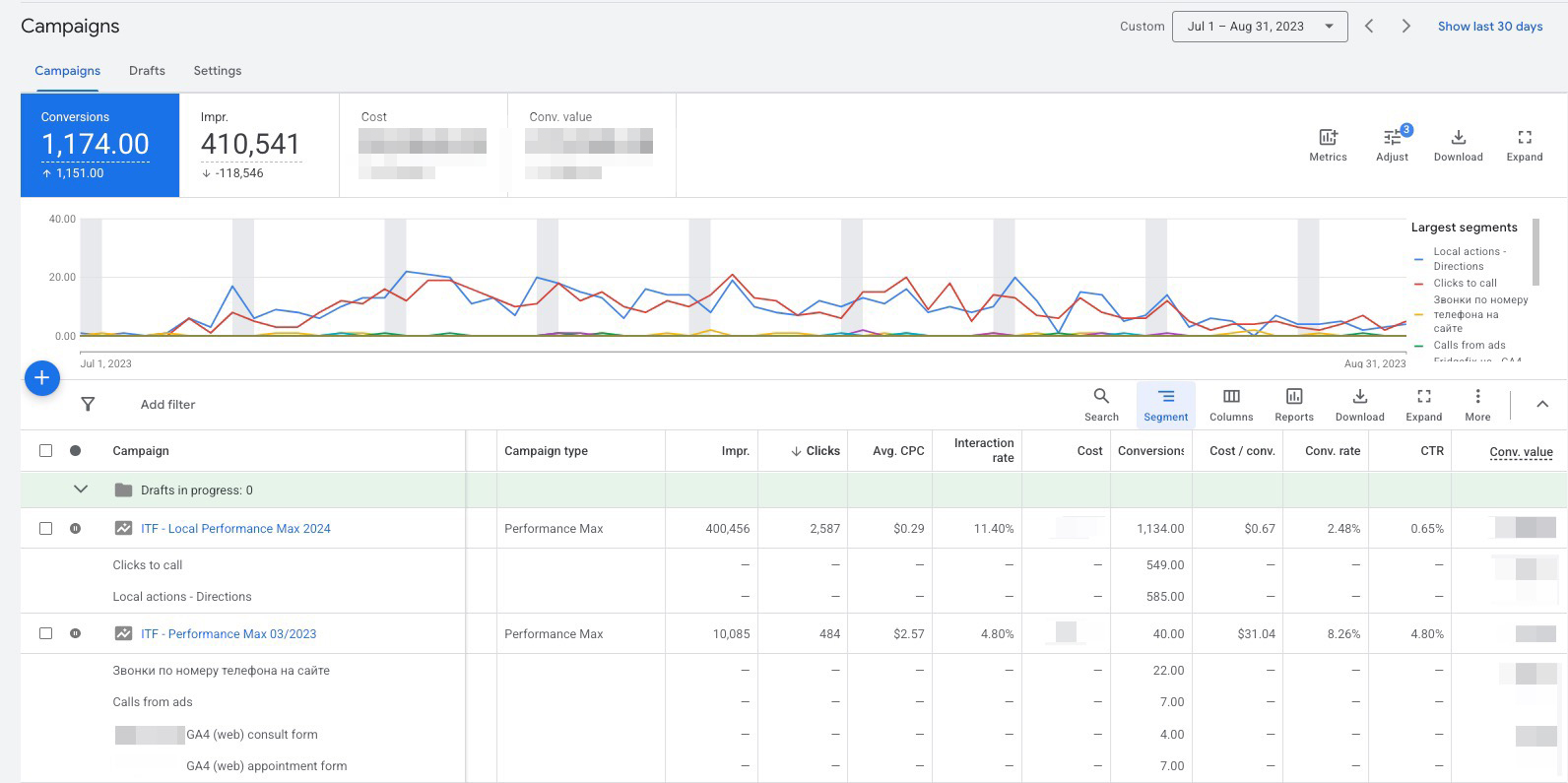
Fig. 3 - Google Ads Campaign Performance in July–August 2023
The configured Local Performance Max campaign proved to be the most effective, with the following results:
- 2,587 ad clicks;
- 1,134 conversions;
- $0.67 cost per conversion;
- $0.29 average cost per click.
This confirmed our assumption that Local Performance Max would be the most efficient solution for attracting local customers in this case.
Google Ads Results for the Refrigerator Repair Company
Is paid search advertising effective for a company offering household refrigerator and freezer repair services? Let’s take a look at the overall traffic data for July–August 2023 from Google Analytics 4 to see how much traffic was generated by Google Ads:
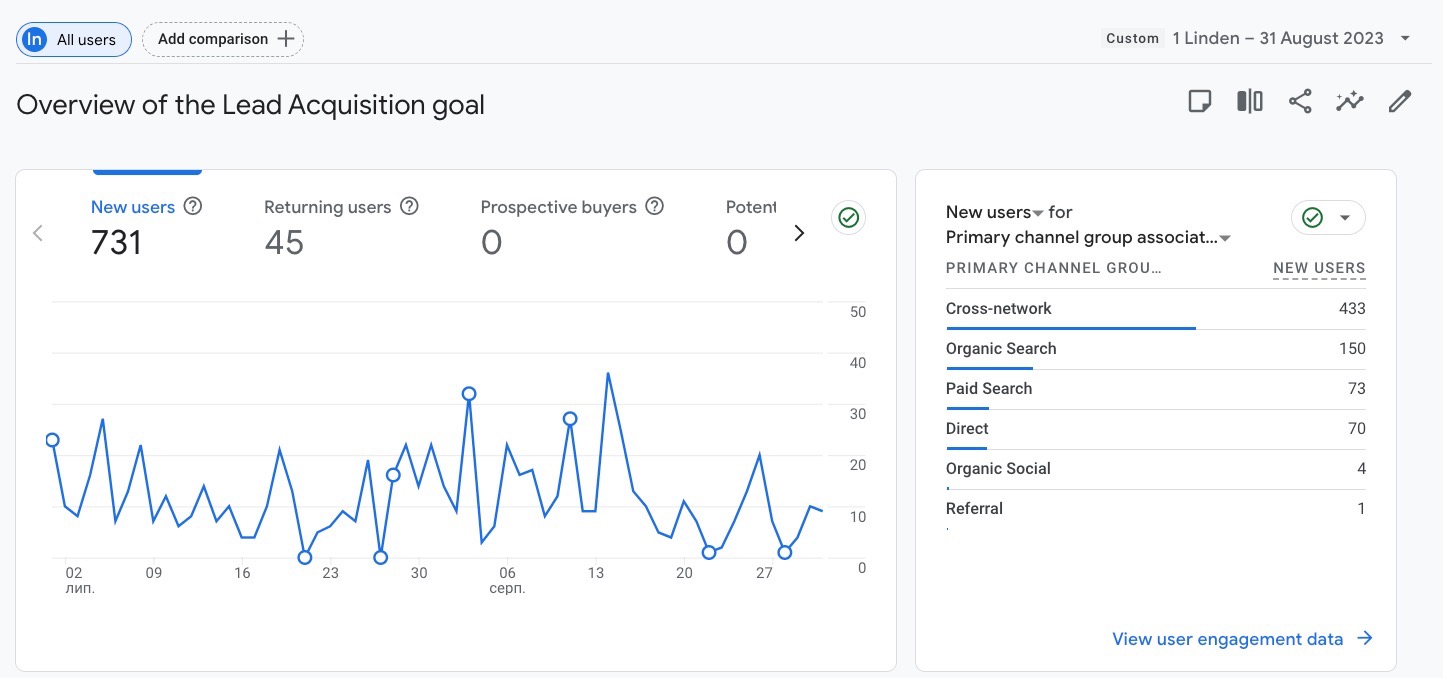
Fig. 4 - GA4 Traffic Acquisition Data
Cross Network and Paid Search are the primary paid advertising channels, and together they drive the majority of traffic to the website. This indicates that the advertising is effective—it brings in new, relevant visitors who perform a significant number of targeted actions. This includes not only increased traffic but also improved user engagement on the website. Thanks to properly configured campaigns, we were able to attract an interested audience that actively interacted with the site content and used the services offered by the client.
We are using the periods of March–April and July–August 2023 to compare advertising performance in this case. Let’s review the ad campaigns for these selected timeframes in terms of the number of conversions and their cost.
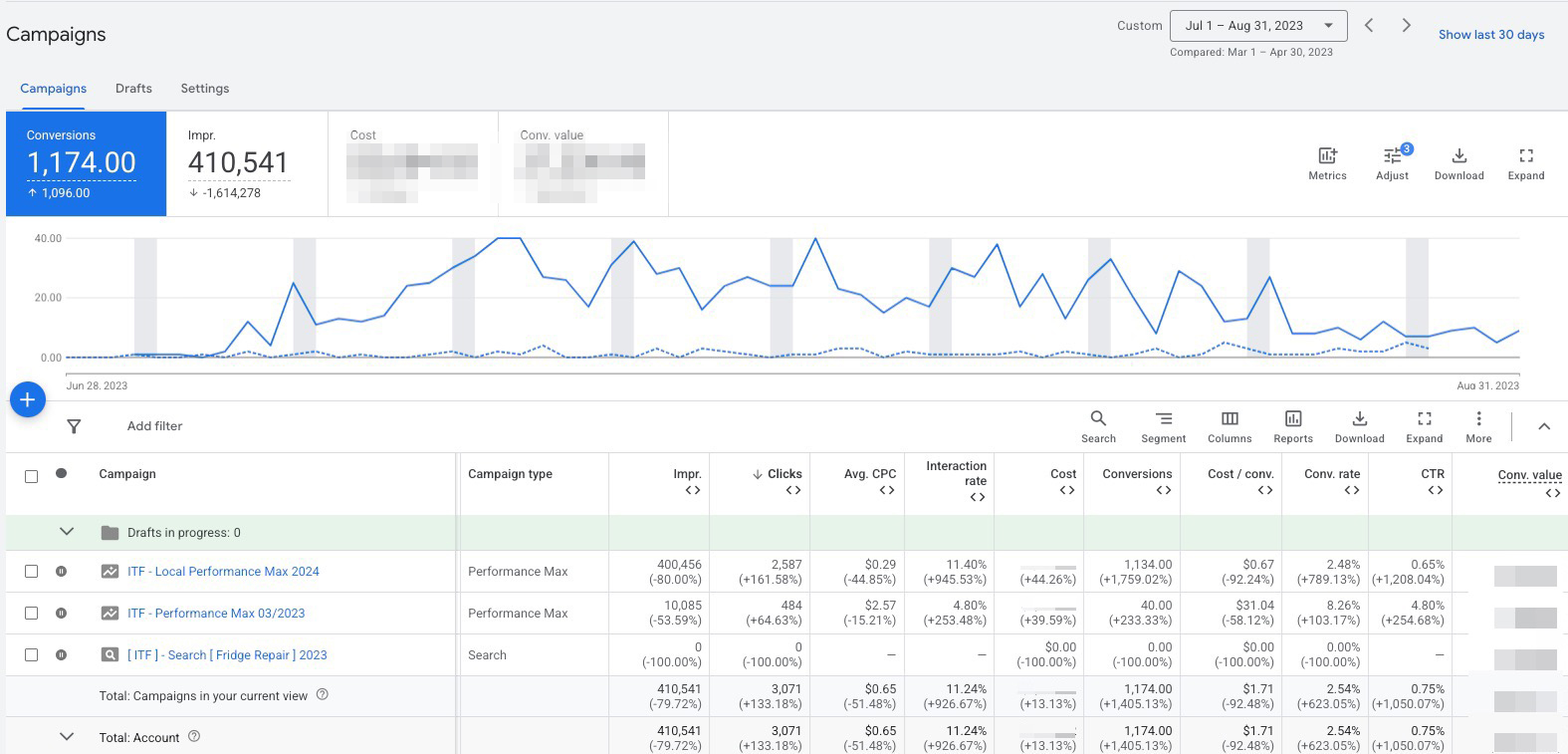
Fig. 5 - Google Ads Performance Comparison by Periods
The total number of conversions in the account increased by 1,405%, while ad spend rose by only 13% (including local conversions). If we consider only tracked calls or on-site actions (the conversions counted in the standard Performance Max campaign), then:
- +233% increase in the number of such conversions
- –58% decrease in cost per conversion
- +39% increase in campaign spending
The most effective campaign launched was the Local Performance Max, which delivered a +1,759.02% increase in conversions while reducing the cost per conversion by 92%. Ad spend rose by 44%, which was fully anticipated. At the same time, the average cost per conversion across the account is $1.71, significantly lower than the initial KPI target of $30 set at the beginning of the collaboration.
Сonversion data for each campaign goal configured:
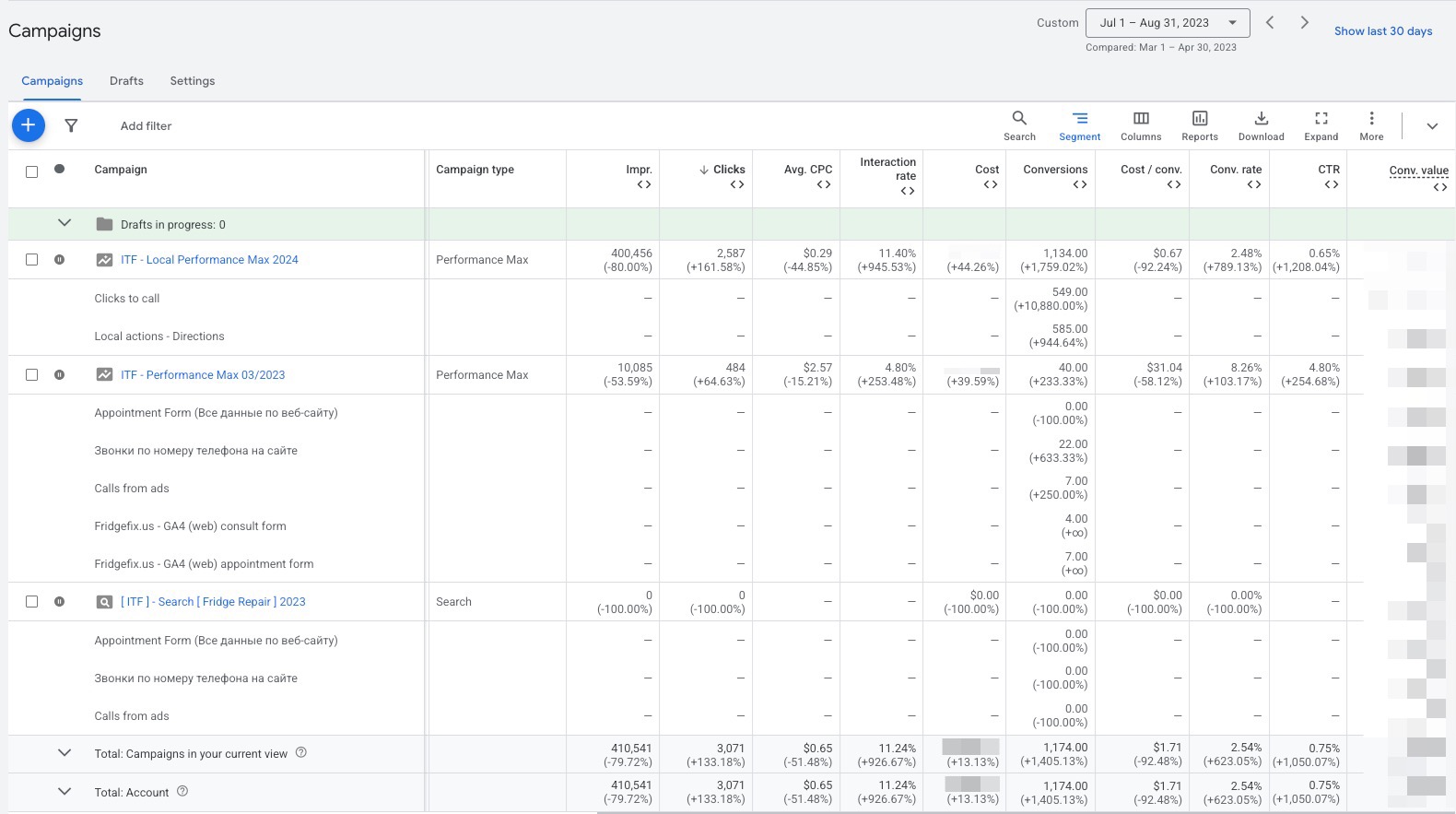
Fig. 6 - Сonversions by ad campaign goals
The most frequently completed goals are clicks on the "Get directions" and "Call" buttons in local ads (or in Google services after interacting with an ad). This means that the Local Performance Max campaign is the most effective across most key metrics, generating the majority of leads at an acceptable cost per conversion. Our client receives the majority of leads specifically through the local campaign on Google Maps.
The Local Performance Max campaign in Google Ads is a powerful automated solution for businesses focused on attracting local users. By leveraging cross-channel reach across the Google ecosystem, advanced targeting, and artificial intelligence, it ensures efficient use of ad spend and maximum return on investment. The results observed in this case demonstrate that it is a highly effective advertising tool for local businesses.
We track campaign performance, monitor the geographic distribution of impressions, and exclude irrelevant locations every week. We also adjust bid settings across devices and fine-tune the ad schedule. We provide recommendations for strategy adjustments and budget reallocation based on the collected data. Our work focuses on ongoing ad optimization in line with the client’s defined KPIs.