Google Ads for a store selling barber supplies in Slovakia





In this case study, our Google Ads configuration and management work coincided with the off-season, a period when the vacation season in Europe leads to a significant decrease in purchasing activity. We managed paid search campaigns for a client in the professional men's grooming niche, catering to barbers and barbershops.
Despite the challenges of this off-season slump, we successfully ensured the stable and effective performance of the advertising campaigns.
About the Client
BeautyDepot.sk - is an online store specializing in men's cosmetics, grooming products, and professional supplies for barbers and barbershops.
The company positions itself as one of the premier online retailers for men's cosmetics, fragrances, and accessories.
Location: Bratislava, Slovakia. The store also maintains a physical retail presence in Bratislava.
Target audience
- Professionals (B2B): Barbers and barbershop owners. This is a consistent audience seeking professional-grade, high-quality, and reliable products for their daily operations. They prioritize efficacy, cost-effectiveness, and the fast-acting nature of the products.
- End consumers (B2C): Individuals looking to maintain their grooming routine at home. They tend to purchase the same brands used by their stylist, making barber recommendations a key sales channel.
Marketing and sales channels
- Focus on Expertise: Clients trust the opinions of professionals. Therefore, marketing materials should emphasize expertise, professional use, and recommendations from stylists.
- Seasonality: The largest sales slump occurs in July/August. Most people in Europe go on vacation, users spend less time at home, order less online, and their overall purchasing activity declines.
- B2B and B2C Marketing: It is better to have separate strategies for professionals (offers for barbershops, wholesale discounts) and retail customers (website advertising, social media), as the purchasing behavior of these user segments differs.
- Influence of Trends: The niche is highly sensitive to trends in men's haircuts and grooming. The popularity of beards or, conversely, a clean-shaven look directly influences the demand and sales of relevant products.
We started the collaboration in May 2025. The client's main KPI was a ROAS above 10,0% across the account.
Workflow
The work began with an audit of the current situation in the client's account and the development of our recommendations.
Post-audit recommendations for optimizing advertising campaigns
1. Ad extensions:
- Use all available extension types, including Phone Number, Structured Snippets, and Promotions.
- Verify the relevance of existing extensions.
2. Audiences:
- Add new audiences in Observation mode to track system recommendations.
3. GDPR compliance:
- The cookie consent banner does not meet GDPR requirements. It must include 3 equally visible buttons: Accept All, Reject All, and Customize.
- Banner visibility: The banner does not appear until the email input window is closed.
- Links: The link from the banner leads to a third-party site, even though the client's site has a dedicated cookie policy page.
4. Keywords and semantics:
- Consider expanding the semantics, specifically based on conversion search queries, if they are relevant.
- Regroup keywords for better performance.
5. Ads:
- Do not pin headlines in responsive search ads, except for the first position.
- Add calls to action (CTA) and benefits in numerical format (e.g., number of years in business, reviews, customers, orders, products/brands).
6. Budget and strategies:
- Recommendation to change the budget by no more than 20% per iteration. Sudden changes can lead to a loss of learning progress for automated bidding strategies.
- Do not use the text asset optimization feature, as it may decrease ad quality or distort their content.
- Consider pausing asset groups with low performance.
7. Shopping campaigns:
- Exclude the lowest-value products from impressions.
- Move products that have not received clicks in the last 2 months into a separate campaign with a small budget.
- Test Performance Max asset groups without creatives, using only the product feed.
- If possible, add GTIN and MPN attributes to the product feed.
8. Analytics and conversions:
- Configure conversion data transmission directly from the site. Mark these events as secondary, and compare the data with similar events in Google Analytics 4 after 1-2 months.
- Set up click tracking for phone numbers, email addresses, and Telegram links if orders are placed through these channels.
- Recommendation to redistribute a portion of the budget towards campaigns with high ROAS.
The target market is Slovakia. This implies that advertisements and creatives must be adapted to the Slovak language and local cultural nuances.
To configure conversions for direct transmission to the Google Ads account, we recommended installing GTM. Alternatively, events can be configured directly within the website's source code.
Consent mode
For projects in the Eurozone, it is critical to comply with the user consent regime.
Consent Mode is a tool that allows Google Ads and Google Analytics 4 (GA4) to adapt data collection based on the user's consent to the use of cookies.
It is important to configure consent mode correctly.
Since March 2024, Google has stopped counting conversions for users located in the European Economic Area (EEA) without a correctly configured Consent Mode on the website. Correct configuration of Consent Mode allows for a more accurate picture of user behavior and the effectiveness of your advertising campaigns, even if not all visitors have consented to tracking. Implementation was carried out on the client's side.
Paid search ads were already being run in the client's account, but we decided to move away from a general approach (combining campaigns and increasing the budget) to further segmentation based on performance results. Therefore, we reconfigured the campaigns from scratch.
The ad schedule is set to 24/7, as people purchase products at any time. We will reach the audience on both mobile and desktop devices. Ads were configured for all product categories, but with a focus on 5 priority brands.
Campaigns to be configured:
- PMax for cosmetics (all brands).
- PMax for tools (all brands).
- Standard Shopping for all products.
- Brand campaign.
- Test campaign consolidating all brand search queries into one campaign.
- DSA.
The scope of paid search setup and management included verifying the correct connection and data transmission from GA4 and goals. Tasks also included setting up e-commerce tracking.
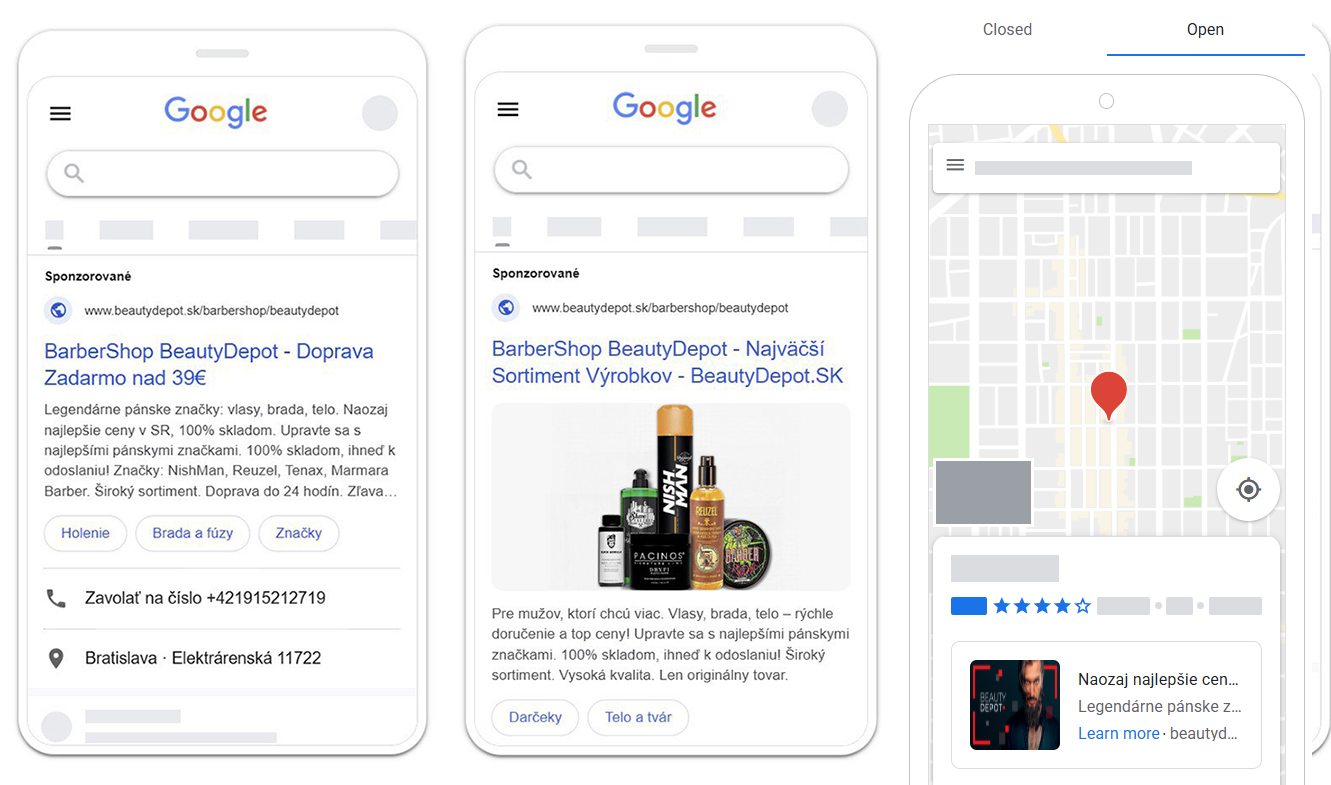
Examples of created creatives:
General tasks for the first month of cooperation:
- Setting up conversions that are transmitted directly to the Ads account.
- Processing search queries, adding negative keywords.
- Checking products in the feed.
- Pausing ineffective products when necessary.
- Pausing keywords/groups/campaigns when necessary.
- Processing system recommendations to improve the account quality score.
- Adding the Image extension.
- Adding the Promotion extension.
- Analyzing and adjusting bidding strategies and budgets.
- Excluding ineffective geographic regions when necessary.
Experiment with a branded search campaign
At the beginning of our work, we set up an experiment with a branded search campaign using a manual bidding strategy. We excluded brand queries from PMax; instead, they were to be handled by a combination of:
- Google Shopping for displaying products based on brand queries.
- Branded Search for text ads based on the same queries.
Experiment with manual bidding:
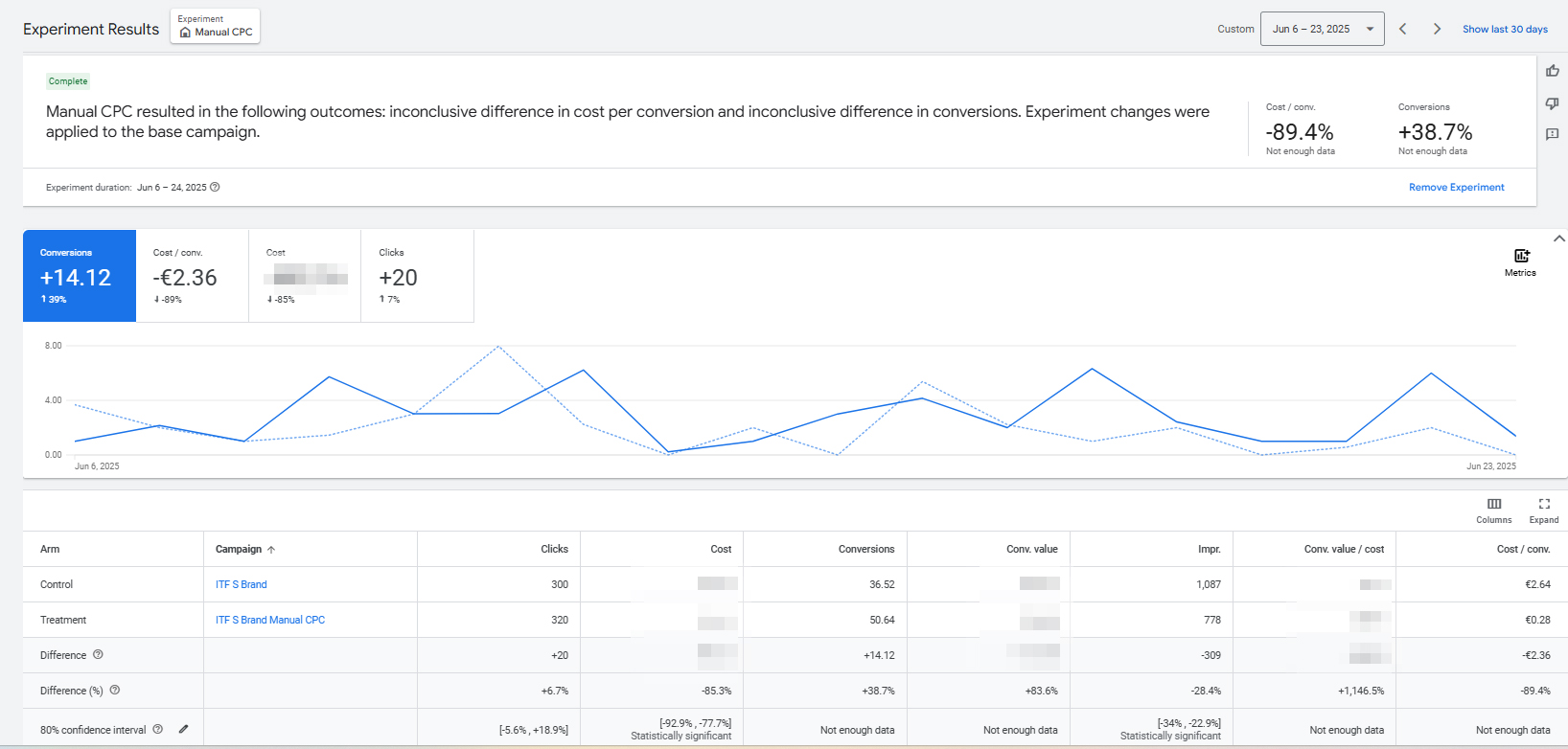
- Conversions. The test campaign generated 50,64 conversions, while the control group generated 36,52. This represents a growth in conversion volume of 38,7%.
- Conversion value increased by 83,6% in the test group. The total conversion value saw an even more significant increase.
- Cost per click decreased by 89,4%, and this is a key indicator. The test campaign using manual CPC significantly lowered the cost per click (from €2,05 to €0,28).
- Cost per conversion decreased by 82,16%. Manual bidding led to a significant reduction in the cost of acquiring a single conversion.
- ROAS in the test group increased by 1146,5%, confirming that manual bidding proved to be much more cost-effective.
In short, manual bidding enabled us to increase the number of conversions, boost conversion value, lower both the cost per click and cost per conversion, and significantly increase ROAS. The brand search experiment proved successful, so we applied these settings to the main campaign. Ultimately, manual bidding contributed to achieving higher performance metrics.
Shopping campaign
Google Shopping works as a supplement to branded search. The goal is to ensure that when a query contains the store name, the user sees not only a text ad but also product cards.
Advantages of the chosen strategy:
- Maximum reach: the client's store occupies more space on the SERP, displaying both a text ad and product cards at the same time.
- Improved user experience: a user who already knows the brand and is searching for it receives the most relevant information, specifically products they can purchase.
- Effective budget allocation: we can control which campaigns work on branded queries, preventing competition between our own campaigns and optimizing costs.
Thus, the Shopping campaign became part of the client's brand strategy, helping to effectively protect brand traffic and provide users with the best interaction experience with advertising.
Next, we decided to test a hypothesis and expand the current campaign: add 3 brands that are most often associated with the client's store. The client assumed that these brands are magnets for attracting traffic, as users often search for them along with the store name or in the context of similar products. Adding specific, most popular brands can increase ad relevance and attract more targeted traffic. Testing will help determine how effectively the selected brands attract users and whether it is advisable to further isolate them in the campaign.
Local PMax
In June, we received a request from the client to test and set up a local campaign. To do this, we:
- linked the GMB and Ads accounts - this is the main requirement for launching local campaigns, so Google Ads can receive information about the company's physical address to display it in ads;
- set up a Local campaign;
- set geographic targeting to Bratislava;
- added an Address extension - it uses data from Google My Business to show the address, route, and phone number directly in the ad.
The mission of the Local campaign was not online sales but attracting customers to the offline store. That is why we chose 2 key events as conversions for the Local campaign:
- getting directions - to encourage the user to get directions to the store;
- click-to-call - to encourage users to call the store.
Weekend budget optimization
During the project, we noticed a decline in conversions and an increase in their cost over the weekend. This is quite typical, as user behavior changes.
Therefore, we configured automatic budget adjustments:
- decreasing the budget for the weekend: we created an automatic rule that reduces the budget by 20% on Friday at 22:00, which helps avoid overspending during periods when ads are less effective;
- increasing the budget for weekdays: to compensate for the decrease on the weekend, we set up a budget increase of 25% on Monday at 06:00, to be able to maximize the use of the period of highest activity and conversions.
Customer lists
Adding customer lists to Google Ads is an effective tool that helps significantly improve the performance of advertising campaigns. In July, we received the store's customer list and added it to the account to increase ad effectiveness:
- Google encrypts this data and matches it with its user databases;
- If a match is found, the user is added to the audience;
- This way, we can target ads to them (e.g., remarketing).
We added the provided customer lists as audience signals to the PMax campaigns — this helps the Google algorithm identify the most valuable users faster and show them ads. Thus, in our case, we do not use classic remarketing campaigns, as their functions are effectively performed by PMax campaigns. Performance Max uses Google's machine learning capabilities to reach audiences across all platforms and in all formats automatically. This reach also includes those users who have already interacted with the site or the brand. Thus, PMax independently identifies and targets potential customers during the remarketing stage.
Purchase Ads conversions
Later, we switched conversion accounting to Purchase Ads, meaning we track them directly from Google Ads. The advantage of this method is that conversion tracking via Google Ads provides a more complete picture of the impact Google Ads has on sales. This allows the system to optimize bids more effectively and achieve higher ROAS.
Here is why the account ROAS increased after switching to conversion tracking from Ads:
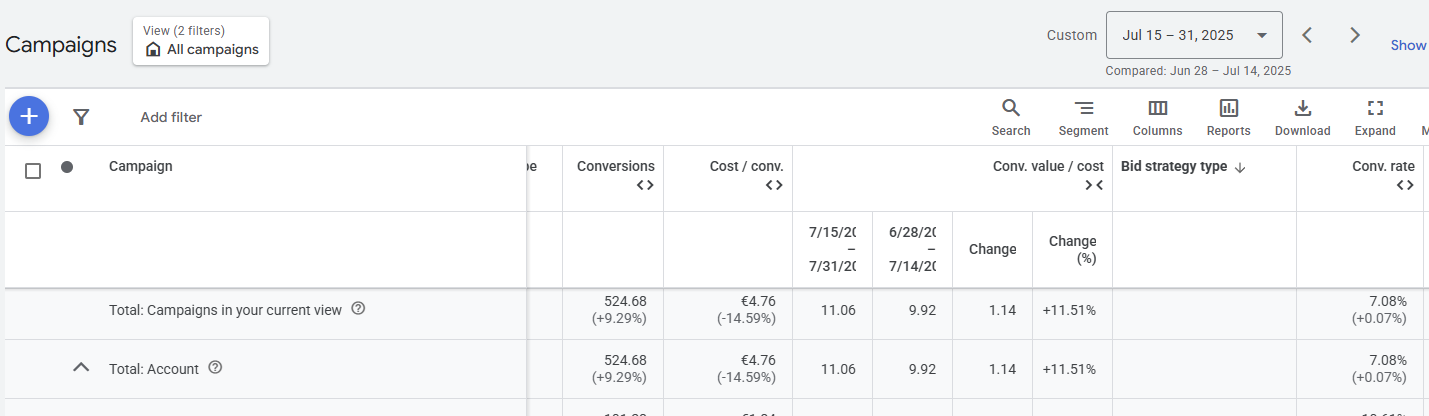
This happened because of a change in the attribution model used by Google Ads. The Ads purchase tag counts all user interactions with Google Ads along the path to conversion. In other words:
- A user first clicks on a Google ad;
- The user then returns via another source (such as Facebook) and makes a purchase;
- Google Ads may attribute a portion of this conversion value as a purchase via the ad.
This results in a higher total number and value of conversions visible to the Google Ads system, which in turn leads to a higher ROAS.
not set
During our work, we discovered that the client had the same remarketing tag for the current website and another domain for a different country, which was not ideal. We provided consulting and informational support, and passed the problem solving on to the client's developer.
Location-based queries
Later, we received a task to collect location-based queries for all of Slovakia to launch a test campaign. However, the volume of search queries containing geographic names turned out to be extremely low. Furthermore, these queries were already effectively covered by the Local PMax campaign. Creating a separate campaign for location-based queries would have been inefficient in terms of time and budget, and it would not have led to a significant increase in conversions. Therefore, we decided to continue working with the Local campaign.
General list of work for Google Ads
1. Optimization and adjustment of campaigns
- Analyze and adjust bidding strategies and budgets as needed.
- Pause less effective keywords, ad groups, or campaigns when necessary.
- Segment campaigns for more precise targeting.
2. Work with keywords and queries
- Process search queries and expand the list of negative keywords based on non-target queries.
- Add new keywords based on target search queries.
3. Performance Max (PMax) configuration
- Adding new asset groups, specifically with creatives.
- Pausing less effective asset groups in PMax.
- Adding new audience signals to optimize campaigns.
- Checking PMax campaign placements and adding irrelevant ones to exclusions.
4. Analytics and tracking
- Setting up enhanced conversion tracking.
- Configuring conversion values in local campaigns.
5. General optimization
- Working with system recommendations to improve the account quality score.
- Adding customer lists to the account for use in remarketing.
Throughout our collaboration, the client has demonstrated a high level of trust and engagement, which facilitates the optimization of advertising settings. The client's openness to experimentation and the absence of any issues attest to effective communication and mutual understanding. This creates favorable conditions for a long-term partnership.
Results
Brand campaign experiment
The test combination of Google Shopping and Brand Search delivered the desired result regarding impression control. However, it led to a decrease in the total budget, the number of conversions, and the value of those conversions. This indicates that the PMax campaign is more effective at using branded queries to generate sales than separate campaigns. Based on the data obtained, we decided to return to showing PMax campaigns for branded queries as well. This step allows us to utilize the full potential of Google machine learning to maximize conversions and their value.
Overall advertising performance
Traffic acquisition volume
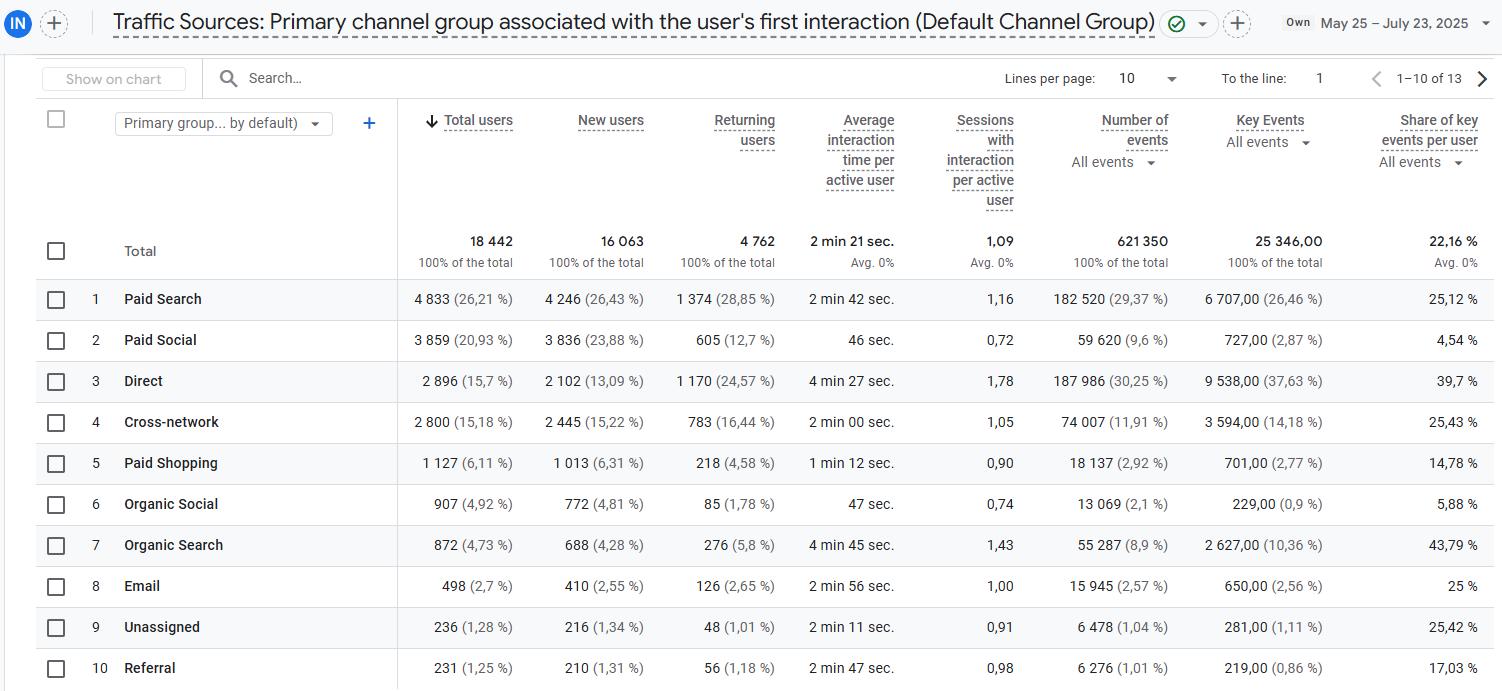
47.5% of traffic was generated by paid search channels (Paid Search, Cross-network, and Paid Shopping). Paid social media ads rank second.
Furthermore, Paid Search is the largest paid advertising channel, which demonstrates the high effectiveness of search ads. The average engagement time is 2.42 minutes, indicating that users who arrive from paid search actively interact with the site. This channel generated 26.46% of key events, surpassed only by direct traffic (Direct: traffic from saved browser bookmarks, entering the URL directly, etc.). This proves that paid search is an effective source of conversions.
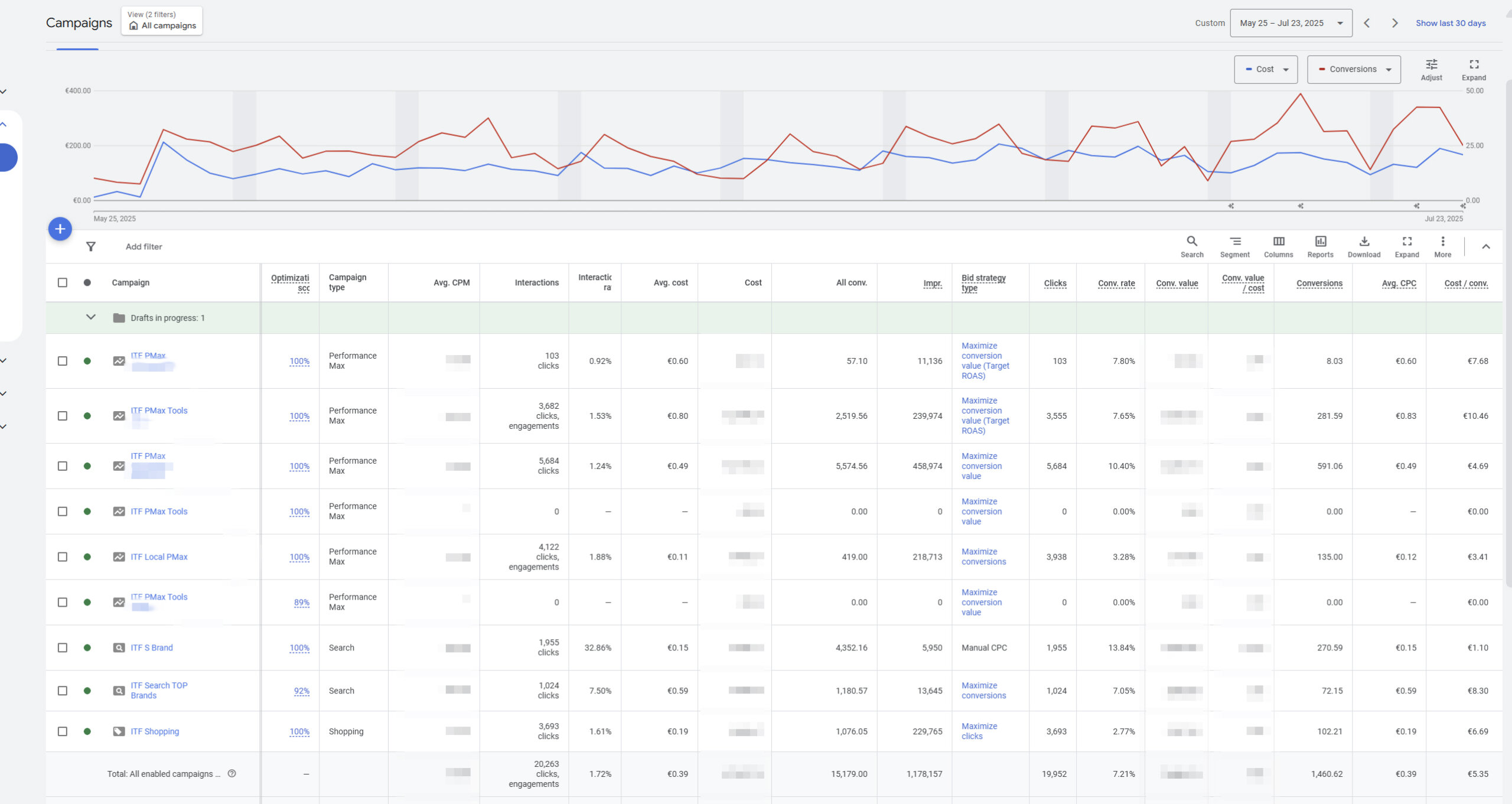
Google Ads campaign data:
- 1,440.62 transactions
- 9.78 ROAS
- 15,179 total conversions (including Local PMax)
- 7.21% conversion rate
- €5.27 cost per conversion
Search Brand and Search Top Brands campaigns have the highest CPM, which is normal for branded queries, as the audience is familiar with specific brands and is actively searching for them. PMax campaigns and Local PMax specifically have the highest number of interactions, which highlights their effectiveness in engaging users. PMax campaigns again have the highest number of total conversions, demonstrating their high effectiveness in achieving the final goal. This is especially true for branded PMax campaigns, which are the leaders in the number of transactions. Performance Max campaigns are the core of the advertising strategy, generating the majority of conversions and revenue.
A 7.21% conversion rate shows that over 7% of visitors who interacted with the ads completed a target action (purchase, call, etc.). This figure indicates the relevance of the ads and the effectiveness of the landing page.
A ROAS of 9.78 means that for every euro spent on advertising, our client received 9.78 euros in revenue. This demonstrates the high efficiency of advertising investments. The average cost per conversion of €5.27, considering the high ROAS, is acceptable and allows for stable profit generation.
High ROAS and conversion rate figures indicate successful targeting of the core audience and maximum return on ad spend.
Over the past week, we have observed a decline in sales from advertising. This is due to seasonality and vacation periods in Europe. During this time, people spend less time at home and make fewer online purchases, which naturally leads to a decrease in demand.
We are currently working on optimizing and improving our results.