



Project for comprehensive website promotion in the car insurance niche. SEO efforts were conducted from December 2023 to December 2024. As of December 2024, the partnership was suspended at the client's initiative. According to the client's official notification, the decision was driven by a temporary reduction in business activity.
The advertising campaigns we configured remain active within the Google Ads account and have been running unchanged for over a year, as the client has not made any adjustments since the conclusion of active management.
About the Client
The client is a car insurance company operating in the Ukrainian market (Geo: Odesa), specializing in insurance services. They are locally based in Odesa.
The client's core services include:
- MTPL (Motor Third Party Liability Insurance): mandatory liability insurance for vehicle owners.
- Green Card insurance: mandatory policy for traveling abroad with a private vehicle (Europe, Moldova).
- CASCO insurance: voluntary vehicle insurance covering damage and theft.
- Health insurance: for individuals traveling abroad..
- Firearm owners insurance.
List of the company’s key advantages:
- 24/7 support: Manager consultations available around the clock.
- Any format: Option to receive an electronic policy or a hard-copy original.
- Free delivery: Courier delivery of documents across Odesa to the home or office.
- Fast payouts: The company ranks in the Top 10 for compensation payout timelines.
- Online claims handling: Remote document submission upon the occurrence of an insurance event.
- Local presence: Physical offices located in the center of Odesa.
- Strong reputation: Top-tier ratings and the highest volume of reviews on Google Maps and Facebook.
The primary objective of the partnership was to secure Top search engine rankings for priority segments - Car insurance and Green Card, while scaling visibility for the company's ancillary services. We initiated the project with a comprehensive analysis of the niche and the competitive landscape.
Niche and competitor analysis
It should be noted that for competitor analysis, we also included companies whose GEO did not align with the client’s site, as they operate nationwide across Ukraine and provide insurance services directly. Given that these direct competitors are not aggregators or intermediaries, we used their backlink profile metrics as a benchmark to determine the optimal volume and structure for the client’s link profile.
Conclusions and recommendations for promotion in the Odesa GEO:
1. Competition in Top search results:
- 90% of Google’s Top 10 results for the primary query "car insurance Odesa" are occupied by major financial portals and aggregators. Effectively competing with such resources is nearly impossible, as they possess massive audiences, high authority, and substantial promotion budgets.
- Rankings are stronger for lower-frequency queries. For instance, the site holds a Top 5 position for "green card Odesa" and Top 6 for "CASCO insurance Odesa".
- The main competitive advantage of the client’s website is its strong regional association with the .od.ua domain zone.
2. Semantic core and optimization:
- It is important to collect semantic keywords not only for queries containing the toponym “Odesa”, but also for more general phrases such as “car insurance” or “car insurance”.
- The search volume of these general queries must be verified specifically for the Odesa region to optimize pages accordingly, as competitors secure a significant share of traffic through these keywords.
3. Off-page promotion:
- Competitor analysis revealed that high-authority domains often secure top positions even without a high volume of direct links to specific service pages, leveraging their overall Domain Rating (DR).
The strongest players have been operating in the market for up to 19 years, which gives them a significant authority advantage and allows their pages to rank higher even in the absence of direct external links to specific services.
- The client’s website had around 200 pages indexed, while large aggregators had tens or even hundreds of thousands. This indicated the client’s narrow specialization compared to major financial portals.
- At the onset of the partnership, the client’s site ranked for 119 keywords, a figure significantly lower than that of its competitors. This indicated a critical need for substantial semantic core expansion.
- The client’s current traffic level was very low compared to even the smallest competitor. The majority of traffic in the niche was captured by large aggregators, which was a logical outcome.
- Unlike some major companies, the client’s website had a blog, which was a positive factor for attracting informational traffic and improving internal linking.
- Almost all market leaders actively use Facebook and YouTube, with some also developing Instagram, Twitter, and Telegram bots. The lack of social media activity limited channels for acquiring backlinks and referral traffic.
- The client’s website was built on WordPress, which was convenient for SEO optimization and rapid implementation of changes. Most large competitors used custom-built systems or frameworks (such as Laravel), driven by the scale of their projects.
The primary gap between the client’s resource and competitors lay in domain authority and the scale of the semantic core. Aggregator competitors captured 90% of traffic for high-frequency queries. Consequently, the promotion strategy had to be built on leveraging the regional domain (.od.ua) advantage and focusing on medium- and low-frequency queries, where the chances of securing a Top 5 ranking were more attainable.
Technical audit of the website
List of identified errors:
- Incorrect Canonical tags: Some pages had incorrectly specified canonical tags, negatively affecting Google indexing.
- Blog pagination errors: When navigating to the second page, users were redirected back to the first. Additionally, outdated Rel Next/Rel Prev tags were identified.
- Language version issues: It was necessary to fix the hreflang tags for all pages and add the x-default value. An unnecessary regional binding was discovered in the lang attribute of the Russian version.
- Crawl waste pages: A large volume of technical pages (separate pages for each review, advantage, or payout) was identified as wasting the crawling budget. These required a 410 (Gone) status code.
- External links: Links passing equity to third-party resources and DOC files leading to external sites were identified.
- Duplicate H1 tags: Multiple H1 tags were recorded on certain pages, which diluted keyword relevance.
- Robots.txt: The file required adjustments to ensure proper access for search engine crawlers.
- 301 redirects: Redirects from the legacy site pages were missing.
- Sitemap (Sitemap.xml): The sitemap contained crawl waste and pages returning status codes other than 200 OK.
- Indexation blocking: Technical pages (search results, order confirmation pages) were open for indexation.
- Structured data:
- Schema.org errors (incorrect URLs on the homepage and missing address details in the contact information).
- Open graph errors (og:url and og:locale).
- Page speed: Certain pages exhibited poor performance metrics (specifically INP and LCP), which could lead to user churn.
- GMB (Google My Business) errors: Technical integration of reviews and maps via HTML code/iframe was required.
- Mobile version: In the Ukrainian version's menu, the "Reviews" item was incorrectly displayed.
- Meta tags: New meta tags configured in the admin panel were not rendering correctly on the live site.
- Broken links in blog: Several articles contained links returning 404 status codes.
To formulate an effective SEO strategy, we conducted a usability audit to ensure not only an influx of visitors but also a seamless user experience, which directly impacts brand loyalty and sales conversion.
Usability audit
Errors identified during the usability audit:
1. Calculator Cost calculation
- Non-functional buttons. The "Calculate cost" button failed to trigger when selecting specific vehicle types: Passenger Car Trailers, Truck Trailers, and Scooters.
- Missing options. In the Russian version of the site, the "Scooter" category was absent from the vehicle list.
- Logic errors. Selecting "Scooter" triggered an engine displacement selection window, whereas the calculation logic for this vehicle type should have mirrored that of motorcycles.
- Incentive issues. Clicking on the "50% discount" option failed to open the list of eligible citizen categories.
2. Checkout and Selection Process
- Header inconsistency. After selecting a package and proceeding to data entry, the page header remained "Cost Calculation," disorienting the user (it should have been "Checkout" or "Data Entry").
- URL duplication. Checkout pages featured nearly identical names and URL structures, which could be perceived as a loading error.
- Information overload. The list of insurance providers displayed excessive granular details that were difficult to process on mobile devices.
3. Mobile version and navigation
- Localization errors. In the mobile menu of the Ukrainian version, the "Reviews" item was displayed in Russian ("Отзывы").
- Table responsiveness. Insurance package comparison tables rendered incorrectly on narrow screens, forcing users to use horizontal scrolling.
4. Content and user trust
- Absence of Calls to Action (CTA). On several service pages, order buttons were placed exclusively at the bottom, forcing users to scroll extensively.
- Feedback forms. The consultation request form lacked a phone number input mask, leading to data entry errors from clients.
5. Service page errors
- CASCO page/ Advantage icons were rendering incorrectly, overlapping with the text.
- Insurance claim block. User instructions were presented as a solid wall of text without visual accents or a step-by-step algorithm, complicating comprehension during stressful situations.
The next phase involved a detailed audit of the site architecture, which resulted in a comprehensive set of technical recommendations for optimization.
Structural recommendations
We categorized our recommendations for enhancing the resource structure into distinct blocks:
General technical recommendations
- Staging environment. We recommended implementing all changes on a password-protected site clone excluded from indexing to prevent errors on the live production resource.
- Removal of numbering. Eliminate redundant point numbering across all site blocks (e.g., "Our Payouts", "About Us", etc.), as it appeared as technical clutter.
- Button optimization. For all CASCO-related blocks, we suggested updating the call-to-action text from "Calculate" to "Purchase" (or "Buy") to drive direct conversions.
- URL management. Configure 301 redirects for pages that were moved or restructured, adhering to the specific mapping provided in the report.
Service page structural recommendations
For each service category (MTPL, CASCO, Green Card), we recommended adding or updating the following modules:
- Advantages block. Integrate icons and concise bullet points highlighting the specific value propositions of choosing this company.
- Our payouts block. Visualize real-world claim settlements (accident date, payout amount, settlement date) to build user trust and credibility.
- FAQ block. Implement an accordion-style module for frequently asked questions, populated with SEO-optimized content.
- Related services block. Establish strategic internal linking between pages (e.g., linking from the "Green Card" page to "Insurance Claims Abroad").
Creation of new landing pages
To further scale the site's footprint, we recommended expanding the architecture through the development of specialized landing pages:
- "About us" page. Refresh modules detailing service offerings, core advantages, and client testimonials to enhance brand authority.
- Insurance claim pages. Develop dedicated, granular instruction guides for each insurance type, specifically outlining protocols for "What to do in a road accident" both within Ukraine and abroad.
- Regional pages. Optimize content specifically for Odesa and the surrounding region to capture localized search intent.
Content and SEO management
- SEO copywriting. Integrate optimized text blocks at the bottom of pages, positioned after the FAQ and Related Services modules.
- Lead capture block. Maintain a contact form at the footer of every page to serve as an additional conversion point.
- Testimonials. Ensure each service page features a dedicated module with up-to-date reviews specific to that particular insurance line.
Blog optimization
- Category hierarchy. Establish a logical organizational structure (e.g., creating a dedicated "MTPL" category within the blog).
- Indexation cleanup. Remove or apply "noindex" tags to empty category pages that do not contain any published articles.
The main goal of the provided recommendations was to transform the website from an informational resource into an effective sales tool by creating a clear structure, fixing UX issues, and strengthening trust factors.
The agreed-upon SEO strategy was based on a combination of general and geo-targeted queries. Using keywords with a low entry threshold aimed to ensure effective site promotion and steady ranking growth in a highly competitive niche.
Link building
The existing backlink profile required a comprehensive overhaul due to critical errors identified in previous efforts. Key findings and audit recommendations included:
1. Quality of donors and content
The use of non-thematic platforms and content for backlink placement reduced search engines’ trust and diminished the overall impact of promotion.
2. Structure optimization. Merging duplicates (SEO architecture)
The “Car insurance” page effectively duplicated the homepage but carried significantly less weight. This diluted the site’s overall relevance.
3. Link building strategy (Link Profile)
Given the client’s low current domain rating (DR), we proposed the following approach:
- Pace. Only gradual and steady growth. Sharp spikes could trigger Google penalties.
- Anchor list and link types:
- Increase the share of Nofollow links (e.g., via crowd marketing, forums, directories) to create a natural-looking profile.
- Use high-quality Dofollow links (e.g., guest posts) to pass link equity.
- Equity distribution. Backlinks should target not only the Homepage but also all high-priority service pages (MTPL, CASCO, Green Card).
In parallel with the technical audit, we analyzed the site in Google Search Console (GSC) and provided the client with actionable recommendations for implementation.
Google Search Console works
1. Crawl budget optimization. To help Google index new services and site changes faster, it was necessary to stop wasting crawl resources on “waste” pages:
- 404 errors: Change the response code to 410 (Gone) to permanently remove them from Google’s index.
- Pagination duplicates (Blog): Pagination pages were still being generated and cluttering search results. Proper closure was required.
2. Indexing and coverage improvement
- Crawled but Not Indexed. Googlebot detected these pages but did not add them to search results. Priority pages with a 200 status code were submitted for re-indexing to speed up their appearance in the TOP rankings.
- Correctly configured canonical tags helped Google identify the main page, preventing internal competition (keyword cannibalization).
3. Technical hygiene control
- Properly implemented redirects (301), ensuring users are seamlessly directed to current pages.
- Robots.txt and Noindex. WordPress technical files and system scripts were correctly blocked, preventing the leakage of technical information into search.
Overall, the website had a solid technical foundation but required cleanup of outdated URLs (410 errors) and correction of the blog pagination loop. This would allow Google to focus exclusively on the target service pages in the Odesa GEO.
Tools
The use of Ahrefs, SE Ranking, Google Search Console, and Serpstat enabled a comprehensive analysis of organic traffic, rankings, semantic coverage, and the backlink profile, as well as timely detection of technical and search issues. Combining data from multiple sources allowed us to adhere to a strategy based on real domain trust metrics (DR), semantic reach, and user behavior signals.
Google Ads management
Our partnership with the client for Google Ads management spanned from August 21, 2023, to December 6, 2024. Throughout this period, our team provided end-to-end management of the Google Ads account, encompassing continuous performance monitoring, technical optimization, and strategic pivots in response to shifting market dynamics.
Account audit
Before our partnership, the client had prior experience with Google Ads; however, campaigns were running without configured conversion tracking. We initiated a comprehensive account audit to verify technical settings and identify high-priority opportunities for optimization and market share expansion.
Identified post-audit deficiencies:
- Campaign type overlap. Search and Display Network (GDN) ads were consolidated within a single campaign rather than being segmented into distinct tracks.
- Broken links.Multiple advertisements were directing traffic to 404 error pages.
- Inaccurate DSA headlines. Dynamic Search Ads were generating incoherent or nonsensical headlines in search results.
- Redundant USPs.Ad copies repeatedly utilized the same value propositions, diminishing their overall impact and engagement.
- Semantic dilution. The "MTPL/Autocivilka" ad group contained irrelevant keywords related to travel insurance and overly broad queries.
- Legacy Ad formats. The account relied on deprecated ad formats that were no longer supported for editing within the system.
- Inaccurate conversion tracking. Conversion metrics were reporting incorrectly, leading to skewed performance data.
- Misaligned goals. Top-of-funnel page views were incorrectly prioritized as primary conversions instead of high-intent leads (e.g., calls, form submissions, or messenger inquiries).
Our team’s primary objective was the optimization and launch of high-performance Google Ads campaigns tailored specifically to the auto insurance niche. To achieve this, we executed a rigorous semantic data collection process across core verticals: MTPL and Green Card.
Furthermore, we focused on key strategic targets: maintaining a consistent conversion volume at a target CPA (Cost Per Acquisition) within the established budget. A critical parallel initiative involved bolstering brand awareness in Odesa to position the client’s company as a formidable competitor in the local insurance market. The ultimate goal of our PPC efforts was to maximize high-quality lead generation while strictly adhering to a fixed daily spend limit.
Competitor analysis
The car insurance market in Odesa is characterized by a high degree of competition. The primary stakeholders include not only local firms but also large-scale national aggregators and top-tier insurance corporations. These major players leverage substantial budgets, enabling them to aggressively maintain high bids within the Google Ads auction. Under such conditions, it is challenging for a local business to compete on broad, general queries; therefore, the strategic focus must shift toward maximum relevance and granular campaign settings.
We decided to add competitor brand names to the negative keywords list to protect the budget.
- Users searching for a specific brand already have loyalty to that company. Capturing this traffic often leads to high bounce rates and wasted spend (clicks without conversions).
- As a result, we filter out external audiences, focusing resources on users who are searching for the service itself rather than a particular brand name.
Client localization - Advantage and limitation. The client's geotargeting was strictly limited to the city of Odesa. This created unique conditions for the marketing funnel, as campaigns operated within a narrow audience segment of a specific region. Large-scale insurance companies and aggregators, backed by substantial budgets, consistently maintained high auction bids, which increased the cost-per-click (CPC) and challenged the visibility of a local business. A further complexity in account management was the client's preference not to expand targeting beyond the city limits, despite the fact that testing the broader Odesa region could have optimized the cost-per-lead (CPA) and scaled overall traffic volume.
Initial advertising settings
Prioritized areas:
- MTPL (and all related queries).
- Green Card (and all related queries).
- Handling all keyword variations in both language versions of the website.
Geotargeting: Odesa (city only).
Ad schedule:
- Daily from 8 AM to 7 PM aligned with the Odesa office hours (the initial schedule of 8 AM to 10 PM was adjusted to optimize budget and efficiency).
Devices: mobile and desktop.
Campaigns Initially set up: Performance Max and Search campaigns targeting the client’s priority service areas.
Goals set as conversions:
- Local actions – Directions: Automatically created by Google for Local campaigns (ITF – Local Visits Performance Max). Shows ads on Google Maps, etc. This goal tracks clicks on the “Get Directions” button in ads or Google services based on the user’s location.
- ITF – phone_click_event: Clicks on the phone number.
- ITF – callback_form_event: Submission of the callback form.
- ITF – payment_success: Successful payment.
- On_order_click: Clicks on the “Оформить” (Place Order) button. In February 2024, this goal was promoted to primary conversion, allowing Google algorithms to better identify audience intent and optimize bids from low positions, which helped increase ad visibility.
- ITF – viber_click_event and ITF – telegram_click_event: Marked as secondary conversions.
The primary conversions in the account were set as:
- Phone clicks
- Callback form submissions.
ITF Search (commercial queries)
Based on the analysis of the ITF Search campaign (commercial queries), which was test-launched on February 22, we observed positive results: by March 25, search queries were significantly more relevant, and the cost per conversion (CPA) was lower compared to the separate ITF Search – Green Card campaign.

The conversion rate reached 8.33%, indicating precise targeting of the audience and high relevance of landing pages to user queries. A total of 453,38 conversions were achieved, with an average cost per acquisition (CPA) of 430,90 UAH. The CTR of 16,61% is an excellent result for search ads in the insurance niche, demonstrating the appeal of the ads to users.
The commercial-query search campaign performed extremely efficiently - every 12th click resulted in a desired action on the site. This confirmed the correctness of the keyword selection strategy and the high-quality technical setup of the account. At the same time, we were testing the ITF Search – MTPL campaign, which will be discussed below.
New Local campaign
On March 18, we launched a new local campaign to revitalize ad activity that had effectively stalled. To gain initial momentum during the ramp-up phase, we initially implemented broad geotargeting (All Countries). However, by utilizing a specific location group tied to our physical address, ad impressions were effectively localized within the Odesa region. Subsequently, we refined these settings to restrict targeting exclusively to Odesa city.
Regarding language settings, it was crucial to account for the fact that in Google Ads, this parameter reflects the user's device interface language rather than the language of the search query itself. Since clients frequently search for Green Cards for travel to Moldova and Romania, the corresponding device languages were added to the targeting profile.
Budget optimizatiioon
Starting May 20, we executed a phased increase of the advertising budget, concentrating primary funding on two core Search campaigns. This strategic shift yielded significant performance gains: conversion volume surged by 50%, while the Cost Per Acquisition (CPA) decreased by 25% compared to the previous period. Furthermore, impression volume saw a substantial uptick. The client’s advertisements gained increased visibility, reflecting an expanded Search Impression Share. According to Auction Insights, the client secured leading positions in terms of Top Placement Rate during this timeframe.
Secondary account audit
To further drive promotional efficiency and capture a larger market share within the Odesa region, we conducted a follow-up account audit and proposed the implementation of the following strategic steps:
1. Implementation of analytics tools
- Call tracking. Given that the majority of account conversions originated from "click-to-call" events (phone_click_event), implementing a robust call-tracking system was mission-critical. This would enable more precise automated bidding, provide clarity on the actual Cost Per Acquisition (CPA), and allow for campaign optimization based on high-quality lead data.
- Conversion tracking calibration. We provided the client with a proposal to audit conversion rates across various channels. This adjustment aimed to recalibrate event values within the "Conversions" column, ensuring that Google’s machine-learning algorithms operate on accurate performance signals.
2. Campaign structure and budget optimization
We reviewed underperforming campaigns and proposed sunsetting the Local Performance Max (PMax) and Dynamic Search Ads (DSA) tracks.
- Local PMax - Offline conversions proved difficult to attribute, hindering accurate ROI assessment.
- DSA - Given the allocated budget, the campaign achieved insufficient reach. We recommended reallocating these funds to high-performing Search campaigns to maximize impact.
A mission-critical objective for the client was driving in-person office visits; consequently, Google Maps ads and Local Performance Max campaigns remained active. The client’s Search Impression Share stood at 20%. To bolster top-of-page presence and capture the remaining 80% of the market, we proposed a budget scale-up, synchronized with rigorous monitoring of conversion momentum and brand visibility.
3. Working with Semantics and Ads
- Niche expansion. We identified significant potential within the commercial truck insurance segment. Since service premiums for this vehicle type are tiered higher in the price list, integrating relevant keywords enabled us to target high-value leads and increase profitability.
- Continuous optimization. Systematic pruning of underperforming assets, ad groups, and keywords to maintain account health.
- Keyword scaling. Proactive expansion of the keyword list based on real-time search query data that has recently driven successful conversions.
A phased budget increase, coupled with the implementation of call tracking and a strategic focus on high-ticket verticals (such as commercial trucks), would facilitate steady growth in actual sales volume. All recommendations have been submitted to the client for final approval.
ITF - Search - MTPL
In February 2024, two active Search campaigns were operating under the "Maximize Clicks" bidding strategy. However, given the uptick in Cost Per Acquisition (CPA) over the previous 30 days, we elected to pilot the "Maximize Conversions" strategy for the ITF - Search - MTPL campaign. For this experiment, we narrowed the ad groups to include only high-volume search terms and keywords with a proven track record of consistent conversions, excluding specific commercial phrases.
The objective of this test was to pivot the algorithm's focus toward acquiring higher-value users with a higher propensity to complete a target action. Should the pilot yield positive results, our roadmap included transitioning to a Target CPA (tCPA) strategy to ensure granular control over the cost of each acquired lead.
Maximize conversions strategy test results
Preliminary results as of early October indicated negative momentum:
- Clicks: Decreased by 22.52%;
- Conversions: Decreased by 25.33%;
- Cost Per Acquisition (CPA): Increased by 205.61 UAH.
Despite the disappointing initial data, we decided to extend the test until October 14 (totaling three full weeks) to allow the Google algorithms sufficient time for learning and to gather statistically significant data.
During the testing window (September-November 2024), a marginal decrease in conversion volume was observed across all active campaigns compared to the previous phase. These fluctuations were likely driven by seasonal factors impacting the insurance market during this period. Based on longitudinal observation, we ultimately concluded that the strategy pivot did not yield the anticipated performance lift. The previous model proved more efficient, delivering higher performance at a lower Cost Per Acquisition (CPA).
Consequently, we elected to revert the "ITF - Search - MTPL" campaign to the "Maximize Clicks" strategy. This move aimed to restore historical traffic volumes and stabilize the conversion cost at an optimal level.
Comprehensive list of tasks completed for campaign setup and optimization
1. Analytics and technical setup
- Tracking setup. Installed Google Tag Manager (GTM) on the site, verified and debugged goals in GA4.
Conversion management. Analyzed GA4 statistics, configured new goals, and checked the correct operation of existing ones. - Scripts. Implemented a custom script for analyzing search queries in Performance Max campaigns.
2. Work with semantics and keywords
- Collection and expansion. Gathered the semantic core and added new keywords based on relevant and converting queries.
- Keyword optimization. Analyzed and paused keywords with high spend but no conversions. Disabled underperforming ad groups.
- Negative keywords. Regularly processed search queries and expanded the negative keyword list, including account-level updates via Google support.
3. Campaign setup and launch
- Creating new campaigns. Launched search campaigns, DSA campaigns, and campaigns targeting commercial queries.
- Performance Max. Set up and relaunched local PMax campaigns; created a specialized campaign ITF - PMax - MTPL.
- Audience signals. Configured and updated audience signals (including remarketing segments) and optimized signals for PMax campaigns.
4. Ad and creative optimization
- Quality Improvement. Enhanced the quality of Responsive Search Ads and Performance Max ads.
- Updates. Refreshed headlines, descriptions, images, and video creatives.
- Expansion. Added and updated assets (structured descriptions, additional links, images).
5. Budget and bidding strategy management
- Budget control. Regularly adjusted and redistributed budgets between campaigns.
- Bidding strategies. Analyzed and optimized bidding strategies (CPA, ROAS), including device-specific bid adjustments.
6. Platform and placement management
- System recommendations. Reviewed and applied relevant Google Ads recommendations, while rejecting irrelevant ones.
- Placements. Monitored PMax campaign placements and excluded irrelevant sites.
- Asset groups. Paused underperforming PMax asset groups and added new ones with updated signals.
Throughout the partnership, the client was highly engaged in the optimization process, frequently providing input on negative keywords and competitor exclusions. While the majority of our recommendations were approved, some remained unimplemented, which partially constrained our ability to scale the campaigns. In these instances, we pivoted our strategy to align with the available budget, maintaining a rigorous focus on high-intent commercial queries within the Odesa region.
Results of comprehensive promotion
The main improvements focused on eliminating technical factors that hindered the proper ranking of the site’s language versions and the correct distribution of SEO weight across pages. As a result, a technical foundation was established for more stable indexing, accurate language relevance, and continued growth in the site’s organic visibility.
Organic traffic
During the analyzed period (December 2023 - December 2024), a clear positive trend in organic traffic was observed, with a sharp increase at the end of the year, indicating the cumulative effect of the SEO efforts.
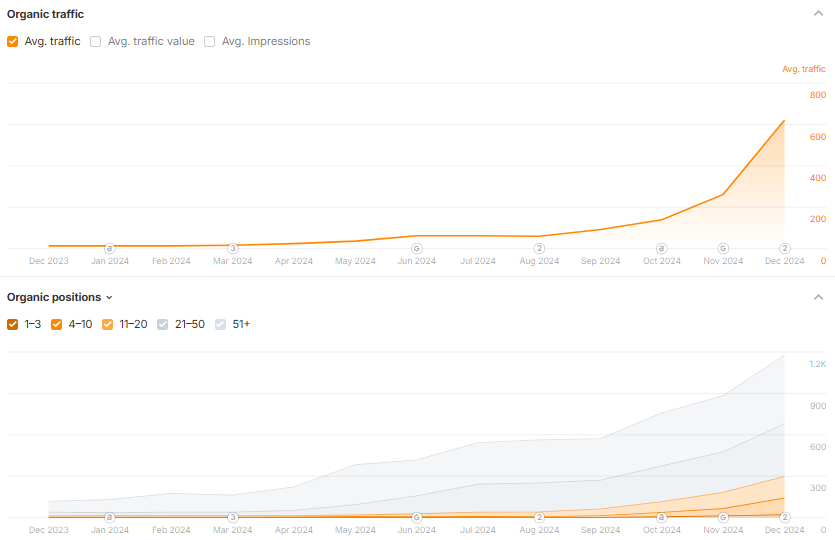
During the first half of the year, traffic remained consistently low (around 50–70 visits per month). This was the period of technical adjustments and accumulation of critical SEO changes. Growth began in April 2024, when traffic increased to 200–300 visits, indicating the initial ranking of the updated pages.
By the end of the year, the SEO strategy led to exponential growth. The chart shows a sharp vertical rise over the last two months of the year, average traffic increased 2,5 times, surpassing 700 visits.
At the same time, the semantic core expanded significantly, with an increase in the number of keywords ranking in the TOP 10 and TOP 20. The total number of keywords in search grew from minimal levels to nearly 1,400. Overall, the trend indicates a transition from the initial growth stage to active scaling of the site’s organic visibility. The content strategy and work with low-frequency queries proved effective, attracting highly targeted users.
Key queries
The data from the screenshots below indicates a successful launch of the promotion strategy within the Ukrainian-speaking segment.
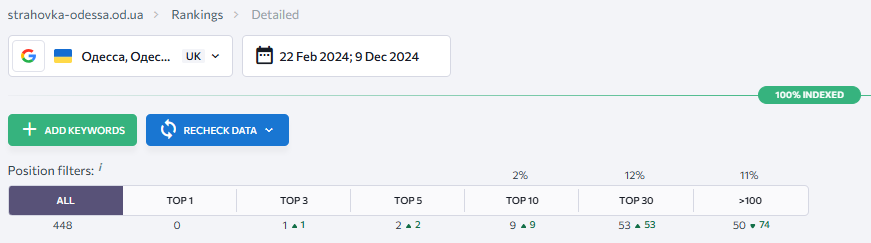
The standout achievement is the website's emergence in search results for Ukrainian-language keywords from a baseline of zero. At the start of the reporting period (February 2024), the site had virtually no presence in the Ukrainian-language TOP; however, as of December 2024, we have secured the following results:
- TOP 3: Secured the first keyword in the top three positions. This serves as a strong indicator of high page relevance for specific high-intent queries.
- TOP 5: Successfully pushed 2 keywords into the top five rankings.
- TOP 10: 9 keywords have now stabilized on the first page of search results, meaning these queries are actively generating organic traffic.
- TOP 30: Significant momentum with 53 keywords now ranked. Over 50 Ukrainian-language keys have ascended to the second and third pages of search results, positioning them as prime candidates to break into the TOP 10.
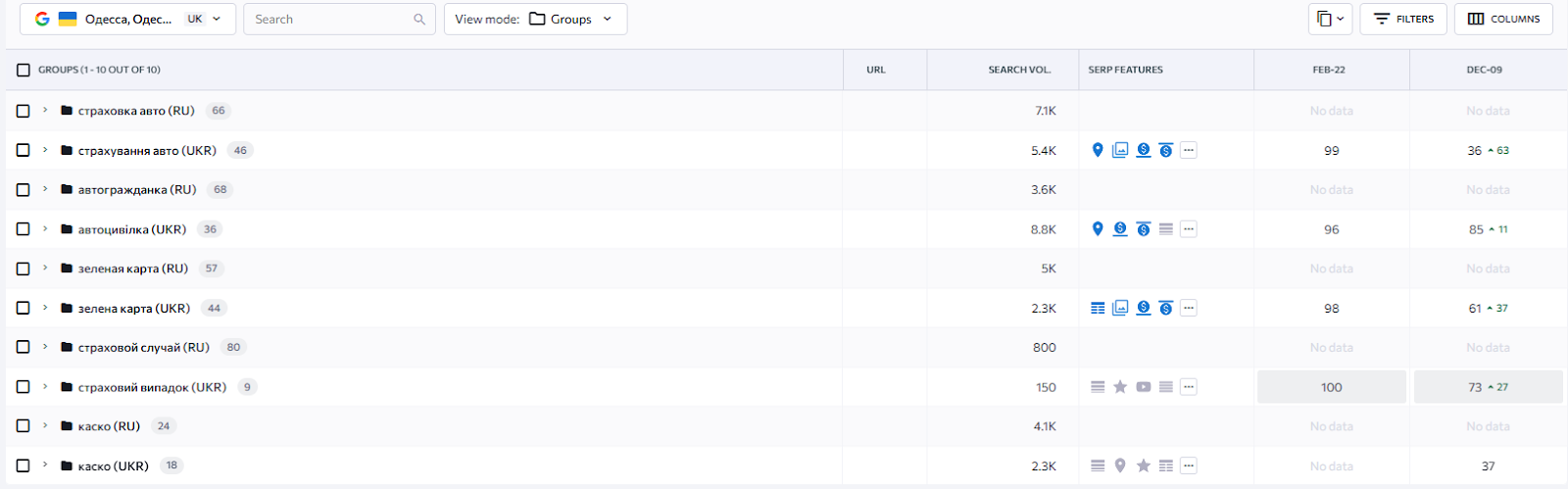
- Car insurance (UKR). This query group climbed from the "blind zone" (Position 99) to 36th place, unlocking access to a high-demand audience with a monthly Search Volume of 5.4 K.
- MTPL (UKR). Despite the intense competition in this niche, the site advanced by +11 positions. This marks the initial phase of growth in a high-volume segment where every upward move yields a significant traffic uptick.
- Green Card (UKR). Rankings improved by +37 positions, ascending from 98th to 61st place.
- Insurance claim (UKR). This group demonstrated steady growth of +27 positions, stabilizing at 73rd place.
- CASCO (UKR). A new vertical for the Ukrainian-language version, which launched directly into the 37th position.
The aggregate monthly search volume for these clusters exceeds 20,000 queries. The observed momentum indicates that the Ukrainian version of the site has evolved into a fully functional customer acquisition channel, an asset that was previously left untapped. This data clearly demonstrates that the platform has successfully transitioned from a monolingual resource to a formidable competitor within the Ukrainian search segment.


The Car Insurance cluster shows the highest growth dynamics, with high-frequency keywords moving directly into the TOP 10. A large number of keywords in this group have already secured positions in the TOP 30, creating a solid foundation for further organic traffic growth. Queries like “buy Green Card online” (39th position) and “Green Card cost” (45th position) are actively moving toward the first page, indicating increasing search engine trust in the Ukrainian-language landing page.
Screenshot results confirm that the technical correction of language versions had a direct commercial impact. Previously, the site primarily ranked for Russian-language queries, but during the reporting period, we successfully increased visibility for the Ukrainian-speaking audience. Since competition in the Ukrainian segment (especially locally in Odesa) can be less intense than in the Russian segment, this created an excellent opportunity to acquire cheaper organic traffic.
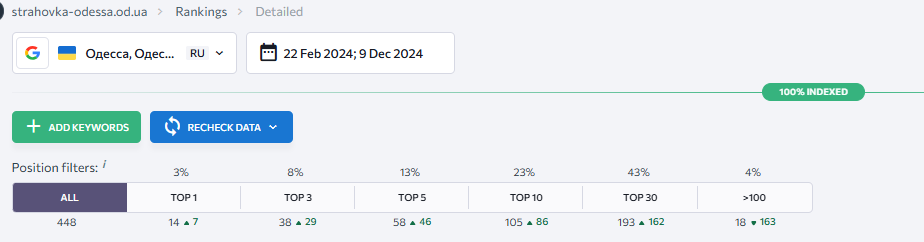
We observe a sharp increase in the site’s search visibility in the Odesa region. The screenshot demonstrates a massive movement of queries from low-visibility zones into the TOP search results:
- TOP 1. The number of keywords in the first position grew from 7 to 14, doubling leadership for the most important keywords.
- TOP 3. Positive growth from 29 to 38 keywords - the most clickable zone, generating the main stream of free traffic.
- TOP 5. Increased from 46 to 58 keywords, indicating stable strengthening of positions in the upper part of the first page.
- TOP 10. Keywords on the first page rose from 86 to 105, meaning that every fourth keyword in the semantic core is now in the TOP 10.
- TOP 30. Growth from 162 to 193 keywords laid a strong foundation for moving these terms into the first ten positions.
The most significant indicator is >100, where the number of keywords decreased from 163 to 18. This means that during the reporting period, SEO efforts successfully brought 145 keywords previously beyond the 10th page into visible search zones.
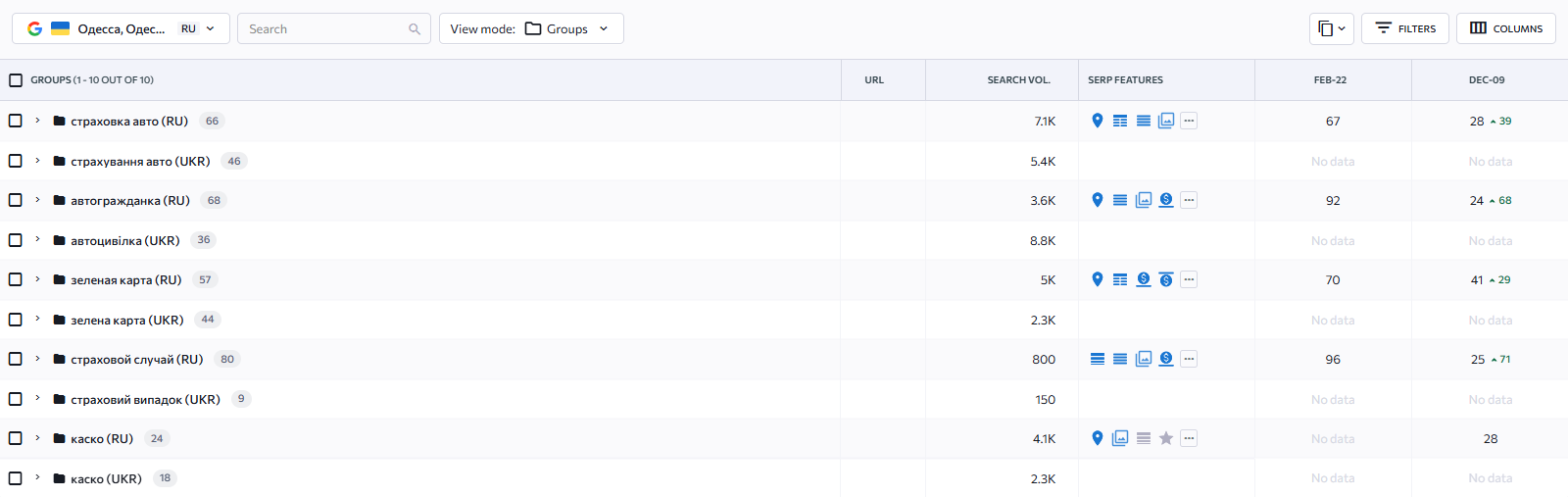
- Car insurance. A high-volume category (7.1K search volume). The group's average position improved by 39 points, climbing from 67th to 28th place.
- MTPL. One of the most critical commercial clusters (3.6K), which recorded the most rapid growth, surged by 68 points.
- Green Card. A cluster with a search frequency of 5K. Visibility improved by 29 points, moving from 70th to 41st position.
- Insurance claim. Rankings jumped by 71 points, ascending from 96th to 25th place.
- CASCO. A vertical where the site has already stabilized at the 28th position.
All key query clusters have demonstrated positive momentum. Currently, the majority of these groups are hovering between positions 24 and 28. These are "pre-top" rankings, where breaking into the first page (TOP 10) will require intensified, targeted content optimization and the strategic acquisition of high-quality backlinks.


Based on the two provided screenshots of Russian-language queries, we can conclude that the site ranks most effectively for transactional queries where users are ready to purchase, even if general high-frequency queries are still growing. Unlike Ukrainian queries, which started from zero, Russian queries have shown a qualitative transformation, moving from the lower positions (50th-90th) into the real sales zone.
The dominance of “online/buy” intent queries indicates that SEO is working in close synergy with business goals: the client receives less irrelevant informational traffic but more visitors ready to purchase a policy immediately.
As of December 2024, the client’s website has transitioned from a local, low-visibility resource to an active player with dynamic growth.
PPC promotion results
The following metrics, including click volume, average CPC, CTR, total conversions, and cost per conversion, reflect the project's performance during the management period from July 21, 2023, to December 6, 2024:
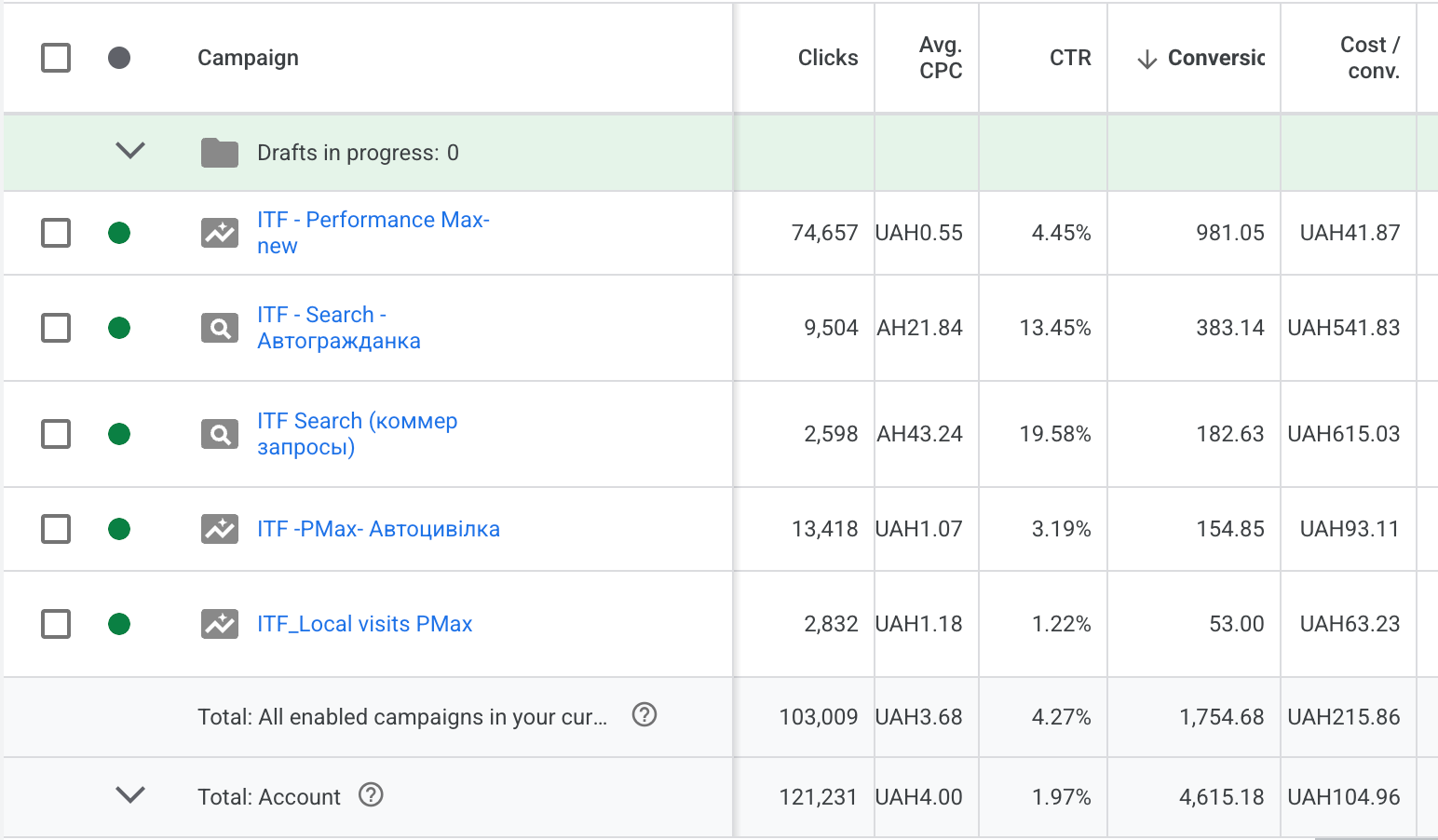
Account overview:
- 4 615.18 conversions.
- 104.96 UAH Cost Per Acquisition (CPA).
- 121 231 clicks.
- 4.00 UAH Average Cost Per Click (CPC).
- 1.97% overall account CTR.
An average CPC of 4.00 UAH reflects disciplined bid management and the strategic leverage of low-cost traffic sources, ensuring the total spend remains within budget. The overall CTR of 1.97% highlights our broad audience reach. By maintaining a low CPC, we are driving high traffic volumes that translate into a significant number of target actions at a highly competitive price point (~105 UAH per lead).
Performance Max campaigns serve as the primary driver for low-cost conversions, whereas Search campaigns engage high-intent, premium traffic as evidenced by their superior CTR and higher CPC.
Comparative Data vs. Previous Period (August 21, 2023 - December 6, 2024):
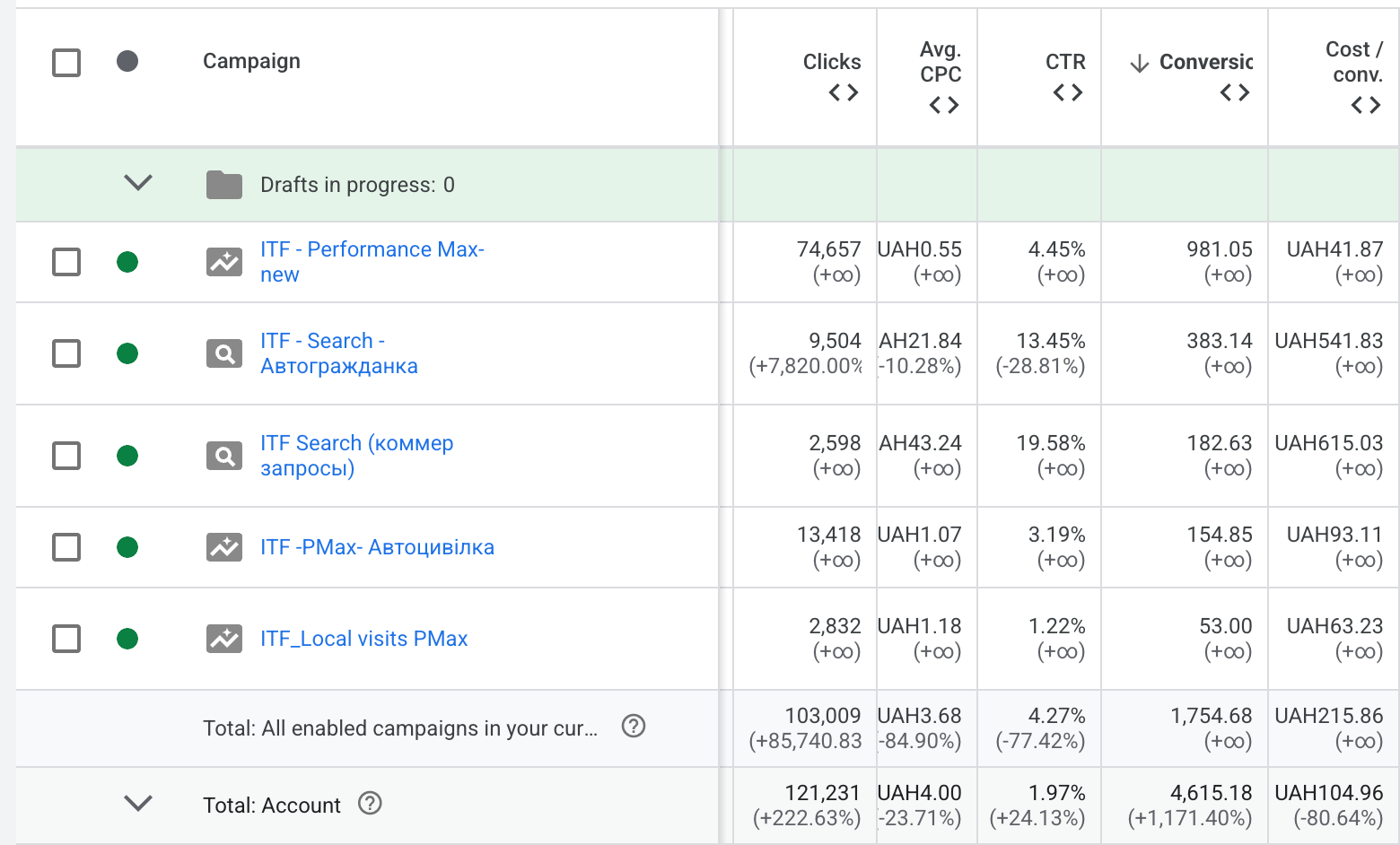
The advertising account demonstrates a substantial increase in performance compared to the previous benchmark period (when the client managed the campaigns internally):
- +1 171.40% increase in total conversions;
- -80.64% reduction in Cost Per Acquisition (CPA);
- +222.63% growth in traffic volume;
- -23.71% decrease in Cost Per Click (CPC);
- +24.13% improvement in Ad quality score.
The side-by-side screenshot clearly illustrates the account's transformation from an underperforming tool into a high-octane lead generation engine at a sustainable price point. Despite fierce competition from national aggregators in Odesa, our strategic focus on local campaigns successfully differentiated the brand from market giants. We achieved a simultaneous 11x increase in conversion volume and a 5x reduction in CPA.
Over the course of our partnership, the advertising account underwent a total overhaul: we restructured the architecture, expanded the semantic core, and deployed Performance Max campaigns alongside dedicated search clusters and local initiatives. This allowed us to scale traffic, lower the CPC, and significantly drive performance. By leveraging negative keyword lists to filter out competitor brand traffic, we successfully reallocated the budget toward high-intent users searching for the service itself rather than a specific competitor.
Currently, the active promotion phase of the project is on hiatus. Having established a stable technical foundation and consistent positive momentum, we are prepared to resume SEO operations and ad management at the client's request.